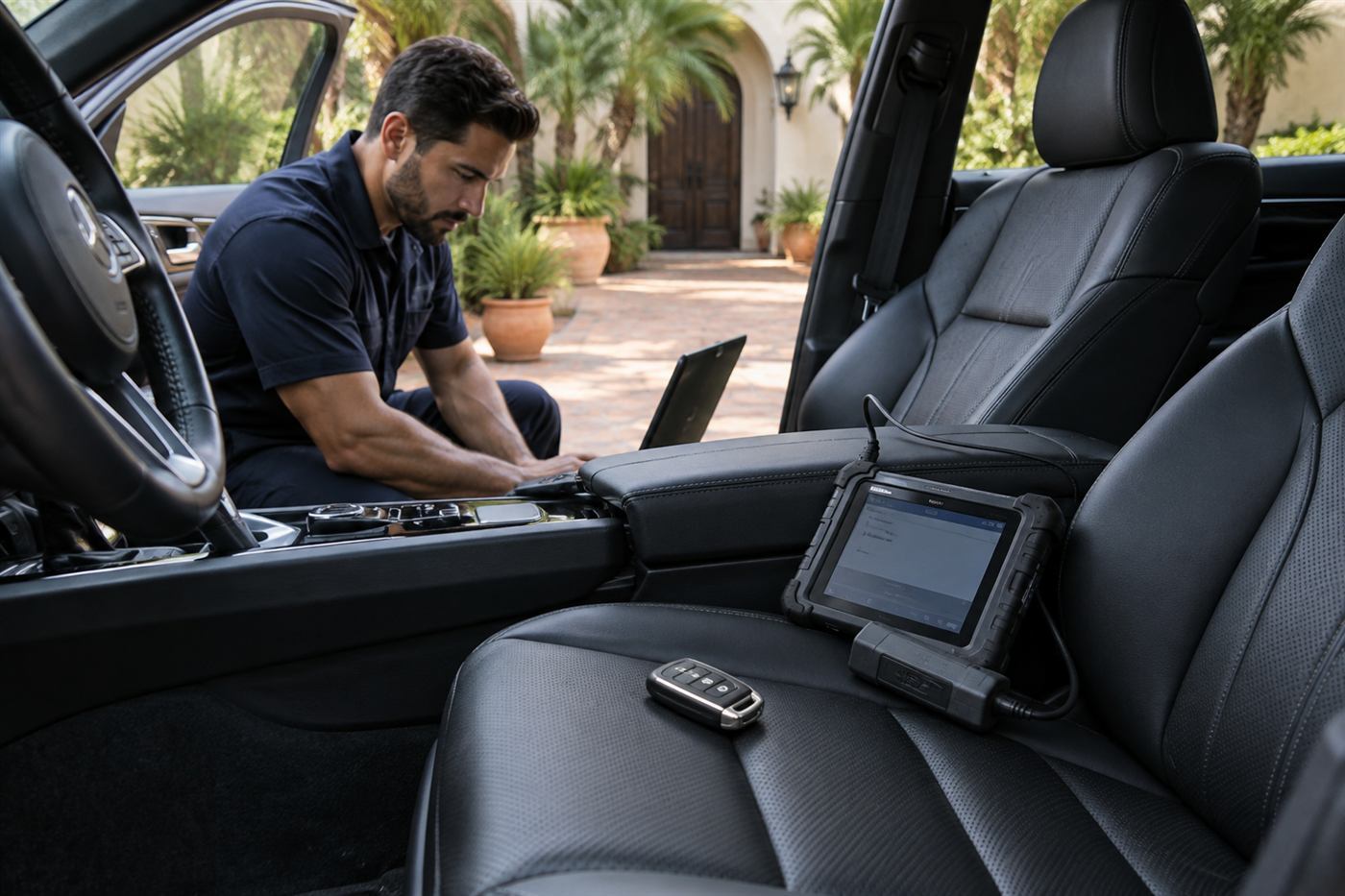
How a call works for Ohio drivers
Every job starts with a phone call. You tell the dispatcher where the vehicle is, what has happened, and the make, model and year. We ask whether you have any working key, whether anyone or any animal is inside the car, whether you are on a public street or private property, and whether you can show the vehicle is yours. Those answers tell us what the work involves and whether a technician needs to see the car.
Quotes are given only by phone. We do not publish prices, because a simple door lockout on an older sedan and a new proximity key for a recent model are very different jobs. For complicated work, we may explain that an on-site visit is needed before a firm number is possible. A service call charge applies when a technician is dispatched, and we explain it before anyone is sent so nothing is a surprise at the vehicle.
We do not promise arrival windows. Snow squalls off Lake Erie, interstate backups and rural distances make a fixed promise dishonest. What we promise is a clear answer on the phone about whether and how we can help where you are, so you can plan the next step with real information.
The 24/7 in our name is the idea behind the service, not a promise of a technician at every hour in every place. If a person, child or pet is locked inside a vehicle in cold or heat, call 911 first. Emergency crews are the right first call, and the key can be sorted out afterwards.
Cleveland and the lake-effect snow belt
Northeast Ohio sits where cold air crosses the warmer water of Lake Erie and drops heavy snow on the land downwind. Cleveland and the eastern suburbs know this well. Snow here arrives in bands, sometimes burying one street while the next stays clear, and it combines with road salt, slush and long stretches of cold temperatures. Everything about a car's locks and keys has to survive that.
Cold drains fob batteries, and a fob that worked all autumn may quit on the first hard frost. A car that has been sitting outdoors overnight in the snow belt can be slow to respond even when the battery is fine. Keep the key close to the car and try a fresh battery before you assume the fob is dead. Our guide on how to change a key fob battery explains the steps.
Door locks ice up. Moisture inside a lock turns to ice, and a key forced into frozen metal can snap. Do not use force, and do not pour hot water on the lock, because the water can turn back to ice and the sudden change can damage paint and seals. Warm the key gently in your hand and try again. If the lock will not turn, call. Our page on broken key extraction explains what happens if a key has already broken.
For city specifics, see our Cleveland locksmith page. In a snow squall, tell us the exact street and whether it has been plowed. A technician needs a place to stop and room to work, and a buried car at the curb with a plow berm in front is a different job from a car in a cleared lot. Our seasonal guide on winter lockout prevention lists habits that help.
Columbus: growth, campuses and commuter lots
Columbus sits near the middle of the state and has grown steadily, drawing students, government workers and employees of large companies. New subdivisions and apartment communities have spread outward, and the city supports a large university campus with its own parking pressure. That mix creates calls from people who are new to the area, who have not yet found a service they trust, and who may be far from home when a key fails.
University areas bring shared cars, borrowed keys and a lot of moving in and out. A student with a single key and a vehicle titled to a parent in another state faces a particular obstacle: proof of ownership. We confirm ownership before making a key, so the documents must match the vehicle owner. If you are a parent arranging help from far away, see our guide on college student and dorm lock safety and our page on proof of ownership for a car key.
Commuter lots, park-and-ride facilities and large office campuses make up much of the parking. A lockout in a big lot is easier if you give us the lot name, the row or a landmark, and tell us whether security should be informed. Send a location pin from your phone if you can. Large lots are confusing, and a pin saves time.
For the city itself, see our Columbus locksmith page. Because many Columbus drivers have newer vehicles with proximity keys, a spare made before the first fails is a sensible habit. Our page on spare car key programming explains the process and why it is simpler than an all-keys-lost job.
Cincinnati: hills, river valleys and tight neighborhoods
Cincinnati is built on steep hills above the Ohio River, with neighborhoods that cling to slopes and streets that wind and double back. Parking is often on a grade, and many older neighborhoods have narrow streets with cars parked tightly on both sides. A lockout on a hill brings its own complications, from where a technician can stop to how a vehicle sits on a slope.
Older housing stock matters here too. Many residents live in older brick homes and multi-unit buildings with original or aging door hardware, and a driver who has just locked a key in a car may also have a front door lock that has seen better days. If you need help at home as well, our page on home lockout, locked out of the house explains the process, and lock rekey service covers what to do when keys go missing.
River valleys collect fog and damp, and in winter hills ice over before flat roads do. A driver heading down a steep icy street in the morning is wise to be careful about getting out of the car in a hurry with the engine running. Many lockouts happen exactly that way: a driver steps out to scrape the windshield, the door shuts, and the keys sit in the ignition of a running car. Our page on locked keys in a running car explains what to do.
For city specifics, see our Cincinnati locksmith page. When you call from a hillside street, tell us the cross street and which direction the car faces, and whether there is room for a technician's vehicle nearby. We will explain honestly whether and how we can help.
Older homes, older locks and why they matter for car key calls
Ohio has a large stock of older housing, from century-old farmhouses to mid-century ranches and city rowhouses. Original locks, worn cylinders and unknown copies of keys are common. When a driver calls about a car key, the conversation often turns to the house, because keys for both live on the same ring. A ring lost at a bus stop is a lost car key and a lost house key at the same moment.
If a ring with a house key and an address clue went missing, think about both. A car can be reprogrammed so the missing keys no longer start it, depending on the make and model. A house lock can be rekeyed so old keys no longer work while the hardware stays in the door. Our page on lock rekey service explains what that involves, and how often to rekey or change locks offers guidance.
Older doors and frames also settle, swell with humidity and shrink in dry winter air, and a lock that suddenly will not latch or turn may be a door problem, not a lock problem. Our page on a door that will not latch describes the symptoms. Do not force a stuck lock. A bent latch or a damaged strike makes the repair harder.
For a new owner of an older home, a security review is a sensible first step. Our guide on the home security checklist for new homeowners explains what to look at. A quote for any residential work is given by phone, and some jobs need an on-site look.
Road salt, rust and worn ignition cylinders
Ohio uses a lot of road salt, and the effect on vehicles is visible in rust along door bottoms and wheel wells. The effect on locks is less visible. Salt spray and slush work into door lock cylinders, trunk locks and the keyhole area. Over a few winters a lock can become stiff, sticky or gritty. A key that used to turn smoothly begins to resist, and the temptation is to force it.
The better move is to stop and ask. A worn key and a worn cylinder wear each other, and forcing a stiff key can bend it or snap it off in the lock. Our page on worn car key symptoms explains the warning signs, such as a key that needs jiggling, turns only in one position, or leaves brass-colored shavings on the blade.
Ignition cylinders wear as well, above all when a key ring carries a heavy load. Every bump of the road swings the weight against the cylinder. Over time the cylinder can fail to turn, release or start the car. Our page on ignition cylinder replacement explains what is involved. If your key will turn but the car will not start, key turns but car will not start explains the possible causes.
Prevention is simple. Keep the car key on a light ring, replace a visibly worn key before it fails, and mention a stiff lock to a locksmith before it fails. A fresh battery in the fob before winter is a small step that prevents many cold-morning calls. Our guide on car key care and maintenance collects habits that help.
Auto industry vehicles, work trucks and farm country
Ohio has a long connection to manufacturing and driving. Plenty of residents drive domestic trucks and sedans, many of them a decade or more old, and many work in trades or on farms where vehicles earn a living. Older domestic models often use transponder keys or simple keys, and some have wear in the ignition and door locks after many years of use.
Work trucks and vans are shared and used hard. A single key for a shared truck is a business risk, and a lost key can idle a crew. If you run a small business with vehicles, think about spares and a simple log. Our page on truck and van keys covers vehicle specifics, and key control basics for business owners explains how to keep track.
Rural Ohio has long stretches of two-lane road, small towns and farm properties with long gravel drives. A stranded vehicle may be a long way from the nearest town. When you call from the country, give the road name, the nearest crossroad, any mile marker and a landmark such as a barn or a sign. If the property is private, tell us who can give access, and be honest about the state of the drive in wet or snowy weather.
Classic and older cars are also common in Ohio, from restored muscle cars to vintage pickups. Older keys can be hard to match, and blanks may not be stocked. Our guide on classic and older car keys explains what to expect, and why a call before a project begins is worth making.
Key types and all-keys-lost situations
Knowing which key you have makes any call easier. A basic metal key has no chip. A transponder key has a chip in the head that the car must recognize. A laser-cut key has a groove milled along the blade. A proximity key lets the car start by button when the fob is nearby. See types of car keys explained for how to tell them apart.
Replacement depends on type. A basic key is cut. A transponder key must be cut and programmed. A proximity key must be paired to the car's computer. If you have lost every key, a technician has to cut a new key from the vehicle's identification number and program it to the car, and some models take longer or need extra steps. See all keys lost service.
Gather your details before you call. The VIN is on the dashboard near the windshield on the driver's side, on the door jamb and on your registration and insurance documents. Have a photo ID and proof of ownership such as a title, registration or insurance record. Our guide on how to find your VIN shows where to look.
We verify ownership before making a key. That check protects honest owners from someone else driving away with their car. If you cannot show paperwork at the car, tell us on the phone, because there may be other ways to confirm.
Choosing a locksmith and getting ready to call
Lockouts happen at bad moments, and dishonest operators count on that. A local-sounding listing can route to a call center, and a low phone quote can become a much larger bill at the curb. Ask for the company name and the technician's name. Ask what the service call charge covers. Ask whether the phone quote is the amount for the work described. Our guides on questions to ask a locksmith before dispatch and locksmith scam warning signs list more.
We make no claim about credentials on this page and we encourage you to check any locksmith yourself. Ohio sets its own rules for locksmith work, and a reader can ask a company for its details and check them with the proper state office. See how to verify a locksmith's credentials.
Before you call, know your exact location, the make, model and year, and whether any key works. Have a photo ID and proof of ownership ready. Keep your phone charged and find a safe, sheltered place to wait. Our checklist on how to prepare for a locksmith visit covers the rest.
If you are in Ohio and need help with a car key, a lockout or a lost fob, call. Tell us where you are and what happened, and we will explain what is realistic and what comes next before anything is arranged. A service call charge applies when a technician is sent, and we explain it on the phone first.
Questions people ask
Do you publish prices for Ohio service?
No. Quotes are given only by phone after we know the vehicle and the situation. A simple lockout and a new proximity key are very different jobs. Some work needs an on-site visit before a firm quote. A service call charge applies when a technician is sent, explained before dispatch.
Can you say when a technician will reach me in a snow squall?
No. We do not promise arrival windows, because lake-effect snow, road conditions and distance vary too much. We tell you plainly whether we can help at your location and what is realistic. If anyone is in danger in a cold vehicle, call 911 first.
My key broke off in a frozen door lock. What now?
Do not try to pry the piece out and do not pour hot water into the lock. Leave it as it is and call us. A technician can often extract a broken key, depending on how it broke and how the lock is built. We explain what is involved before arranging anything.
I locked my keys in a running car while scraping the windshield. Help?
First make sure no one is inside. Call us with the make, model and year and where the car is parked. Tell us if it is on a hill or a busy street. Do not break a window. If a child or pet is inside, call 911 immediately.
A ring with my car key and house key was lost. What should I do?
Think about both locks. The car can often be reprogrammed so the lost keys no longer start it, depending on the make and model. The house lock can be rekeyed so old keys stop working. Call and we will explain the options for each before anything is arranged.
What proof do I need to get a new car key made?
A photo ID and a document that ties you to the vehicle, such as a title, registration or insurance record in your name. Know the VIN, which is on the dashboard near the windshield and on the door jamb. We check ownership before cutting or programming any key.
Describe the situation by phone and we will tell you what the job involves. Quotes are given by phone. Jobs that cannot be quoted without seeing them need a technician on site, and the service call charge is explained on the phone before anyone is dispatched.
(844) 715-0800Related pages
Written by Claude (AI) (AI) for 24/7 Locksmith USA.