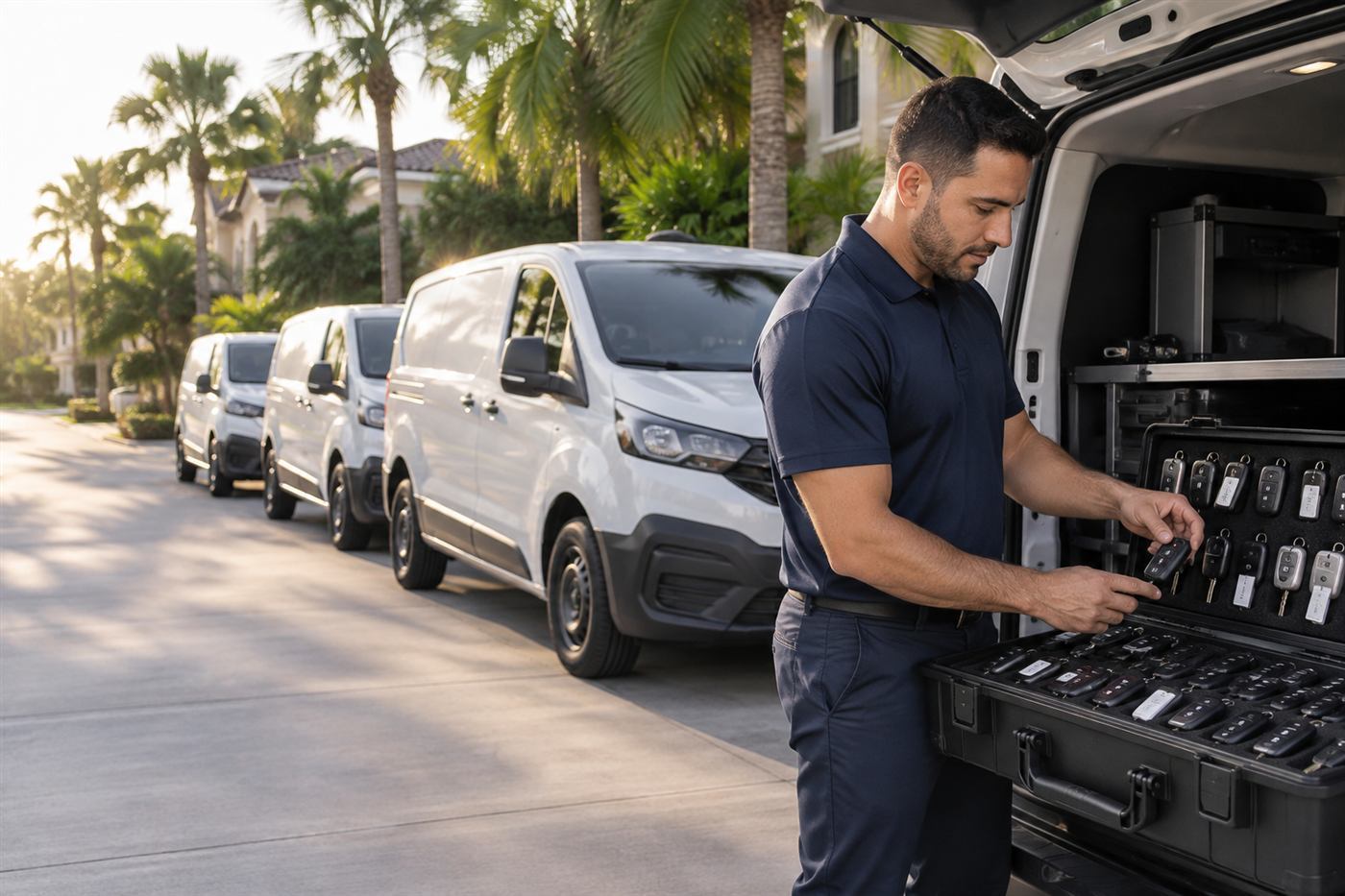
MOBILE SERVICE · COMMERCIAL GRADE
On-siteWE COME TO YOU
All hardwareCOMMERCIAL GRADE
UpfrontHONEST PRICING
LocalTECHNICIANS NEAR YOU
The Business Calls We Actually Get
Commercial work divides into the urgent and the structural. Urgent: the manager with the only key is unreachable and six employees are standing outside; a mortise lock on a 40-year-old storefront finally gave out on a Friday night; a break-in overnight and the insurance carrier wants the entry point secured today. Structural: a growing company that has lost track of who holds which keys; a retail chain that wants every location on one keying standard; an office that needs the server room on tighter access than the supply closet.
Both kinds get the same treatment, a technician who works on commercial hardware daily, arrives with parts for the common failures, and quotes the work before it starts.
Master Key Systems: One Key for You, Limited Keys for Everyone Else
A master key system is an org chart expressed in brass. The owner's key opens everything; the manager's key opens the floor but not the office; staff keys open the staff door and nothing else. Done properly, planned on paper, pinned precisely, documented, it eliminates the fat keyring and makes staff turnover a one-cylinder event instead of a building-wide crisis.
A technician maps your doors, designs the hierarchy with room to grow, and leaves you with a documented system where every key's reach is known. Restricted keyways, blanks that cannot be copied at a kiosk, are available where control matters.
Staff Turnover, Lost Keys and the Discipline of Rekeying
Every business eventually faces the same uncomfortable math: keys issued over the years versus keys returned. When a keyholder leaves on bad terms, when a master key goes missing, when an audit cannot say who can open the stockroom, the corrective is rekeying, done across the affected doors in one visit, often outside business hours so the workday is untouched.
The discipline that prevents the crisis is simpler than most owners expect: restricted blanks so copies cannot quietly multiply, a written key log, and rekeying as a standard offboarding step for keyholding roles, the cost is minor next to one incident of unauthorized entry.
Panic Hardware, Door Closers and the Parts That Keep You Compliant
Exit devices, panic bars, are life-safety hardware: on designated egress doors they must let anyone exit with one motion, every time, while keeping the outside world outside. Technicians repair and replace exit devices, door closers that slam or drift, continuous hinges on heavy traffic doors, and the aluminum-storefront locks and pivots that take the worst daily abuse in retail.
When hardware touches fire rating or egress rules, the job is done with listed components, a propped-open fire door or a chained exit is the kind of shortcut that surfaces at the worst possible moment, and we will say so plainly rather than install a liability.
Access Control Without the Sales Pitch
Keypads, code locks and standalone electronic locks earn their place where codes need to expire, where audit trails matter, or where one door serves many people, and mechanical keys remain the right answer for plenty of doors. A technician will tell you which is which for your building, install what is chosen, and keep the mechanical override honest, because electronics fail and the door still has to work that day.
Commercial Locksmith, straight answers.
We are locked out of our business right now, how does this work?
Call (844) 715-0800 with the address and what kind of door it is, storefront glass, steel back door, interior office. A commercial technician opens it non-destructively wherever the hardware allows, and authorization to open a business is verified first: documentation, signage match, or confirmation from the listed owner protects your business the same way it protects every other one.
An employee left and did not return their keys. What is the right move?
Rekey every cylinder that key operated, same day where possible, after hours if the business cannot pause. If it was a master key, the affected group of the system is rekeyed and the key log updated. If this keeps happening, that is the signal to move to restricted keyways or access control, and the technician can quote both while on site.
Can you set up one key that opens all our locations?
Yes, keyed-alike for simple cases, or a designed master key system when different people need different reach. Multi-site standardization is planned on paper first so a lost key at one location never silently compromises another; documentation stays with you.
Do you repair panic bars and door closers?
Yes, exit devices, closers, hinges, storefront locks, and the door alignment problems that masquerade as lock failures. Egress and fire-rated hardware is repaired or replaced with listed components; if a requested fix would compromise egress or a fire rating, the technician says so before any work is done.
Do you handle after-hours work so we do not close the shop?
Yes, 24/7 dispatch is the point. Rekeys, master system changes and hardware swaps can run overnight or before opening, and emergency lockouts and break-in securing are handled whenever they happen, because commercial lock failures do not book appointments.
File Cabinets, Safes and Small Locked Storage That Businesses Forget About
Master key planning tends to focus on doors, but plenty of businesses have valuable locked storage that never made it into that plan: a file cabinet holding personnel records or contracts, a small safe for a cash drawer or backup drives, a supply closet with a lock nobody remembers issuing keys for originally. These smaller locks fail the same way any mechanical lock does, worn tumblers, a lost key with no spare cut, a combination nobody wrote down before the person who set it left the company, and they get overlooked precisely because they are small and easy to forget until the day someone actually needs to open one and cannot. A technician can service or rekey file cabinet locks and small office safes as part of the same visit that handles the building's doors, and folding that inventory into a written key log alongside the door hardware means nothing in the building is left as an unknown quantity the next time an employee with access moves on.
Multi-Tenant Buildings, Mailrooms and Shared Common Areas
An office building or retail center with several tenants sharing a lobby, a mailroom or a loading dock creates a layered access problem that a single business occupying its own building never has to think through: a lock that the property manager controls for common areas, a separate lock for each tenant's own suite, and often a third layer for mail and package delivery that needs to stay accessible to a carrier while remaining secure from anyone else. Coordinating hardware across these layers usually means working with whoever manages the building on the shared elements while handling each tenant's individual suite separately, and a technician familiar with multi-tenant properties can plan a keying hierarchy that respects both, so a departing tenant's key stops working on their own suite without disturbing the building's shared systems, and vice versa.
Warehouse Roll-Up Doors and Loading Dock Security
Warehouses, distribution centers and light industrial spaces typically secure their largest openings, roll-up or sectional overhead doors, with hardware that looks and behaves very differently from a standard office door lock, slide bolts, chain hoists, or an electric operator with its own separate lock-out mechanism for when the power is disconnected. These doors see far more daily cycling than an office entrance ever does, opening and closing repeatedly through a shift for deliveries and shipments, and that volume of use wears slide bolts, guide tracks and locking hardware faster than the relatively gentle wear on an office door. A dock door that will not fully secure at the end of a shift is a real overnight vulnerability for a warehouse holding inventory, and servicing this hardware on the same schedule as the rest of a facility's equipment maintenance, rather than only when it visibly fails, keeps that opening from becoming the weak point in an otherwise well-secured building.
Planning a Rekey Around a Business That Cannot Actually Close
Not every business can pause operations for a lock change the way an office might over a weekend, a restaurant kitchen, a 24-hour facility, a retail location that loses real revenue for every hour its doors are not fully operational. Rekeying a business like this takes more planning than simply showing up and swapping cylinders, since the work needs to be sequenced around which doors can go offline first, staged during a slower stretch of the day or overnight, and coordinated with whoever is managing the floor so staff are never caught with a key that stopped working mid-shift without warning. Discussing the business's actual operating pattern before scheduling the work, rather than assuming every business can simply close for an hour, is part of doing commercial lock work responsibly rather than treating every job like a residential rekey with no operational consequences attached.
Restricted Keyways and Why Copy-Proof Actually Matters
A standard hardware store key blank can be duplicated at any kiosk in a matter of minutes, which means a standard keyway offers essentially no control over how many copies of a given key end up in circulation once it leaves your hands, regardless of how carefully you tracked who was issued the original. A restricted keyway uses a blank that is not available for open sale, controlled instead through a registration process tied to the property or business, so a copy cannot be produced without going back to the source that controls the keyway. For a business managing turnover among employees, contractors and vendors who each need some level of access, this is the difference between a key system you can actually account for and one where the honest answer to how many copies exist is simply unknown. Restricted keyways cost more upfront than standard hardware, but for a business where unauthorized access has a real cost, inventory shrinkage, a compromised server room, a break-in traced back to a duplicated key, that cost is minor compared to what it prevents.
Server Rooms, IT Closets and Access Tiers Within a Single Building
Modern offices increasingly treat their server room or network closet as requiring a meaningfully different level of access control than the rest of the building, since a compromised network closet can affect every system the company runs, while a compromised supply closet is simply an inconvenience. This is exactly the kind of scenario a properly designed master key hierarchy is built for: general staff access to common areas, a tighter tier for management offices, and the tightest tier reserved for the handful of people who genuinely need to physically access networking equipment. Where a business wants an audit trail showing exactly who accessed a sensitive room and when, rather than only controlling who is physically able to, that is where standalone electronic access with logging capability earns its cost over a purely mechanical lock, since a mechanical key proves nothing about who actually used it once it has been issued.
Retail Display Cases and Loss Prevention Hardware
Retail businesses carrying higher-value merchandise, electronics, jewelry, specialty goods, rely on locked display cases and cabinets as a frontline loss-prevention measure, and that hardware takes a different kind of wear than a building's entry doors, opened and closed dozens of times a day by multiple staff members rather than a handful of times by the same few people. Display case locks that are cycled this often wear out faster than their low profile would suggest, and a lock that has become easy to force or that no longer latches securely undermines the entire point of the case regardless of how good the glass and frame themselves are. Retail locations benefit from including display case and cabinet hardware in the same periodic maintenance conversation as their door locks, rather than only noticing a worn case lock after a loss has already occurred and the investigation turns to how the case was actually secured that day.
Franchise and Multi-Location Standardization in Practice
A business operating several locations, whether a small regional chain or a single owner running two or three sites, faces a choice about whether every location uses its own independent key system or whether the company standardizes hardware and keying across all of them under one plan. Standardizing has real advantages: a manager who covers multiple locations carries one set of keys instead of several, a replacement cylinder ordered for one site matches every other site's hardware, and a company-wide rekey after a security incident can be executed consistently rather than improvised differently at each address. The tradeoff is that standardization needs to be planned deliberately from the start, or retrofitted carefully across existing locations, since simply keying every site alike without a hierarchy means a single lost master key compromises every location at once rather than just the one it was issued for. A properly designed multi-site system keeps that risk contained, a district manager's key reaching every location while a single store's key reaches only its own building, so growth does not have to mean growing exposure at the same rate.
ADA Considerations on Commercial Door Hardware
Public-facing commercial doors need hardware operable without tight grasping, pinching or twisting of the wrist, which rules out old-style round knobs on many entry and restroom doors in favor of lever handles that can be pushed down with a closed fist or an elbow when needed. This is not only a matter of hardware selection but also of closer force and threshold height, since a door that technically has the right lever but closes with too much resistance for someone with limited grip strength to manage still fails the underlying purpose of that requirement. When replacing or upgrading commercial door hardware, checking that levers, closers and thresholds work together as a system, rather than swapping only the visible handle and assuming that alone resolves the concern, keeps a business's entrances genuinely usable for the full range of people walking through them.
A technician reviewing a building's egress and public-facing hardware can flag mismatches like this as part of an ordinary service call, mentioning a lever that meets the letter of the requirement but not its purpose, rather than waiting for a complaint or an inspection to surface the same issue later, at a point when fixing it costs more time and disruption than addressing it proactively would have. This kind of walkthrough is a natural add-on whenever a business is already scheduling a rekey or a hardware upgrade, since the technician is on site with the right tools regardless, and folding a hardware review into that same visit costs little extra time while catching problems well before they become a bigger project. Businesses that build this kind of review into their regular maintenance schedule, rather than treating hardware as something to think about only after a failure, tend to spend less overall on emergency calls and lost operating hours over the course of a year.
A Locked Door Is Losing You Money
Call (844) 715-0800, tell us the address and the door, and a commercial technician takes it from there, lockouts, rekeys, master systems, panic hardware. Any hour.
Describe the situation by phone and we will tell you what the job involves. Quotes are given by phone. Jobs that cannot be quoted without seeing them need a technician on site, and the service call charge is explained on the phone before anyone is dispatched.
(844) 715-0800Related pages
Written by Claude (AI) for 24/7 Locksmith USA.