
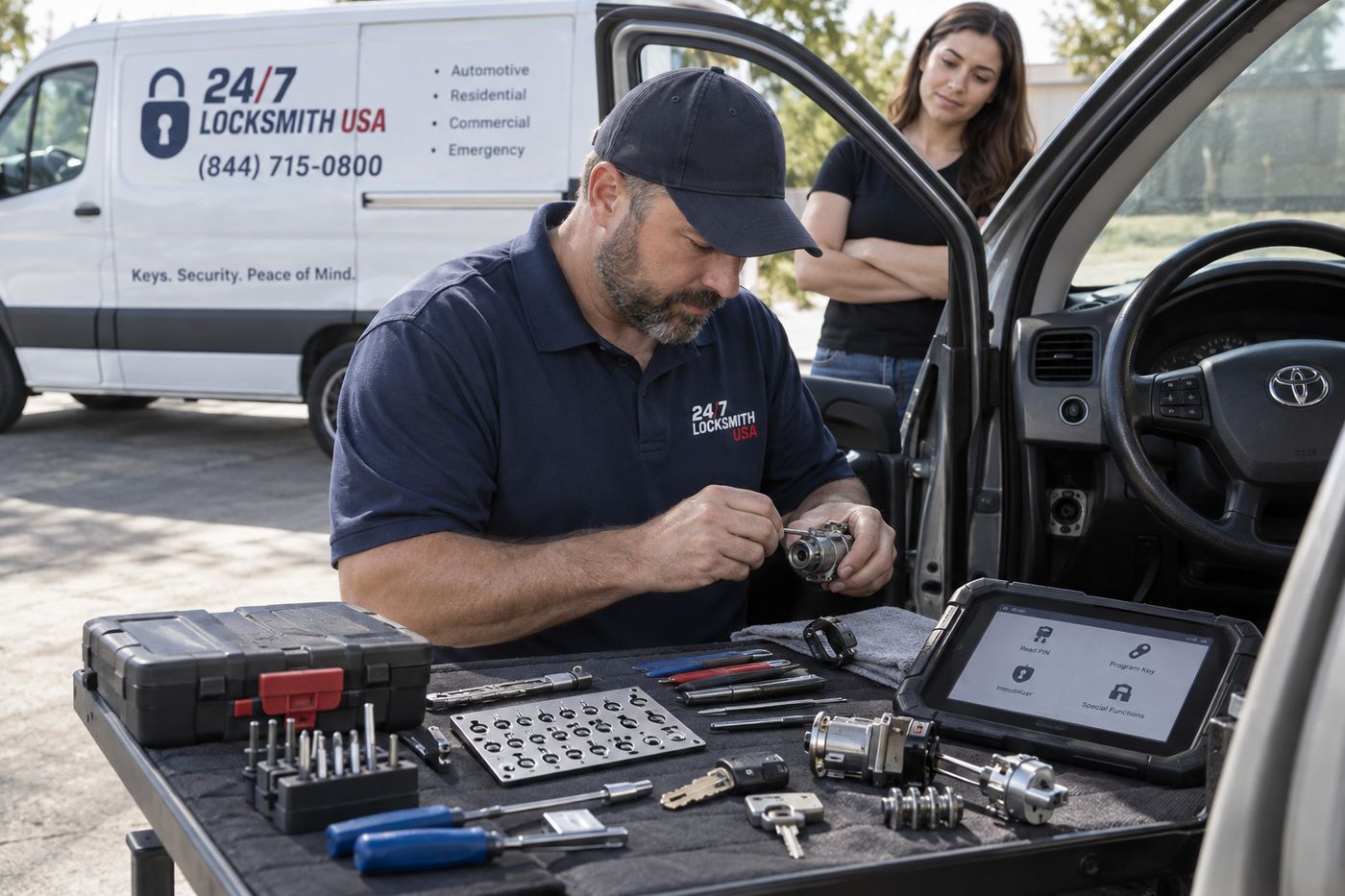
Car keys, lockouts, ignitions and rekeys across Aurora and the surrounding Illinois metro. Call (844) 926-0400.
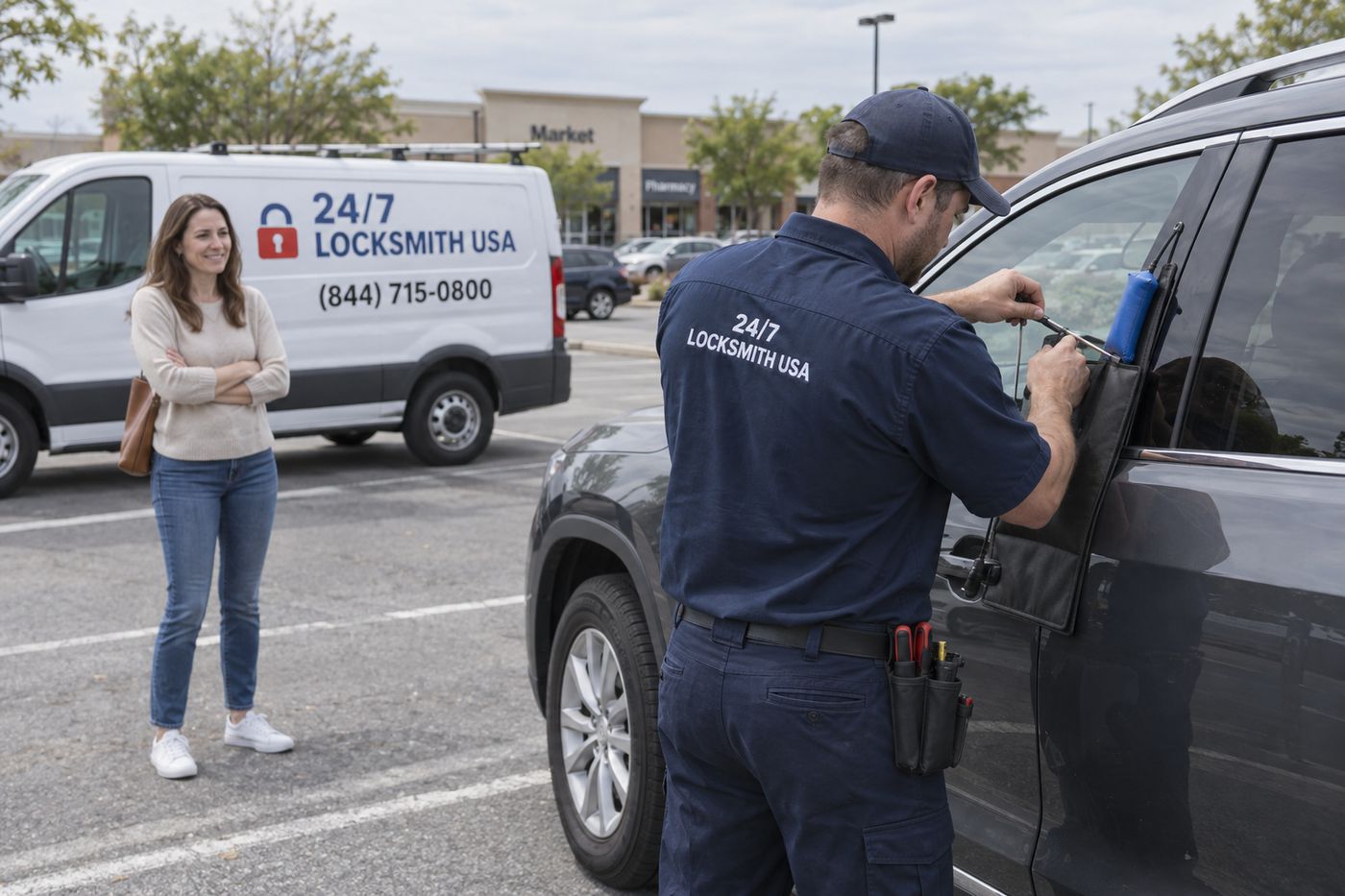
24/7 Locksmith USA covers Aurora for automotive, residential and commercial lock work. Lost car keys and fobs, cars and homes opened without damage, broken keys pulled out of ignitions and cylinders, locks rekeyed after a move, and commercial hardware for storefronts and offices. Everything is done at your address. Call (844) 926-0400.
People searching 247 locksmith aurora land here for the same reason everyone does: they want one number, a real technician, and a price agreed before anybody drives out. That is how we run it. You describe the situation on the phone, you get a number, and if what we find on site is different from what was described you hear the revised figure before any work starts.
What We Handle in Aurora
Aurora ZIP codes covered: 60502, 60503, 60504, 60505, 60506
- Car key replacement, cut and programmed on site from the VIN and proof of ownership, including push-to-start systems
- Key fob programming, added to a vehicle that still has a working key, or programmed from scratch when every key is gone
- Car and home lockouts, opened without damage to the door, the seal or the latch
- Broken key extraction, blades snapped in ignitions, door locks and deadbolts
- Ignition repair, keys that will not turn, cylinders that turn but will not start
- Rekeying, after a move, a tenant change, a breakup or a contractor handover
- Commercial hardware, storefronts, offices, mailboxes, file cabinets and master key systems
What Aurora Actually Calls About
A mix of older downtown housing and newer subdivisions west of the river. Rekeys after closing and car keys in shopping-centre lots.
Illinois Conditions
Cold is the variable that separates Illinois from the sunbelt. A marginal ignition cylinder, a worn key or a dying fob battery will run all summer and fail on the first hard freeze, which is why January is the busiest month.
Arrival Time, Honestly
We do not quote a set number of minutes before we know where you actually are, because nobody who drives this job every day can promise that honestly. Distance from the nearest available technician and whatever the roads are doing at that hour are what actually decide it. Give us your location and we will talk through a realistic window instead of a number picked to keep you from phoning somebody else. When a fast arrival is not realistic, we will tell you that plainly rather than let you sit and wait on a promise we cannot keep.
What to Have Ready
For a vehicle: your driver licence or photo ID and something showing you own the car, registration, insurance card or title. Photograph both now and keep them on your phone; it saves twenty minutes on the roadside. For a home or business: photo ID with the address, or a lease, or another way of showing the property is yours. A legitimate locksmith will always ask. One that does not is a warning sign.
How to Tell a Real Locksmith From a Scam Listing
The pattern is consistent: a listing with no verifiable address, a phone quote of fifteen or nineteen dollars, an unmarked car, and a technician who says the lock has to be drilled. Most residential and automotive locks do not need drilling. Ask for the company name, get an estimate before dispatch, and confirm the technician is insured. Read how to spot a fake locksmith before you call anyone.
Other Cities We Cover
Chicago, ILNaperville, ILJoliet, ILAll of IllinoisFull coverage
What people in Aurora usually call about
Most locksmith calls fall into a handful of groups. Someone is locked out of a house or apartment. Someone has lost the only car key. A tenant moves in and wonders who else holds a key. A shop owner needs a lock changed after an employee leaves. And now and then a door simply stops closing properly, or a deadbolt starts to grind.
Aurora is a city with a mix of older houses, newer subdivisions, apartment buildings and commercial buildings. That mix means a wide range of locks, from decades old hardware to modern keypad models. Each type has quirks, and the most useful thing you can do before calling is to describe what you have as clearly as you can.
This page is general guidance for people in Aurora. It does not describe any particular street or neighborhood, and it makes no claim about local history. Its purpose is to help you recognize your situation, know what questions to ask and avoid the usual mistakes that make a bad day worse.
Locked out of the house: your first few steps
When you are locked out, the first impulse is often to try something drastic, such as breaking a window or kicking a door. Please do not. Glass and door frames cost far more to repair than a lockout costs to solve, and an injury is a real risk. Take a breath and think through what you actually know about your situation.
Check the other doors and windows you normally keep closed, but only to see whether someone left one unlocked, not to force anything. Think about whether a family member, a neighbor you trust or a landlord holds a spare. If you rent, the property manager is often the first call, and your lease may say who handles lockouts.
If none of that works, a locksmith can open most residential doors without damage. You will be asked to show that you live there, typically with a photo ID that matches the address or a lease or utility bill. Our page on being locked out of your house covers the situation step by step.
- Do not force a door, window or lock, because repairs cost more than the service call.
- Check with family, a landlord or a trusted neighbor for a spare key.
- Have a photo ID and something that connects you to the address ready.
- Tell the dispatcher what kind of lock you have and whether the deadbolt is engaged.
Rekeying versus replacing locks
People often assume that after a move or a lost key they must buy all new locks. In many cases the better answer is to rekey. Rekeying changes the inner parts of the cylinder so that old keys no longer work and new keys do, while keeping the same lock hardware on the door. It is usually less work than replacing a lock, and it lets you keep matching hardware.
Replacing makes sense when the lock is damaged, worn out, outdated or simply not strong enough. A door with a loose, flimsy knob and no deadbolt might be a good candidate for an upgrade. Our page on lock rekey service explains the process, and the page on lock change and installation covers the other path.
If you cannot decide, describe the lock to the dispatcher and ask what they would suggest. A trustworthy technician will explain the reasoning and let you choose. Be wary of anyone who insists you need new locks without looking at the ones you have.
Also think about the key itself. If your keys are worn, bent or copied from other copies, they may be ready to fail, and a rekey is a natural time to cut fresh ones. Ask how many keys come with the job, because a household of several people may want more than two.
After you move in: who still has a key
Whenever you take over a house or apartment, there is no way to know how many copies of the old key exist. Previous owners, tenants, relatives, contractors, cleaners and real estate agents may all have held one. Most are harmless, but you will never know for certain, and the cost of changing the locks is small compared to the peace of mind.
The same applies after a breakup, a roommate leaving or an employee being let go. Changing or rekeying the locks is a routine, sensible response and not an accusation. Make sure that every exterior door is included, including side doors, garage entry doors and any shed or gate.
Our moving day lock and key checklist lists the items to cover. Also read the guide on how often to rekey or change locks for general timing. Renters should check their lease and talk with the landlord, since many leases limit what a tenant may alter.
Choosing a deadbolt that does its job
A deadbolt is the lock that matters most on an exterior door, because the bolt extends deep into the frame and resists being pushed open. A door with only a spring latch in the handle is much easier to defeat. If your door has a deadbolt, make sure you actually use it, even when you are at home.
Quality varies. Look for solid construction, a bolt that extends well into the frame, and a strike plate fixed with long screws that reach the wall stud, not just thin trim. A strong lock in a weak frame will not protect you, so a technician may suggest reinforcing the door edge or strike as well.
Our guide on how to choose a deadbolt goes through the options in plain language, and the page on deadbolt installation describes what happens when a new one is fitted. Ask questions before you buy so you know what the hardware is meant to do.
Lost or locked car keys
Car trouble happens in driveways, shopping lot corners, office garages and roadsides. Typical calls include a key locked inside, a key lost entirely, a fob that quit or a key snapped in the ignition. Each is handled differently, but the starting point is the same: the technician needs to confirm that the car is yours or that you have authority over it.
You will be asked for a photo ID and a registration, title or similar document. For making a new key, the vehicle identification number is also required. It is on a plate on the dashboard near the windshield on the driver's side, and on your insurance card and registration.
If you only need the door opened, explain where the car is and what kind of lock it has. Our page on car lockout describes the usual approach. Do not wedge tools between the door and the frame yourself, since that can bend the weatherstrip and damage the paint.
If the problem is a key that no longer starts the car, say whether the engine cranks, whether any dashboard lights flash and whether the key is a plain metal key or has a plastic head with a chip. Those details point the technician toward the cause. A chip that no longer talks to the car behaves very differently from a worn ignition cylinder, and the repairs are not the same.
Cold weather and sticking locks
Illinois winters bring temperature swings, ice and road salt. Door locks can stiffen, latches can freeze, and wooden doors can swell or shrink with humidity. A door that closed smoothly in summer may refuse to latch in winter, or a lock that was fine yesterday might refuse to turn this morning.
A little patience helps. Do not pour hot water on a lock or a car door, because the sudden change can crack glass or damage finishes. A graphite lock lubricant or a de icer made for locks is a better choice than random household oils. If a key feels rough, have it checked before it breaks off in the lock.
When a lock sticks repeatedly, it is telling you something. The cylinder may be worn, the door may have shifted, or the bolt and strike may no longer line up. A technician can look at the alignment and tell you whether an adjustment or a replacement is wiser. Small fixes now prevent a lockout later.
Keep an eye on the weatherstripping and the threshold too. A door that drags on the floor or pinches against the frame puts side pressure on the bolt every time you lock it, and over many months that pressure wears the latch. If you can see a worn spot or a bright scrape on the strike plate, the alignment needs attention.
Cold also affects the things we carry. A key fob left in a freezing car can lose battery strength, and a smart lock on a front door may behave strangely when its batteries are weak. Replace batteries in keypad locks and fobs at the start of the cold season, rather than waiting for a warning light, and keep a physical key as a backup somewhere you can reach.
Apartments, landlords and shared buildings
Apartment living adds a layer of rules that single family homeowners do not face. The building owner usually controls the front door, the mailroom and the common areas, while you control your own unit. A lease may say whether you can change your own lock, who must hold a copy of your key and who pays when a lockout happens.
Read your lease and ask the property manager before altering anything. In some buildings the management arranges all lock work, and in others tenants may hire their own help provided they leave a key with the office. Requirements differ from one building to the next, so there is no single answer, and your landlord is the right person to ask.
If you are locked out in the evening, check whether the building has an after hours number for emergencies. If it does not, a locksmith can often open the unit after confirming that you live there, though they may ask you to show a lease or ID with that address. Our page about apartment and landlord locksmith work describes how this usually goes.
Tenants should also keep a record. Note the date you moved in, whether the locks were changed, and who has copies. A short written note can settle disagreements later and shows that you took reasonable care of the property.
Small business and storefront locks
Shops, offices and workshops have their own set of needs. A door might get heavy daily use, which wears hardware down sooner. Several people might need access at different times, which creates a key control problem. And a business has more to lose from a security lapse than most households do.
Start by keeping a simple list of who holds which key. When someone leaves, change or rekey the locks they could open. Consider whether a master key system makes sense, so that each person carries one key that opens only what they need. Our commercial locksmith page explains the range of work.
Whatever the size of the business, avoid leaving a spare key under a mat or over a door frame. Those are the first places anyone looks. Keep the spare in a secure place away from the building, and give the person who manages it clear instructions.
It also helps to think about the end of the day. Who locks up, who checks the back door, and who has the alarm or keypad code? A lock only works when the routine around it is dependable, and a simple written closing checklist prevents most of the mistakes that lead to an after hours call.
Questions worth asking before anyone is sent
A good phone call answers most of your concerns. Ask what the service call charge covers, what could change the quote and whether the technician will confirm the price before starting work. Ask whether they can handle your type of lock or key. Answers should be plain and direct.
Be careful if someone refuses to explain, gives a vague range, or says the price depends on what they find without telling you how it is determined. Those are old warning signs. Our guide on how to spot a fake locksmith lists more of them.
Ownership checks are normal and a sign of a responsible company. If a technician is willing to open any door for anyone without asking a question, that is not a good sign. Expect to be asked for ID, and be ready to show it.
Finally, keep your expectations realistic. No one can know the exact work until they see the lock, and an honest company will say so rather than invent a number. What you can expect is a clear explanation of how the quote is built, a statement of the service call charge, and a willingness to answer follow up questions. Write down what you were told, so there is no confusion at the door.
Nearby cities and the Illinois overview
Aurora sits among several larger cities, and people often work or shop in more than one of them. If you are in Naperville, Joliet or Chicago, the guidance on those pages applies in much the same way.
For a wider view, visit the Illinois state page. Rules about rentals, permits, building codes and vehicles vary by place, so ask your landlord, your city office or your insurer about anything that affects your particular case.
When you are ready to call, have your address or location, the kind of lock or vehicle, and your ID ready. Describe the situation honestly and in order, ask for the quote and the service call charge, and do not be shy about asking a second question if something is unclear.
Common questions
What proof will I need if I am locked out of my home?
Expect to show a photo ID, and something that links you to the address, such as a lease, a utility bill or mail addressed to you. Renters may need to involve a landlord. The check protects residents from anyone who might try to enter a place that is not theirs.
Is rekeying the same as changing the lock?
No. Rekeying changes the internal pins of the existing cylinder so that old keys stop working and new keys work. Changing a lock means removing the old hardware and installing a new one. Rekeying is often simpler when the lock itself is sound, while replacement suits damaged or weak hardware.
How do I know whether my deadbolt is strong enough?
Look at the bolt, the strike plate and the door frame together. A solid bolt that extends into the frame, with a strike plate secured by long screws, is a good sign. A loose frame or thin screws weakens even a strong lock. A technician can inspect the setup and suggest improvements.
Can a locksmith help with my car and my house on the same visit?
Usually the two jobs happen at different places, so they are handled as separate calls. If you need both, mention it on the phone so the dispatcher can explain how to arrange them. Each job has its own ownership check and its own quote and service call charge.
What if my key breaks off in a lock?
Stop turning it and do not push the broken piece deeper. A technician can usually extract the fragment and check the lock, and may cut a replacement key. Describe what happened on the phone and say whether it is a door, a padlock or a car, since the tools used are different.
Will the price be explained before the work starts?
A responsible company gives a quote by phone and explains the service call charge before dispatch. The final amount can depend on the lock, the key type and what is found at the door, so ask what could change the number. Do not agree to work if the explanation is vague.