
Car keys, lockouts, ignitions and rekeys across San Jose and the surrounding California metro. Call (844) 926-0400.
24/7 Locksmith USA covers San Jose for automotive, residential and commercial lock work. Lost car keys and fobs, cars and homes opened without damage, broken keys pulled out of ignitions and cylinders, locks rekeyed after a move, and commercial hardware for storefronts and offices. Everything is done at your address. Call (844) 926-0400.
People searching 247 locksmith san jose land here for the same reason everyone does: they want one number, a real technician, and a price agreed before anybody drives out. That is how we run it. You describe the situation on the phone, you get a number, and if what we find on site is different from what was described you hear the revised figure before any work starts.
What We Handle in San Jose
San Jose ZIP codes covered: 95110, 95112, 95116, 95124, 95128, 95131, 95136, 95148
- Car key replacement, cut and programmed on site from the VIN and proof of ownership, including push-to-start systems
- Key fob programming, added to a vehicle that still has a working key, or programmed from scratch when every key is gone
- Car and home lockouts, opened without damage to the door, the seal or the latch
- Broken key extraction, blades snapped in ignitions, door locks and deadbolts
- Ignition repair, keys that will not turn, cylinders that turn but will not start
- Rekeying, after a move, a tenant change, a breakup or a contractor handover
- Commercial hardware, storefronts, offices, mailboxes, file cabinets and master key systems
What San Jose Actually Calls About
Newer housing and a high share of keyless and smart locks. When a smart lock fails here it usually fails on the battery or the app, not the mechanism.
California Conditions
California work is dominated by high-density parking, older housing stock with original hardware, and a very high rate of push-to-start vehicles. Coastal salt affects hardware in the beach cities the same way it does in Florida.
Arrival Time, Honestly
South Bay traffic on 101, 87 and 280 changes by the hour, and that is what actually decides how soon a technician reaches you in San Jose, not a number we picked in advance. Tell us where you are and we will talk through a realistic window based on current conditions and where the nearest tech is working from. If the drive across town is going to run long, we tell you that directly instead of leaving you standing by the car wondering.
What to Have Ready
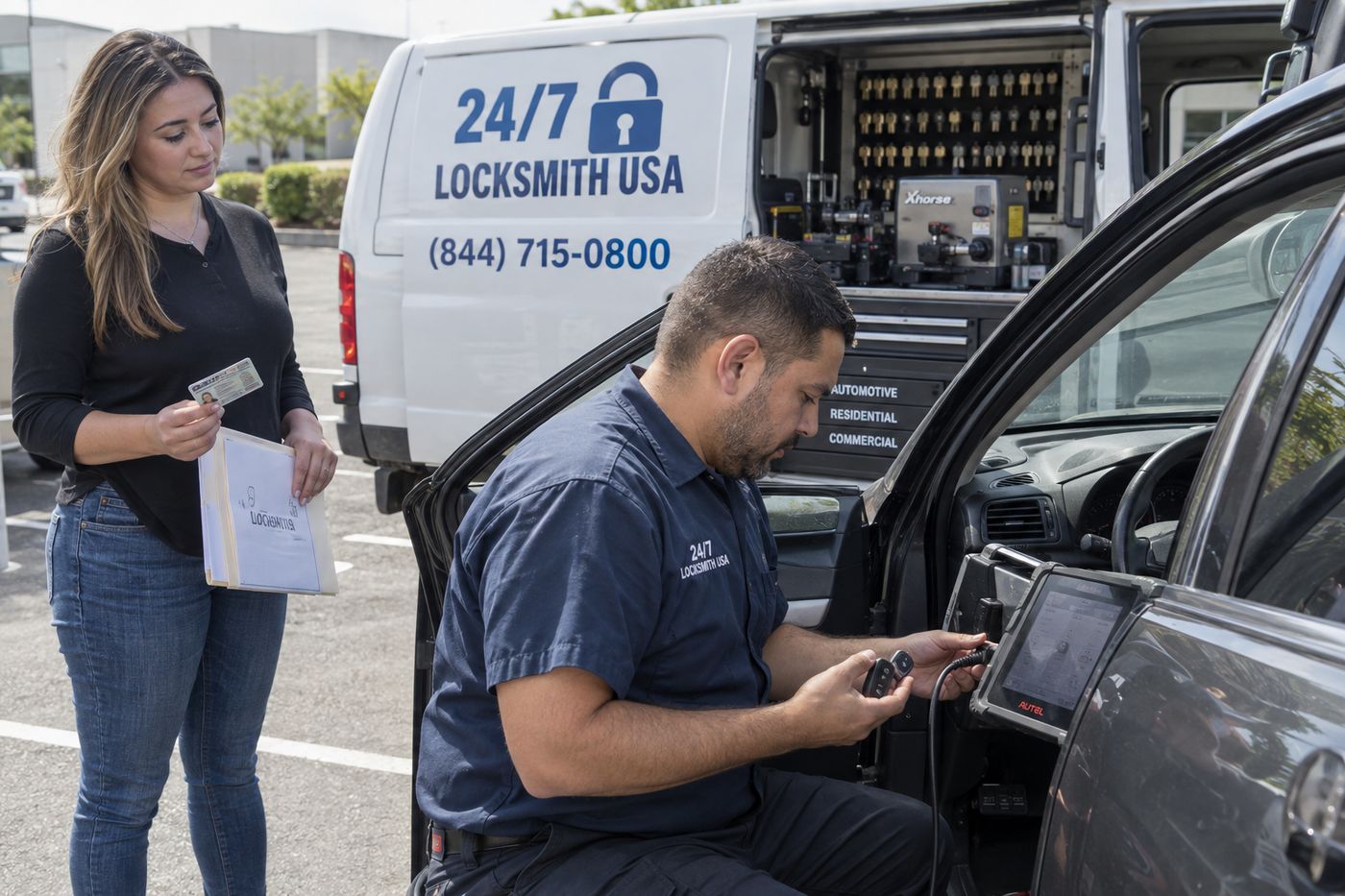
For a vehicle: your driver licence or photo ID and something showing you own the car, registration, insurance card or title. Photograph both now and keep them on your phone; it saves twenty minutes on the roadside. For a home or business: photo ID with the address, or a lease, or another way of showing the property is yours. A legitimate locksmith will always ask. One that does not is a warning sign.
How to Tell a Real Locksmith From a Scam Listing
The pattern is consistent: a listing with no verifiable address, a phone quote of fifteen or nineteen dollars, an unmarked car, and a technician who says the lock has to be drilled. Most residential and automotive locks do not need drilling. Ask for the company name, get an estimate before dispatch, and confirm the technician is insured. Read how to spot a fake locksmith before you call anyone.
Other Cities We Cover
Los Angeles, CASan Diego, CASan Francisco, CASacramento, CAFresno, CAAll of CaliforniaFull coverage
A car dependent city and what it means for keys
San Jose is a place where most people rely on a car for work, school runs and errands. That makes a missing key more disruptive than it might be in a city built around transit. A lost fob can mean a missed shift, a late pickup or a stranded family, so the question of how to get a replacement made properly matters more than it first appears.
Many households have two or three vehicles, and each one may use a different kind of key. One car might have a plain metal key, another a transponder key, a third a push button smart key. The first thing a locksmith asks is what you drive, and the answer shapes the whole conversation. Write down the make, model and year of each vehicle in your household and keep the list on your phone.
This page is general guidance for San Jose and does not describe past work in the city. Requirements for registration, ownership papers, rental agreements or building access vary, so check with the relevant office or your lease when a question comes up that this page does not answer. The goal here is to help you understand the process before you pick up the phone.
It also helps to decide, ahead of time, who in the household is the point person for key problems. When three adults share two cars, a lost key can start a long chain of texts and guesses. One person who knows where spares are kept, where the ownership papers live and which vehicle takes which key will shorten that chain considerably, and will stay calm when everyone else is not.
Smart keys, push buttons and what they ask of a locksmith
A smart key lets you keep the fob in a pocket while the car senses it nearby. That convenience hides a lot of electronics: a low frequency antenna in the car, a radio in the fob and an encrypted exchange between the two. When one of them fails, the symptoms can be confusing. The car may start only when the fob is held against the dash, or it may refuse to recognize the key at all.
Replacing a smart key is a different job from cutting a metal blade. The key must be programmed to the car, and on many vehicles the old keys must be handled in a particular order. A locksmith can often do this on site if ownership is shown, as described under smart key replacement. Ask whether the quote includes programming and whether it covers an emergency blade inside the fob.
Before you assume a smart key is dead, check the simple things. A weak battery is the leading cause, and some vehicles display a warning message. Read a car that will not unlock with the fob for a list of causes, and keep in mind that interference from other devices, though rare, can briefly confuse a fob in a crowded parking lot.
Try the simple tests in order. Hold the fob close to the start button or the spot the manual names, try the emergency blade in the door if there is one, and see whether the dash shows a message about the key. Note exactly what you see and hear, such as clicks, warning lights or a dead silence from the dash. Those details help the dispatcher guess whether the problem is the fob, the car or the battery.
Electric vehicles and phone keys
Electric vehicles are common in the Bay Area, and many of them use key cards, phone based keys or both. These systems are convenient, but they bring new failure modes. A dead phone, a software glitch or a lost card can leave a driver without a way in. Always find out what backup method your vehicle offers and keep it somewhere you can reach.
What a locksmith can do for these vehicles varies widely by manufacturer. Some systems can be handled with the right equipment and proof of ownership, while others require the maker's own process. Our guide to electric vehicle key cards and phone keys explains the general picture. When you call, say plainly that the vehicle is electric and tell the dispatcher what key type it uses.
Do not assume a locksmith can solve every case, and be wary of anyone who promises certainty before they know your vehicle. A careful dispatcher will tell you honestly when a job may need the manufacturer or dealer. That honesty is a sign of a company worth trusting, and it saves you a wasted visit.
Charging and parking habits matter too. If an electric car is left at a public charger or in a shared garage, the phone key may be the only way in, and a flat phone becomes a flat car. Carry a charging cable, keep the backup card in a wallet rather than in the car, and learn the manual unlock procedure before you need it. A calm ten minutes with the owner's manual is a small price to pay against a stuck evening.
Attached garages and the door between house and car
Many San Jose homes have an attached garage with an interior door that leads into the house. That door is easy to neglect. It often has a basic latch, a weak strike plate and no deadbolt, yet it connects the most exposed part of the property to the living space. A garage door opener remote left in a parked car can also be a weak link.
Check the interior door lock and consider a deadbolt if there is none. The page on garage entry door lock problems covers common issues such as a latch that sticks or a door that no longer closes properly. Keep that door locked in the same way as your front door, even when you are home.
Take care with anything involving the garage door itself. The springs, cables and brackets carry dangerous tension, and the opener mechanism is not a do it yourself project. Leave all such repairs to a trained garage door technician. A locksmith can deal with the lock on the entry door, the side door and the keys, but not with a spring under load.
Side gates, sliding doors and the quiet entry points
Thieves and honest mistakes both tend to find the weakest entry. In many suburban homes that is a side gate with a flimsy latch, a sliding glass door with a worn track, or a back door that is rarely checked. Walk around your property in daylight and look at each one. Does the gate latch securely, does the slider lock engage properly, and is the back door deadbolt actually being used?
A sliding door can often be improved with a secondary lock or a bar in the track. A side gate benefits from a padlock or a latch with a protected shackle. A locksmith can suggest hardware appropriate for your door or gate, and installation is usually simple. The page about residential locksmith work describes the range of home jobs.
Do not forget windows. Basement or ground floor windows with broken latches are a common weakness. You do not need an elaborate system, only working latches and a habit of checking them. Thorough, boring maintenance beats expensive gadgets nine times out of ten, and it can be done on a Saturday morning with a screwdriver and a cup of coffee.
Lighting and visibility also play a part. A gate hidden behind overgrown shrubs gives anyone a private place to work, while a clear view from the street and a light that comes on at dusk discourage attention. None of this requires a locksmith, but combining sensible habits with solid hardware gives a household layered protection, which works better than any single product.
Smart locks, keypads and what to ask first
Households with connected devices often consider a smart lock. These range from simple keypads to units linked with a phone app and a hub. The convenience is real: shared codes for family, no key to lose, and logs of who came and went. The tradeoff is that batteries run down, software needs updating and a poor installation can make the door harder to open rather than easier.
Before buying, check that the door is prepared properly. The deadbolt bore, the thickness of the door and the position of the strike all matter. A smart lock installed into a misaligned door will jam eventually. The smart lock installation page explains how the work is done, and our page on a smart lock not working lists the usual causes when something goes wrong.
Keep a mechanical key as a backup unless the model has another reliable fallback. Test it after installation. Teach everyone in the household how the lock behaves when the batteries are low, and replace those batteries on a schedule rather than when the warning appears. A lock that fails politely is a lock that was planned for.
Think about guests and helpers as well. A cleaner, a dog walker or a contractor may need access, and giving each person a separate code, if the lock allows it, means you can remove one without disturbing the others. If your lock only supports a single shared code, change it whenever the circle of people who know it changes, and do not text it to anyone you would not hand a key.
Workplaces, parking structures and commuter lockouts
Commuters park in large lots and structures, often on a regular weekly routine, and the habit of hurrying away from the car can lead to a key left inside. If you work in a building with controlled parking, tell security that a locksmith will be arriving. Some sites require visitors to sign in or follow rules about where vehicles may be worked on.
If your car is a company vehicle or part of a lease, contact the owner or fleet manager before arranging a replacement key. Ownership papers may be held by someone else, and the process can be easier when the right party is involved from the start. The page on leased and financed car keys explains what to expect in those cases.
For a plain lockout at the office, a locksmith can open the car without damage if the vehicle is accessible. See car lockout for the method in general terms. Do not try to force the door or use tools you saw online, because airbag wiring and window mechanisms inside the door are easy to damage.
If you are stuck in a parking structure with poor signal, walk to a spot where your call will hold, and tell the dispatcher the level, the nearest pillar marking and any gate or ticket rules. Technicians cannot help if they cannot find you, and a confusing description is the most common reason a visit starts badly. Take a photo of the marking so you can describe it exactly.
Rekeying after a move, a break in or a lost key
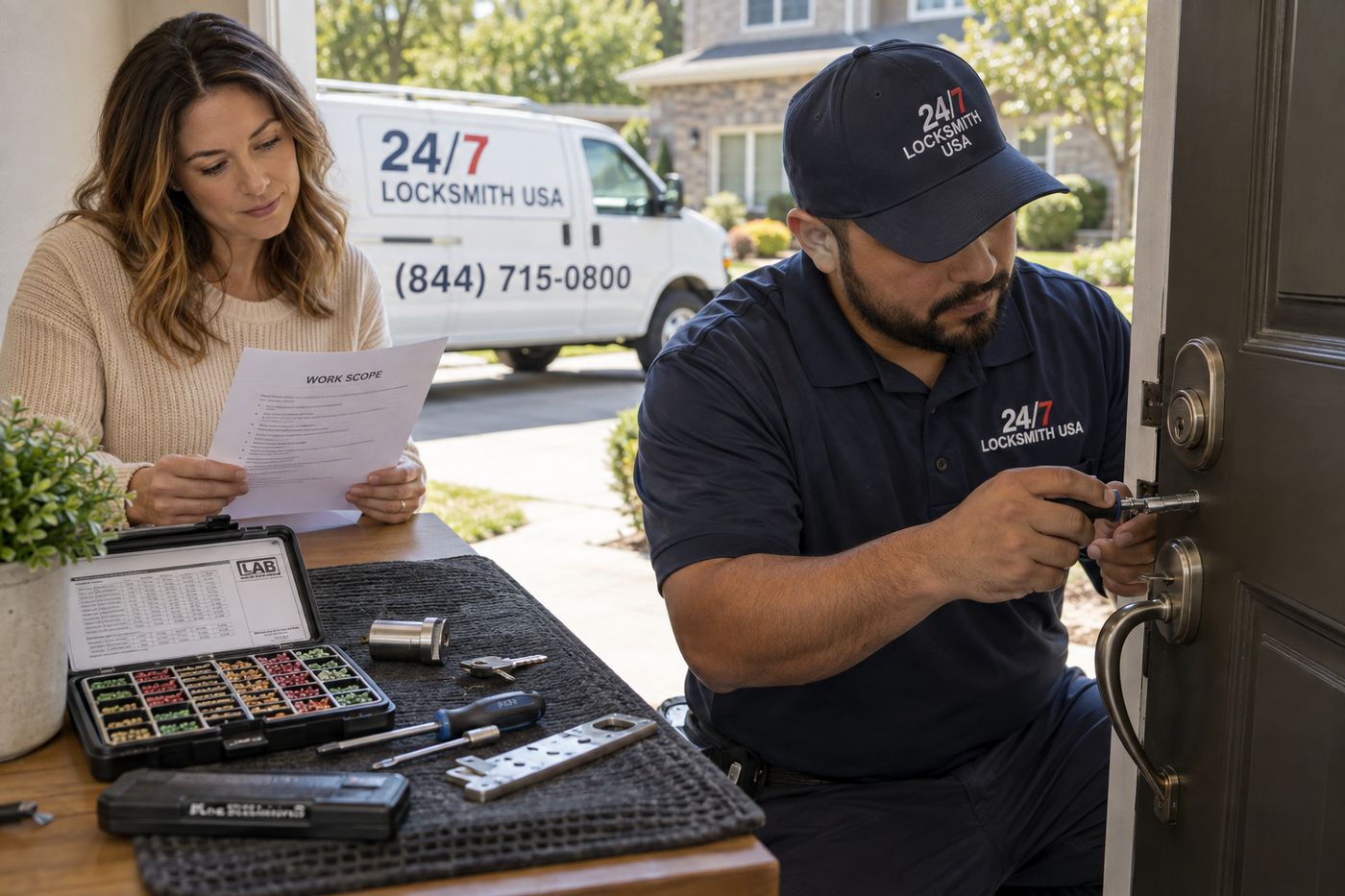
Some events always justify rekeying: moving into a place you did not build, a lost key with an address attached, a break in, or a change in who lives in the home. Rekeying is straightforward, and the lock stays in place while the internal pins are changed to match a new key. Old keys stop working, and you know exactly who can enter.
Rekey every door at once if you can, so that one key opens the front, back and garage entry. This is convenient, and it removes the risk of an old key still working on a side door. The page on lock rekey service explains the process step by step and what to expect during the visit.
If the existing locks are loose, worn or damaged, replacement is a better choice. Ask the technician to explain honestly whether rekeying will do the job. A reputable locksmith will tell you when a lock is past saving, and will not try to sell you new hardware when a rekey is enough.
Reading a quote and asking the right questions
A fair phone quote has two parts: a service call charge for traveling to you, and the price of the work. Ask for both. Ask whether parts, programming and any extra steps are included. Ask what could change the total once the technician sees the lock or vehicle. The answers should come without hesitation, and they should match what happens on arrival.
Be careful with quotes that seem unrealistically low. A low number that grows on site is a classic tactic, and it relies on your being stuck and tired. If the company will not give its name, or the technician arrives in an unmarked vehicle and cannot explain who they work for, you are entitled to say no. The guide on the service call charge explained describes what is reasonable.
Keep notes. Write down who you spoke to, what was quoted and what was promised about the visit. If a dispute arises, written details carry more weight than memory. It also keeps you calm, because writing forces you to slow down and consider each number before you agree.
Everyday habits that avoid the call
Most lockouts come from a few repeated habits: setting the key down while carrying groceries, leaving a fob in a jacket that went in the wash, or letting a door close behind you in a hurry. Create a routine, such as touching your pocket before pulling the door shut, and keep a spare key with someone you trust.
Do not hide a key in an obvious spot like a flowerpot or under the mat. Those places are the first anyone checks. A lockbox with a code, placed out of sight, or a spare with a neighbor you know well is safer. Think about every key as something that could be copied or lost, and limit the number of copies in the world.
Once a year, go through your keys. Label them, throw away the ones that no longer open anything, and make sure each vehicle has at least one working spare. Taking an hour to do this is far more pleasant than losing an afternoon to a lockout, and it keeps your household calm when something does go wrong.
Common questions
Can a locksmith replace a push button smart key?
In many cases yes, once ownership is shown. The key must be programmed to the vehicle, and the exact process depends on the make and year. Tell the dispatcher the model, whether you have any working key left and whether the car is electric, so the quote reflects the real work involved.
What if my electric vehicle uses a phone as the key?
First check what backup method the vehicle offers, such as a key card. A locksmith may or may not be able to help, depending on the manufacturer. Be honest about the vehicle when you call and expect a careful dispatcher to tell you if the maker's own process is required.
Is it safe to repair my garage door myself?
No. The springs and cables on a garage door carry dangerous tension, and the opener is not a casual project. Leave all garage door repairs to a trained technician. A locksmith can help with the entry door lock and keys, but not with high tension parts.
Should I rekey every lock when I buy a home?
It is a sensible step, since you cannot know who holds copies of the old keys. Rekeying all exterior doors to one key is convenient and removes the risk. A technician can look at each lock and say whether it is worth rekeying or ought to be replaced.
How do I avoid a surprise charge from a locksmith?
Ask for the service call charge and the work price by phone, ask what could change the total, and write down what you are told. Decline the work if the price changes without a clear reason. A reputable company will explain every line without pressure.
What documents do I need for a replacement car key?
Bring a photo ID and proof that the vehicle is yours, such as a registration or title. The technician will also need the vehicle identification number. For leased or financed cars, the owner or lender may need to be involved, so ask what is acceptable before the visit.