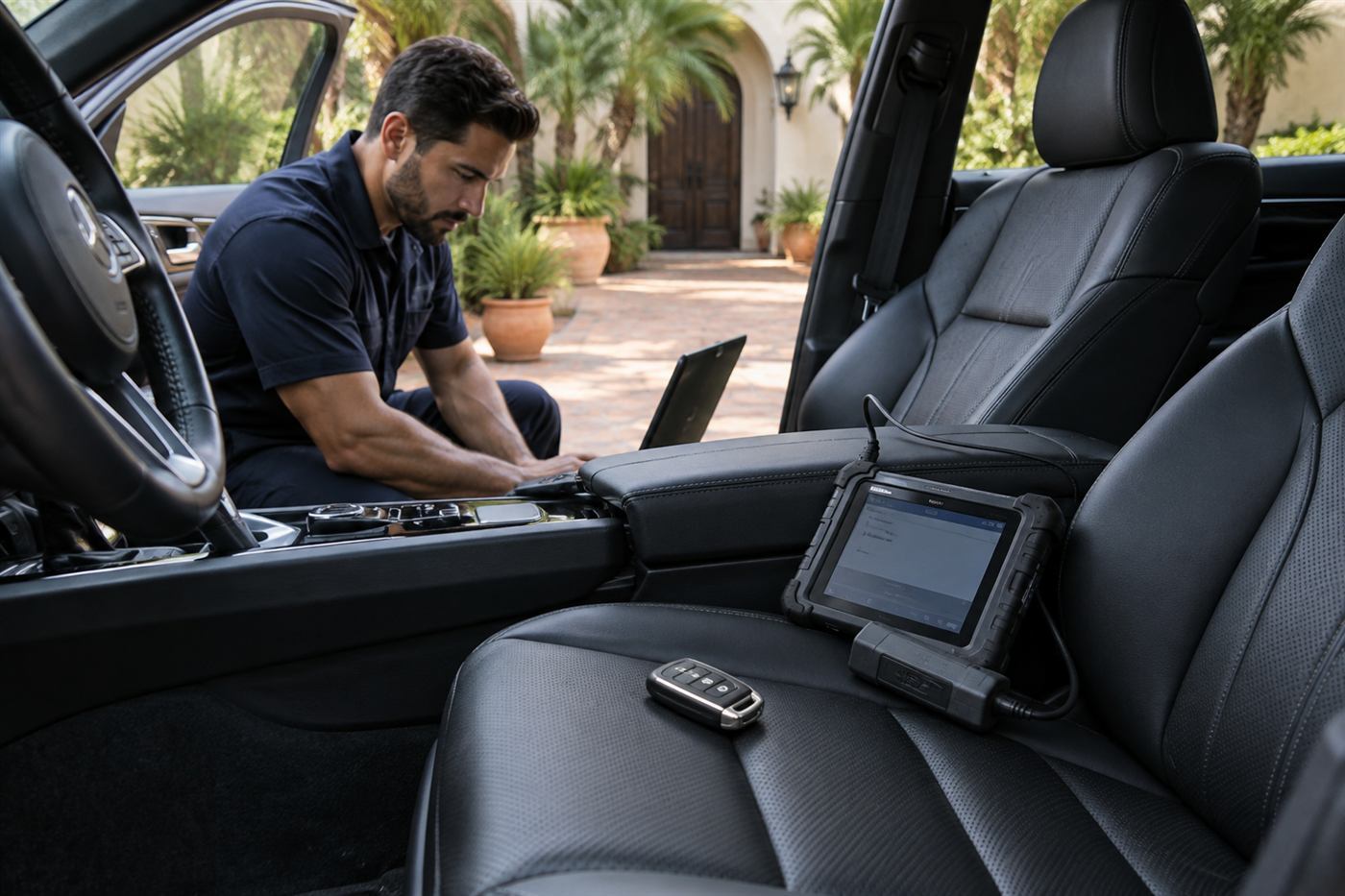
Why an all keys lost job is different from a duplicate
When you still own one working key, a copy is a short job. A technician reads the existing key, cuts a matching blade, and teaches the car to accept the new electronic chip. The original does most of the thinking for you. When every key is gone, that shortcut disappears, and the technician has to work out each piece from scratch: the shape of the blade, the electronic identity of the chip, and the permission to add a key to the car's memory.
That is why an all keys lost call takes longer and involves more questions than a simple spare. It is not a sign that something is wrong with your situation. It is simply how modern vehicles are built. Most cars made in the last two decades will not start unless the key presents a recognised electronic signature, so a blade that merely turns the ignition is not enough.
The work usually falls into three parts. First the technician confirms who you are and that the car is yours. Second, the cutting information for the blade is obtained, often from the vehicle identification number or by working directly at the car. Third, a new key is cut and programmed so that the car accepts it, and any old key that is still missing can be removed from the car's memory so it no longer works.
First steps before you call anyone
Before you assume the key is truly gone, spend a few calm minutes retracing your steps. Check the pockets of the jacket you wore, the bottom of bags, the cup holders, the gap between car seats, and the place where you usually drop things at home. Many all keys lost calls end with a key found in a coat pocket. If you recently had the car washed, valeted or serviced, a quick phone call to that business can save a lot of trouble.
If the key could have been stolen, treat it as more serious. A missing key together with a missing wallet or a recent break-in is a different situation from a key dropped at the beach. In that case, mention it when you call so the technician can talk through how to have old keys removed from the car after the new one is made.
If you are somewhere unsafe, such as a dark roadside, a deserted lot or any place where you feel threatened, call 911 first and move to a safe location. A key problem can wait, and your safety cannot. If a child or pet is inside a locked car, call 911 immediately before doing anything else.
- Search the places you last remember using the key, and ask anyone who rode with you.
- Check whether a spare is held by a family member, partner, roommate or employer.
- Look through the glove box, trunk and any magnetic box if the car is unlocked.
- Decide whether theft is possible, and tell the locksmith if it is.
- Move to a safe, well lit spot if you are stranded before making the call.
What a locksmith needs to know about your car
The more accurate your details, the faster the call goes. The technician will ask for the make, model, and year of the car, and whether it uses a traditional blade, a laser cut blade, a flip key, or a push-button start system with a smart key. If you do not know which kind you had, describe how you started the car: turning a key in a slot, pressing a button with the key somewhere in your pocket, or pressing a button after inserting a fob.
The vehicle identification number, often called the VIN, is the most important single detail. It is a seventeen character number found on the dashboard near the windshield on the driver side, on a sticker inside the driver door frame, and on your registration, insurance card and title. You do not need to be at the car to read it from paperwork. If you cannot reach any document, a photo of the dashboard plate through the windshield works too. Our guide on how to find your VIN shows every common location.
Also tell the technician where the car is. A vehicle parked at your home is a very different job from one in a parking structure, at a roadside, or in a locked garage with a tight ceiling. Mention anything that affects access, such as a gate, a permit requirement, or limited parking. If the car cannot be reached or is inside a building you do not control, say so right away.
Proof of ownership and why it is asked for
A responsible locksmith will ask you to prove the car is yours before a key is made. This can feel slow when you are stressed, but it protects you. A key is the strongest proof of control over a vehicle, and no reputable technician wants to hand one to a stranger who walked up to a parked car. The same check would protect your own car if someone else tried to claim it.
Typical items include a government photo identification that matches the name on the registration, and the registration or title for the vehicle. A lease or finance agreement can also support your claim if the car is not fully in your name. If the car is registered to a company, a business letter or a fleet document may be requested. The technician will tell you exactly what applies on the phone, and the details may vary a little by state and by vehicle.
Read more in our guide on proof of ownership for a car key. If you have none of those papers at hand, say so honestly. Sometimes a phone photo of a registration, a digital insurance card, or an online account copy is enough to move forward, and sometimes the technician will ask you to retrieve a document first. Do not offer false details or try to pressure the technician. That only slows the call and may end it.
How a new key is made when no key exists
For the physical blade, the technician needs cutting information for your lock. Many manufacturers tie that information to the VIN, and a trained technician can obtain it through legitimate channels once ownership is confirmed. In other cases the information is worked out at the car itself using professional tools made for locksmiths. The blade is then cut on a portable machine, often on the spot, to match what the car's own locks expect.
For the electronic part, a transponder chip inside the key head must be introduced to the car. The car's computer stores a list of approved chips. To add one when no working key is available, the technician connects diagnostic equipment to the car's data port and goes through the manufacturer's approved procedure to add the new key to that list. Some makes allow this directly, while others require extra security steps. The details differ by brand, which is why a good technician asks about your vehicle before promising anything.
Smart keys and push-button start systems add more complexity. They use encrypted two-way communication, and some brands lock down the programming process more than others. Our pages on transponder key programming and smart key replacement explain how these systems work in more depth. A few vehicles may need work that a mobile technician cannot complete, and an honest technician will say so on the phone rather than promise something they cannot deliver.
Locksmith or dealership when every key is gone
Many drivers assume the dealership is the only place that can make a key from nothing, and they arrange a tow to get there. For a large share of vehicles, that tow is not necessary. A mobile locksmith with the right equipment comes to the car, which means you avoid moving a vehicle that has no key to start it. Towing a car with no key can itself be awkward, because steering locks and automatic transmissions can be hard to move without the key.
That said, some vehicles, usually newer or higher end models, do need dealership level access. In those cases the dealership may need to order a key blank or unlock the security system with manufacturer tools. A fair locksmith will tell you plainly when your car falls in that group. Our comparison of dealership versus locksmith keys sets out the questions worth asking in each case.
Compare the practical details rather than guessing. Ask how soon the work can start, whether the key arrives at your location, whether the vehicle must be moved, and how long the whole job usually takes once the technician is there. Ask also whether the quote covers the key itself, the programming, and any service call charge. Quotes are given by phone only, and you should expect to hear the full picture before anyone is dispatched.
What happens on the day, step by step
After you call, you describe the car and your location. The dispatcher explains the service call charge and gives you a quote based on what you have described. If the job is simple, that quote may be firm. If it is complicated, such as a high security vehicle or a car in an awkward spot, an on-site visit may be needed first. Either way, the explanation comes before the technician is sent out.
When the technician arrives, expect them to ask for identification and proof of ownership before beginning. They will confirm the vehicle details, check the lock and ignition, and tell you what they intend to do. They may need to access the car's data port, which is why the car must be reachable and, in some cases, powered by a healthy battery. A very weak battery can interrupt programming, so mention it if the car has been difficult to start lately.
Once the key is cut and programmed, test it properly. Lock and unlock the doors, start the engine, switch it off and start it again, and try any buttons on the remote. If the car has more than one lock, such as a trunk or glove box, test those too. Ask the technician to remove any lost key from the car's memory if there is a chance someone else could find it, and ask whether a spare should be made while the equipment is already connected.
- You call, describe the vehicle and location, and hear the quote and service call charge.
- The technician arrives and checks identification and proof of ownership.
- The lock and ignition are examined, and the key type is confirmed.
- The blade is cut and the electronic key is programmed to the car.
- You test every function before the job is closed, and decide on a spare.
Make a spare while the equipment is connected
The easiest moment to prepare for the next lost key is the moment you are already having one made. Once the technician has diagnostic equipment connected and the car in programming mode, adding a second key is usually a small extra step compared with another full visit. Ask about it even if your budget feels tight, because a spare in a drawer at home can spare you from repeating this same stressful call.
Think about who else drives the car. If a partner, a teenager or an employee will use it, a key for each person means you are never sharing one set. Consider also keeping one key away from your daily bag, so a single lost bag or a stolen purse does not take the whole set. Our page on spare car key programming goes through how many keys a car can usually hold and how a spare is added.
A word of caution about spare keys hidden on the vehicle. A magnetic box under a bumper is easy for a thief to find and gives access to the whole car. Our guide on keeping a spare in a magnet box explains why leaving the key with a trusted person is generally a safer choice.
Common situations and how they usually go
A commuter leaves a key in a rental bike bag and cannot find it. The car is parked in a work lot, the VIN is in the registration inside the car, and the car is locked. The technician first helps the owner gain access to the locked car using approved professional methods, then reads the dashboard VIN and proceeds with the key. It is a good example of why a call should always mention whether the car is also locked.
A family returns from a beach day and realises the only key fell into the sand. The car is a mid-size SUV with a push-button start. The technician asks for the registration and photo identification, confirms the model year, and explains that a smart key requires additional programming steps. Because it is a newer vehicle, the technician mentions that the work may take longer and that the car should have a healthy battery.
An older pickup with a basic transponder key is used by a contractor, and the only key was left on a job site that has since closed. The truck is parked at home. With proof of ownership and the VIN, the blade is cut and the key programmed in a single visit. Because the truck is used for work, the contractor asks for a second key so a crew member can drive it. Read more about this kind of work on our truck and work van key page.
Call when you are ready
You do not need to have every answer before you call. Have the car's make, model and year, your location, and whatever documents you can reach, and the dispatcher will guide the rest. If you are unsure about a detail, say so and the technician will help you find it. Be honest about the situation, including whether the car is locked, whether theft is possible, and how soon you need to move.
Remember the key points. The work is done by phone quote only, there is a service call charge explained before dispatch, and a complicated vehicle may need an on-site visit before a final quote. Verify the technician's credentials when they arrive, and our guide on how to verify a locksmith shows what to look for.
When you are ready, call and tell us your car and where it is parked. We will walk through what is needed and what happens next, so you are never guessing about the process or the charges.
Questions people ask
Can a locksmith really make a key if I have none?
In most cases, yes. With confirmed ownership and the vehicle identification number, a technician can usually cut a blade and program an electronic key to the car using professional tools. A few makes and models have tighter security that may need dealership level access, and a good technician will tell you so plainly on the phone before anyone is sent to your location.
Do I have to tow my car to the dealership?
Often not. A mobile locksmith with the right equipment usually works where the car is parked, which avoids the effort of moving a vehicle that has no key. Some newer or high security models are the exception. Describe your car when you call and the dispatcher can tell you whether the work is likely to be done at your location.
What documents will I need to show?
Expect to show photo identification and proof that the car is yours, such as a registration, title, or lease paperwork. The technician will explain exactly what applies when you call. A phone photo or digital copy of a document may be accepted in some cases, though the technician decides what is sufficient for your situation and vehicle.
Will my old lost key still start the car?
It might, unless it is removed from the car's memory. If there is any chance someone else could find or has taken the old key, ask the technician to remove it when the new key is programmed. Not every vehicle supports this in the same way, so ask during the call and confirm it before the work begins.
How is the price decided?
Quotes are given only by phone, based on the vehicle, the key type, and your location. A service call charge applies and is explained before a technician is dispatched. A complicated job may need an on-site visit before a final quote is given. Ask any question you have during the call, so the full picture is clear before work begins.
Should I make a spare at the same time?
It is usually worth asking, because the equipment is already connected and the car is already in programming mode. A spare kept with a trusted person, or somewhere safe at home, can prevent a repeat of the same problem. Ask during the call so the technician can bring the right number of key blanks.
Describe the situation by phone and we will tell you what the job involves. Quotes are given by phone. Jobs that cannot be quoted without seeing them need a technician on site, and the service call charge is explained on the phone before anyone is dispatched.
(844) 715-0800Related pages
Written by Claude (AI) (AI) for 24/7 Locksmith USA.