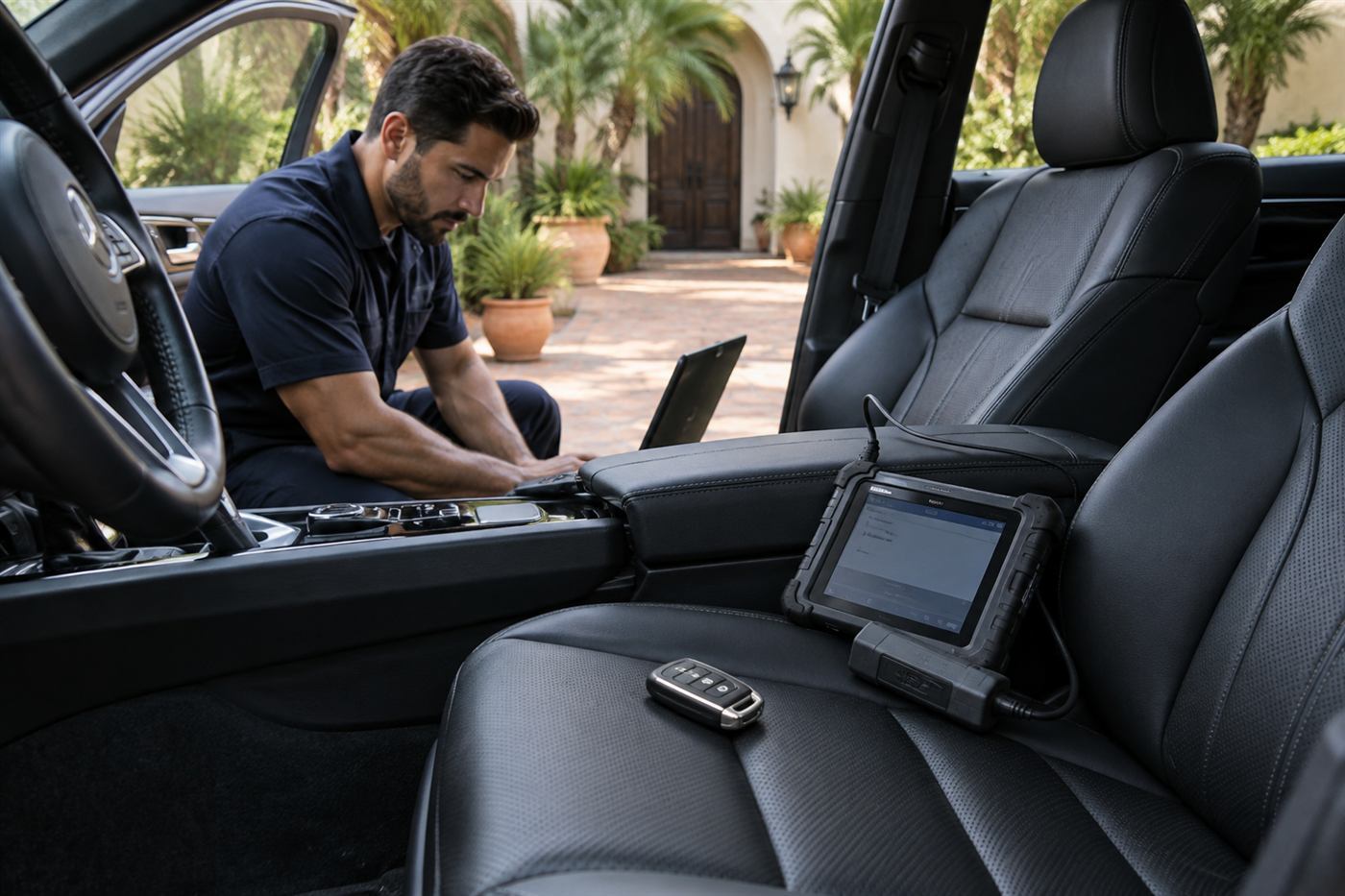
How a locksmith call works in Virginia
Virginia is a state where the first question is nearly always the same: where exactly are you? A driver stranded in a parking structure in Arlington has a very different situation from a driver at a gravel pull-off on a Shenandoah Valley road, even though both are holding a phone and saying the same sentence, that the keys are gone. The dispatcher on the phone needs your location, the vehicle, and what happened, and from those three facts can tell you what kind of job it is and how it will proceed.
Every job starts with a phone call. Quotes are given by phone only, after the dispatcher has the vehicle make, model, and approximate model year, and has understood the problem. A straightforward lockout on a common car is a different conversation from an all-keys-lost situation on a push-button start vehicle that needs a new key made and paired from scratch. Some jobs are complicated enough that a technician has to see the vehicle or the door before a firm number can be given, and in that case there is an on-site visit first. There is a service call charge for dispatch, and it is explained on the phone before anyone is sent, so nothing about it is a surprise at your car door.
The brand name carries the phrase 24-hour because that is the idea behind the service: people lose keys at night, on weekends, and during storms, and a locksmith service should be reachable then. It is a description of the concept, not a promise that a technician is standing by at every hour in every county. When you call, the dispatcher tells you honestly whether service is available where you are and when.
- Where the vehicle or door is, including the cross street, garage level, or nearest landmark
- Make, model, and approximate year of the vehicle
- What happened: keys inside, keys lost, key broken, fob dead, or something else
- Whether the car is in a safe place, and whether anyone or any animal is inside
Northern Virginia: commuters, garages, and tight schedules
The northern part of the state is built around commuting. People park at transit stations, in office parking structures, and in apartment garages with assigned spaces, and the cars are often newer models with smart keys. That mix creates a recognizable pattern of calls: a push-button start fob that stopped working after the battery died, a key left on the roof or in a coat check, a spare that was supposed to be at home and was not.
Parking structures matter for two practical reasons. First, a locksmith needs legal and physical access to the level where your car sits, and some garages require a resident or visitor to meet the technician at the gate or ticket the vehicle in. Tell the dispatcher about gate arms, height limits, and whether the garage is run by a management office. Second, concrete decks can weaken phone signal, so it helps to give the dispatcher a callback number and to step toward a ramp opening if the call keeps dropping.
Many Northern Virginia drivers also work irregular hours, and a lost key at the end of a long day is not a good moment to start comparing options. The better time to compare is before it happens. Read the guide on questions to ask a locksmith before dispatch and keep it in mind, so that when the call comes you already know what to ask about the service call charge and how the quote is built.
- Stay with the vehicle if you can, and choose a spot that is lit and visible.
- Check the places the key might be before assuming it is lost: pockets, bags, the last stop.
- Call, give the location including the garage level, and describe the vehicle.
- Have your registration or a matching document and a photo ID ready to show on arrival.
Richmond and central Virginia: neighborhoods, college towns, and spread-out driving
Richmond has older neighborhoods with street parking, newer subdivisions on the edges, and a college presence that brings a steady rhythm of students, parents helping students move, and visitors for events. Central Virginia drivers also tend to cover real distances. A person might live in one county, work in another, and visit family in a third, so a lockout can happen far from home.
That changes what you should do first. If the car is at your home and you are locked out, you may have a spare in the house, a family member with a key, or a roadside program through your insurer or car maker. If you are far from home, the useful question is whether the dispatcher can send someone to the spot where you are. Describe the road, the nearest business or exit, and any landmarks. Rural stretches have fewer street signs than people realize, and a technician who finds you faster is a technician who can start work sooner.
For older homes in established neighborhoods, a lock problem may be on a front door instead of a car. Wood doors settle and swell with humidity, and a deadbolt that used to turn easily can start to bind. The explanation and a clear plan of what to try and what not to force are in the deadbolt guide. If a door is warped, forcing the bolt tends to make a small problem bigger, so stop and call.
Hampton Roads: military families, moves, and unusual schedules
Hampton Roads has a large military community, and that shapes key and lock calls in specific ways. Service members and families move often, vehicles are sometimes bought or sold in a hurry, and a household may have one person away on a long assignment while the other manages everything at home. A car key that existed in a pair may now be a single key, and a spare is no longer something anyone has time to think about until the first one goes missing.
If you are on a base or entering one, base access rules apply to everyone, including a locksmith technician. Gate procedures, visitor passes and vehicle checks can add steps, and the technician may need your help getting through them. Tell the dispatcher at the start if the vehicle is on a base or in a restricted lot, because that decides how the visit is arranged.
Shipping a vehicle, buying one out of state, or taking over a lease and financed car can also complicate key work. The guide on leased and financed car keys covers what to check with the lender or lessor before keys are replaced. The common thread is paperwork: a locksmith will want to see that you are entitled to have a key made for the vehicle, and having the right documents in a folder makes that quick.
Coastal humidity, salt air, and keys that wear out
Along the coast, humid air and salt exposure work on metal and electronics over time. Key blades can pit, door lock cylinders can stiffen, and fob buttons can stop responding when moisture finds its way into the housing. A fob that has been through a rainy season in a coat pocket or a beach bag may work one day and fail the next.
None of this means every fob needs replacing, and a technician will tell you if something is repairable. A weak response from a fob is often the battery, and swapping a coin cell is a reasonable first step on many models. The article on changing a key fob battery shows what to look for, and the guide to fob battery and repair service explains when the problem is bigger than a battery.
A fob that has been wet deserves a more careful approach. Do not press buttons repeatedly or try to dry it with heat. Take the battery out if you can do so without prying hard, let it dry in open air, and then see whether it responds. If it does not, call and describe what happened, because water damage to a transponder chip is a different problem from a drained battery.
Mountains, valleys, and long rural drives
Western Virginia and the Blue Ridge area bring a different set of conditions. Cold mornings stiffen locks, snow and ice affect door handles, and many drives happen on roads with no shoulder and no signal. A lost key in a mountain parking area is a different level of problem from the same event in a city lot, and it deserves a plan.
If you lose a key in a remote spot, the first priority is safety. Make sure you have adequate clothing and water, stay in a visible place, and share your location with someone you trust. If the weather is severe or anyone is in danger, call 911 first. A locksmith is not a rescue service, and an emergency always comes before a car key.
For rural drivers, it is worth thinking about spares ahead of time. A spare key kept in a safe place at home, a second fob programmed before the first one fails, and a note of your vehicle identification number stored somewhere separate from the car all make a bad day shorter. The guide to finding your VIN shows where to look.
Car key problems most common across the state
Whatever region you are in, the same handful of problems account for most calls. A key that has been copied many times may start to stick in the ignition. A key that is worn smooth can turn a lock partially and then refuse. A fob can lose its pairing after a battery change or a long period in the heat. A broken blade may leave half a key in a lock.
Each of those has a matching page on this site with plain advice about what is safe to try, what to avoid, and what a technician will check. A broken blade is covered in broken key extraction, a stuck ignition in the guide on a key stuck in the ignition, and a completely lost set in all keys lost service.
One caution applies to all of them: do not force a key, a lock, or a fob. A key that will not turn is telling you something, and twisting harder often snaps the blade or damages the cylinder. Stop, take a photo of what you see, and call. The difference between a clean fix and an expensive one often comes down to whether someone forced it first.
| Situation | Safe first step | When to call |
|---|---|---|
| Keys locked inside the car | Check every door and the trunk release, and confirm no one and no pet is inside | Right away if anyone is inside, or after one quick check of other doors |
| Fob does not respond | Try the physical key in the door and a fresh battery if you can | If the battery change does not help |
| Key stuck in ignition | Check that the car is in park and the steering wheel is not locked against the key | If gentle wiggling does not release it |
| Key snapped in a lock | Stop, keep the broken piece, do not push it deeper | Immediately |
| All keys lost | Search the last places you went, then gather ownership documents | After a short search |
Proof of ownership and what a technician will ask for
A responsible locksmith will not make a key for a vehicle without reasonable proof that the person asking is entitled to it. That protects you, because it makes it harder for someone else to have a key made for your car. In Virginia, as everywhere, the usual documents are a photo ID and a registration or title that matches the vehicle, though a technician may accept other reasonable evidence depending on the situation.
If the registration is in the glove box and you are locked out, that is a problem worth knowing about in advance. Many people photograph their registration and insurance card and keep the images on their phone. That does not always satisfy every technician, but it often helps, and it is better than having nothing. The full explanation lives in the guide to proof of ownership for a car key.
For leased or financed cars, the registration may carry the lender or lessor name instead of yours. That is normal. Bring your lease or loan paperwork if you have it, and tell the dispatcher so they can prepare for it.
Avoiding trouble when you hire a locksmith
Locksmith scams exist, and a stressed person standing next to a locked car is exactly who they target. Warning signs include a company that will not give its name, a quote that changes dramatically when the technician arrives, pressure to agree before any explanation, and a vehicle that arrives with no identification. None of this proves anything on its own, but it is reason to slow down.
Before you agree to dispatch, ask for the company name, ask what the service call charge is and what it covers, and ask whether the quote you were given is for the whole job or only the visit. Keep the answers in mind when the technician arrives, and compare. The guides on scam warning signs and verifying a locksmith go further, including how to check what Virginia may require of a locksmith at the state or local level. Verify credentials yourself rather than assuming any company holds them.
If a technician arrives and the situation does not match what was discussed on the phone, you are allowed to say no. A reputable technician would rather have a clear conversation than a tense one.
What to have ready before you call
A little preparation turns a stressful call into a short one. Know where you are, in specific terms. Know the make, model, and rough year of the vehicle, and if you can read the VIN through the windshield, note it. Have a photo ID within reach, and if you can, have the registration or a clear photo of it.
Decide whether you want a spare made while the technician is there. If all keys are lost, making a new key and a spare in the same visit is often more practical than making them separately, though the dispatcher will explain the options and the quote for each. If you have a key that works but is worn, say so, because it affects what can be copied.
Finally, be ready for a short explanation about the service call charge and the quote. Both are discussed by phone before dispatch, and both are easier to accept when you have heard them clearly. When you are ready, call and tell the dispatcher what is going on, and they will take it from there.
Questions people ask
Do you serve every part of Virginia?
Service depends on where you are and what the dispatcher can arrange at that moment. Dense areas such as Northern Virginia, Richmond, and Hampton Roads are generally easier to reach than remote mountain roads. The only reliable answer comes from calling, giving your location, and hearing what is possible. The dispatcher will tell you honestly if a location is out of range.
How much will a car key cost in Virginia?
Quotes are given by phone only, and no price is listed on this site. The cost depends on the vehicle, the type of key, whether all keys are lost, and the location. Give the dispatcher the make, model, and year, and describe the problem. For complicated jobs, a technician may need to see the vehicle first, and the service call charge is explained before anyone is dispatched.
Can you make a key if I have no key at all?
In many cases yes, and this is called an all-keys-lost situation. The technician will need proof you are entitled to the vehicle, such as a photo ID and registration, and will need the VIN or a way to read it. Push-button start vehicles and some makes take more time than a basic key. The dispatcher can tell you what applies to your vehicle.
What if my car is in a base lot or a parking garage?
Tell the dispatcher at the start. Base access rules, garage gates, visitor passes, and management permissions can affect how and when a technician can reach the vehicle. You may need to meet the technician at a gate or contact the garage office. Good information at the beginning prevents delays, and the dispatcher can tell you how to prepare.
Should I try to open the car myself?
It is better not to. Wedges, hangers, and improvised tools can scratch paint, damage weather stripping, and trip side airbag wiring in some doors. If a child or animal is inside, call 911 first. For other lockouts, a technician has the right tools and the training to avoid damage, and a short wait is usually better than a repair.
Do you also do home and business locks in Virginia?
Yes, the services here include residential and commercial work such as rekeying, lock changes, deadbolts, and lockouts, though the focus is on cars. Describe the door and the problem when you call, and the dispatcher will explain what is involved. Larger jobs may need an on-site visit before a quote can be given.
Describe the situation by phone and we will tell you what the job involves. Quotes are given by phone. Jobs that cannot be quoted without seeing them need a technician on site, and the service call charge is explained on the phone before anyone is dispatched.
(844) 715-0800Related pages
Written by Claude (AI) (AI) for 24/7 Locksmith USA.