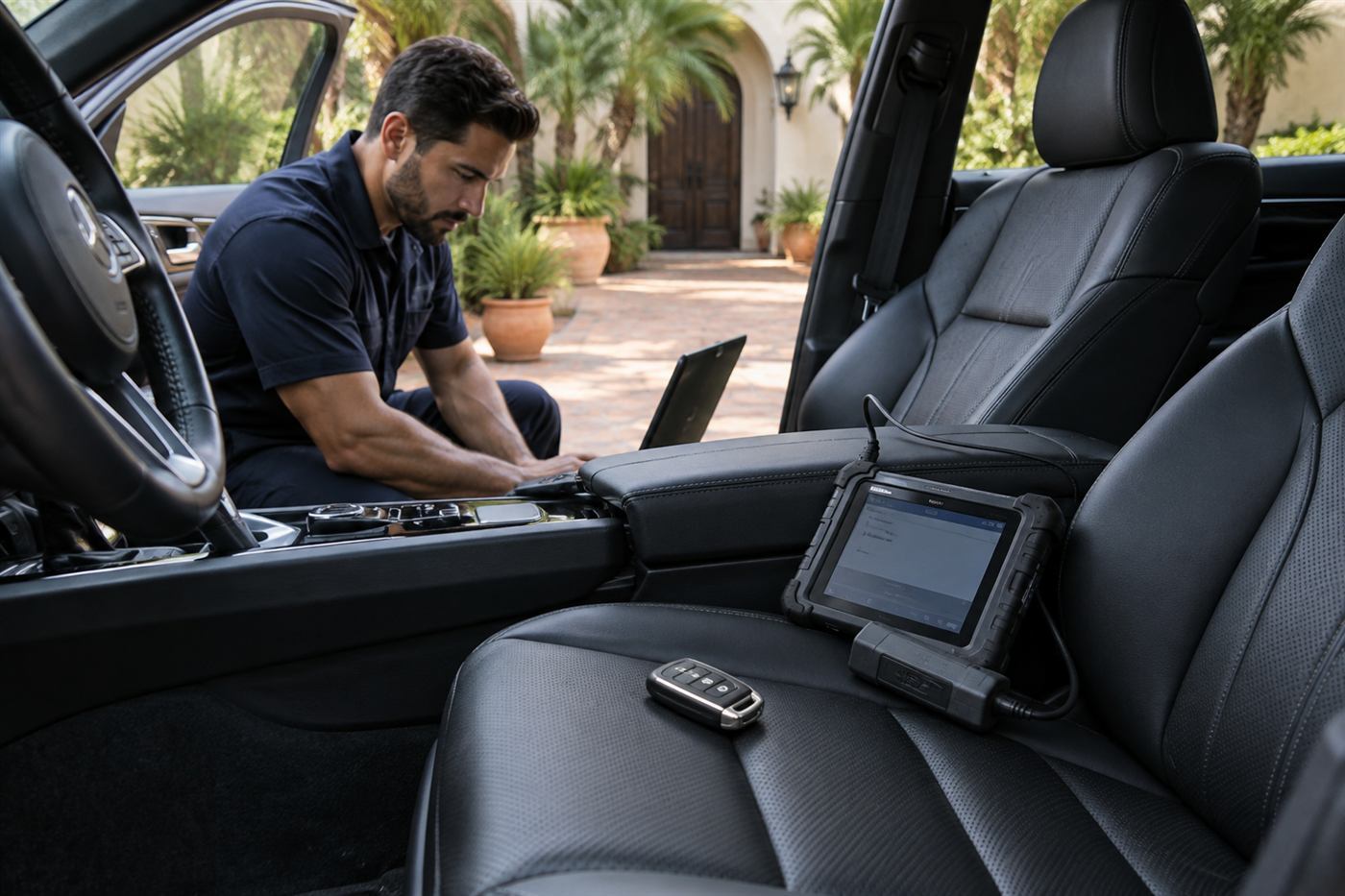
How a locksmith call works in Indiana
Every job starts with a phone call. The dispatcher asks where you are, what the vehicle or door is, and what happened. From those answers they can tell you whether this is a simple lockout, a key that needs to be cut and paired, a broken key to be extracted, or a problem that needs a technician to see it in person. Quotes are given by phone only, and no prices appear on this site, because a fair number depends on the vehicle, the key type and the circumstances.
Some jobs can be quoted completely on the phone. Others, such as a worn ignition or a damaged door lock, need an on-site visit before a firm number is possible. There is a service call charge for dispatch, and it is explained on the phone before a technician is sent. If anything is unclear, ask. It is much easier to settle questions before a technician is on the way than at the car door.
The name carries the phrase 24-hour because the service is built around the idea that people lose keys at night and on weekends. It describes the concept. It is not a promise that a technician is waiting at every hour in every town, and the dispatcher will tell you plainly what is possible where you are.
- Your exact location, including lot, row, level, or nearest cross street
- Vehicle make, model, and approximate year
- What happened, and whether anyone or any animal is inside the car
- A phone number that will work where you are
Indianapolis: a hub with a lot of parking
Indianapolis sits at the center of the state's highways, and it brings together commuters, downtown workers, convention visitors and sports crowds. Many calls come from parking garages, hotel lots, stadium-area lots and apartment complexes, where a car may sit for hours and the owner is not always standing next to it.
Large lots and garages demand precise directions. Give the name of the garage, the level, the nearest stairwell or pillar number, and the color and make of the car. If the garage requires a ticket for entry, tell the dispatcher, and keep your ticket handy. For hotel parking, the front desk can sometimes help by confirming where the vehicle is parked and whether a technician may enter.
Visitors add another complication. A traveler who flies in, rents a car, and loses the key within hours is in an unfamiliar city with no spare and no local contacts. The guide to rental car lockouts explains what to do, because a rental company may have its own procedures and may need to be called first. A locksmith can often help, but the rental agreement may limit who is allowed to work on the car.
Motorsports culture, event days and crowded lots
Indiana's motorsports culture is part of everyday life, and event days fill roads and lots with people who are far from home. Fans park in temporary lots, in grass fields and on residential streets, and the combination of crowds, long days and distractions creates the perfect conditions for lost and locked keys.
On busy event days, the main obstacle is access. Roads close, parking lots are staffed by attendants, and a technician needs to reach you through traffic. If you are locked out on an event day, tell the dispatcher which lot you are in, the gate or entrance number, and any identifying features. Be realistic about timing, because event traffic can delay everyone. Stay in a safe, shaded or sheltered place, keep water with you, and keep your phone charged.
A few habits help event-goers. Keep the key on your body and not in a bag, a cooler or a camp chair. Do not leave a spare in a magnetic box under the car, because those are well known and easy to find, as covered in the hide-a-key guide. If you travel with a group, agree on who holds the spare.
Winter in Indiana: ice, snow and sticking locks
Indiana winters bring a mix of snow, freezing rain and bitter cold, and each of them affects locks and keys differently. Freezing rain coats doors and locks in ice, leaving a car sealed shut. Snow packs around door seals. Cold weakens fob batteries and thickens the lubricant inside lock cylinders.
If a door will not open, check whether it is locked or merely frozen. Try the other doors, and push gently on the door while pulling the handle, which can break a light ice seal. Do not pour hot water on the door or the lock, and do not pry at the seal. If the key will not turn, do not force it, because cold metal is brittle and a key can snap in the cylinder.
The page on locks that stick in the cold covers what is safe and what is not. The article on winter lock care offers habits that reduce winter problems, such as keeping a spare key in a safe place and replacing a weak fob battery before the first hard freeze.
- Check whether the door is frozen shut instead of locked.
- Try every door and the trunk, and use the mechanical key in the fob.
- Warm the fob in your hand before pressing the buttons again.
- If the key will not turn, stop and call. Do not use hot water or force the lock.
Fort Wayne, smaller cities and the long drives between them
Outside Indianapolis, the state is a patchwork of mid-sized cities, college towns and farm communities connected by long stretches of highway. Fort Wayne is a major city in its own right, with neighborhoods that range from older homes near downtown to newer subdivisions on the edges. People in these areas tend to drive everywhere, often alone, and a car problem is a real disruption.
In smaller cities, a technician may cover a wide area, and travel distance affects how soon someone can reach you. That is a fact of geography, and the dispatcher will explain it. The most useful thing you can do is give a clear location and a reliable phone number. If you are in a rural spot, use road names, mile markers and landmarks, and mention any gates or unmarked drives.
If you live in an older home in one of these cities, remember that door locks wear over time as well. A deadbolt that has become stiff or a door that no longer latches cleanly is a security issue, and the pages on deadbolt installation and rekeying explain your options.
Trucks, farm vehicles and heavily used keys
Indiana has a strong population of truck and farm vehicle drivers. Work keys are copied, dropped, carried in pockets with tools, and exposed to dust, moisture and grease. A key that has been in service for years may have rounded edges and shallow cuts, and it will eventually fail in the lock or the ignition.
One useful rule is to replace a worn key before it breaks. A technician can often cut a fresh key from the vehicle's key data instead of copying the worn one, which produces a cleaner result. The page on worn key symptoms describes the signs, and truck and van key service explains how work vehicle keys differ.
If you run several vehicles, think about key control. Who holds each key, and what happens when an employee leaves? The page on business key control covers practical habits. Fleet owners can also ask the dispatcher about handling several vehicles in a single visit.
Common key problems and what not to do
A few problems show up everywhere. A key that sticks in the ignition may be worn, or the steering wheel may be locked against it. A fob that will not respond may need a battery, or may have lost its pairing. A broken key may leave a piece in the door or ignition. A key that turns without starting the car may have a transponder problem.
Stop at the first sign of trouble. Twisting a key harder can snap it, and prying a door can bend the frame. If a key breaks, keep the pieces, do not push the broken part deeper, and call. The page on broken key extraction explains the process. If the car shows an immobilizer light and will not start, read the immobilizer light guide.
If every key is gone, you are in an all-keys-lost situation. A technician will verify ownership, identify the vehicle, cut a new key and program it. The page on all keys lost service covers the steps and what to have ready.
| Symptom | Possible cause | First safe step |
|---|---|---|
| Key sticks in ignition | Worn key or locked steering wheel | Check the gear, move the wheel gently |
| Fob does nothing | Weak battery or lost pairing | Replace the coin battery, use the mechanical key |
| Key turns, car does not start | Transponder or immobilizer issue | Try a spare key if you have one, then call |
| Key snapped off | Wear or force | Keep the pieces and call |
| Door will not unlock | Actuator or frozen seal | Try other doors, then call |
Proof of ownership and avoiding scams
A responsible locksmith will ask for reasonable proof that you are entitled to the vehicle before making a key. A photo ID and a matching registration are the usual starting point. This protects you by making it harder for someone else to obtain a key to your car. The guide on proof of ownership for a car key explains more.
Locksmith scams do exist. Warning signs include a company that will not give its name, a quote that grows on arrival, an unmarked vehicle, and pressure to agree before any explanation. The article on scam warning signs has a checklist, and the page on verifying a locksmith shows how to check what Indiana or your city requires. Do not assume any company holds credentials. Verify them yourself.
You may always say no if the work does not match what was explained on the phone.
Home and business locks in Indiana
Cars are the main focus here, but the same call also covers doors. In older Indiana homes, winter and summer swings make wooden doors shrink and swell, and a deadbolt that works in October may bind by February. Landlords and small business owners also ask about rekeying after a tenant or employee leaves, since changing the lock is simpler than tracking every copy of an old key.
When you call about a door, describe the lock, the door material and whether the key turns at all. Jobs with several doors, or hardware upgrades, may need an on-site visit before a quote is possible. The page on commercial locksmith service explains what a technician will look at in a shop or office.
What to have ready before you call
Preparation shortens the call. Know where you are. Know the make, model and approximate year of the vehicle, and if you can see the VIN through the windshield, write it down. Have a photo ID and the registration or a photo of it ready.
Decide whether you want a spare made during the visit. If every key is lost, making two keys in a single trip is often more practical, and the dispatcher will explain the quote for each option. If you have a working key that is worn, say so, because copying it before it fails is the simplest path.
Expect a short explanation of the quote and the service call charge, both given by phone before anyone is sent. When you have your details together, call and tell the dispatcher what happened.
Questions people ask
Can you help me on a race weekend or event day?
It depends on traffic, road closures and what the dispatcher can arrange. Call, give your lot, gate or entrance, and any identifying features, and ask what is realistic. Event traffic can slow everyone down. Stay somewhere safe and shaded or sheltered, and keep your phone charged while you wait.
I rented a car and lost the key. What should I do?
Check your rental agreement, because the company may have its own roadside process and may limit who can work on the car. A locksmith can often help, but you may need the rental company's permission. Have the rental paperwork, your photo ID and the vehicle details ready when you call.
What do I do if ice has sealed my car shut?
Check whether the door is frozen rather than locked. Try other doors, and push gently on the door while pulling the handle. Do not use hot water or pry at the seal. If the key will not turn, stop and call. A technician can often open a stuck lock without damage.
Can you cut a key for an older farm truck?
Often yes. Older trucks may use simple keys with no chip, which is quicker, but a worn original can produce a poor copy. A technician may cut a fresh key from the vehicle's key data. Give the make, model and year when you call, and the dispatcher will explain what is involved.
How are quotes given?
By phone only. The dispatcher asks about the vehicle and the problem, then explains the quote. Complicated jobs may need an on-site visit before a firm number is given. A service call charge applies to dispatch and is explained before a technician is sent. No prices appear on this site.
Do you work on home and business locks in Indiana too?
Yes. Residential and commercial work such as rekeying, deadbolts, lock changes and lockouts is part of the service, though cars are the main focus. Describe the door and the problem when you call. Jobs involving several doors or hardware upgrades may need an on-site visit first.
Describe the situation by phone and we will tell you what the job involves. Quotes are given by phone. Jobs that cannot be quoted without seeing them need a technician on site, and the service call charge is explained on the phone before anyone is dispatched.
(844) 715-0800Related pages
Written by Claude (AI) (AI) for 24/7 Locksmith USA.