Why a spare is easier to arrange than a replacement
There are two very different jobs that both end with a new key in your hand. One is adding a spare while a working key still exists. The other is replacing the last key after it is lost, stolen or broken beyond use. The first is a planned, calm visit. The second is usually an interruption to a busy day, often at an awkward time and place.
When a working key is present, the technician can use it as proof that the car recognises you, and the programming steps are generally shorter. On many vehicles the car itself will accept a new key once the existing one is used during the procedure. When no key remains, the technician must follow a longer path that involves identification checks, vehicle data and sometimes extra security steps. You can read about that route on our all keys lost car key page.
The practical difference is time and stress. A spare programmed in advance means the next lost key is a nuisance rather than an emergency. You pick up the spare at home, drive to wherever you need to be, and arrange a replacement for the lost key at your leisure. For anyone who relies on a car for work, school runs or medical appointments, that breathing room is the main benefit.
How adding a key differs from replacing one
Adding a key means the car's computer learns one more approved electronic identity while keeping the ones it already knows. Replacing a key usually means the car is also told to forget a key that is lost, so the old one no longer starts the engine. Those are separate decisions, and a good technician will ask which one you want.
If you only have one key and it is still in your hand, adding a spare is the right choice. If you have lost a key and a spare still exists, the better route is often to program a new key and remove the missing one from the car's memory. That way anyone who finds the lost key cannot use it. Not every vehicle supports removal in the same way, and the technician can tell you what your model allows.
There is also the physical side. The blade must be cut to match your locks, and on many cars that includes the door lock as well as the ignition. A poorly made blade that fits the ignition may stick in a door, so a good cut matters even when the car starts. If your key is worn, a spare cut from a worn key may inherit that wear. Read our page on worn car key symptoms to see when it is better to cut from the vehicle's own information instead of from the old key.
How many keys a car can hold
Most vehicles can store several approved keys at once, but the number varies by manufacturer, model and year. Many accept somewhere around four to eight, and some allow more. A few older or simpler systems allow fewer. A technician with the right diagnostic equipment can check how many keys your car currently knows and whether space remains for another.
This matters for two reasons. First, if a car already holds the maximum number of keys, a new one cannot simply be added, and an older entry may need to be removed first. Second, if several keys were programmed over the years by different people, you may not know how many exist. Some owners discover that a previous owner, a former partner or an earlier repair visit still holds a working key.
That is why a spare visit is also a good moment to take stock. Ask the technician to count the keys the car recognises. If the number is higher than the keys you can account for, you may want to remove unknown keys so only the ones in your hands can start the car. This takes a little extra time, but it closes a security gap that many drivers never think about.
What type of spare you need
Spares come in more forms than most people expect. A basic metal key without a chip works only on older vehicles. A transponder key has a small chip in the head that the car must recognise. A remote head key adds buttons for locking and unlocking. A flip key folds the blade into the fob. A smart key allows push-button starting without inserting anything. Knowing which kind your car uses is the first step.
You also have a choice between a full-featured spare and a simple one. Some owners want every button on the remote, while others only want a plain key that can start the car and open a door if the main fob fails. A simple emergency key kept at home or with a trusted relative is a common and sensible approach. Discuss what you actually need with the technician so you are not paying for functions you will not use.
Our guide on types of car keys shows how to tell them apart. If you are unsure, take a clear photo of your current key from both sides and describe how the car starts. For electronic systems, our pages on transponder key programming and smart key replacement explain what makes each system different.
What to have ready for the call
Preparation makes the visit short. Gather the make, model and year of the car, and have the vehicle identification number where you can read it. Have your working key on hand, because it is often used during programming. Have photo identification and the registration or title ready, since a technician will usually ask to see proof the car is yours before making any key for it.
Decide how many spares you want before the technician arrives. Programming two at once is usually smoother than coming back later. Think about who will carry each one: a partner, an adult child, a trusted neighbour, or a drawer at home. If the key will be used by someone who is not on the registration, mention that so the technician understands the situation.
Finally, tell the dispatcher where the car will be. A technician can work in a driveway, a workplace lot or a quiet street, but a vehicle in a tight parking structure or behind a gate needs a little planning. Quotes are given by phone only, there is a service call charge explained before dispatch, and a complicated vehicle may require an on-site visit before a final quote is given.
- Make, model, year and trim of the car, plus the vehicle identification number.
- Your existing working key, with all remotes and buttons tested.
- Photo identification and the registration or title.
- The number of spares you want and who will carry them.
- Where the car will be parked and any access limits such as a gate.
How the visit goes
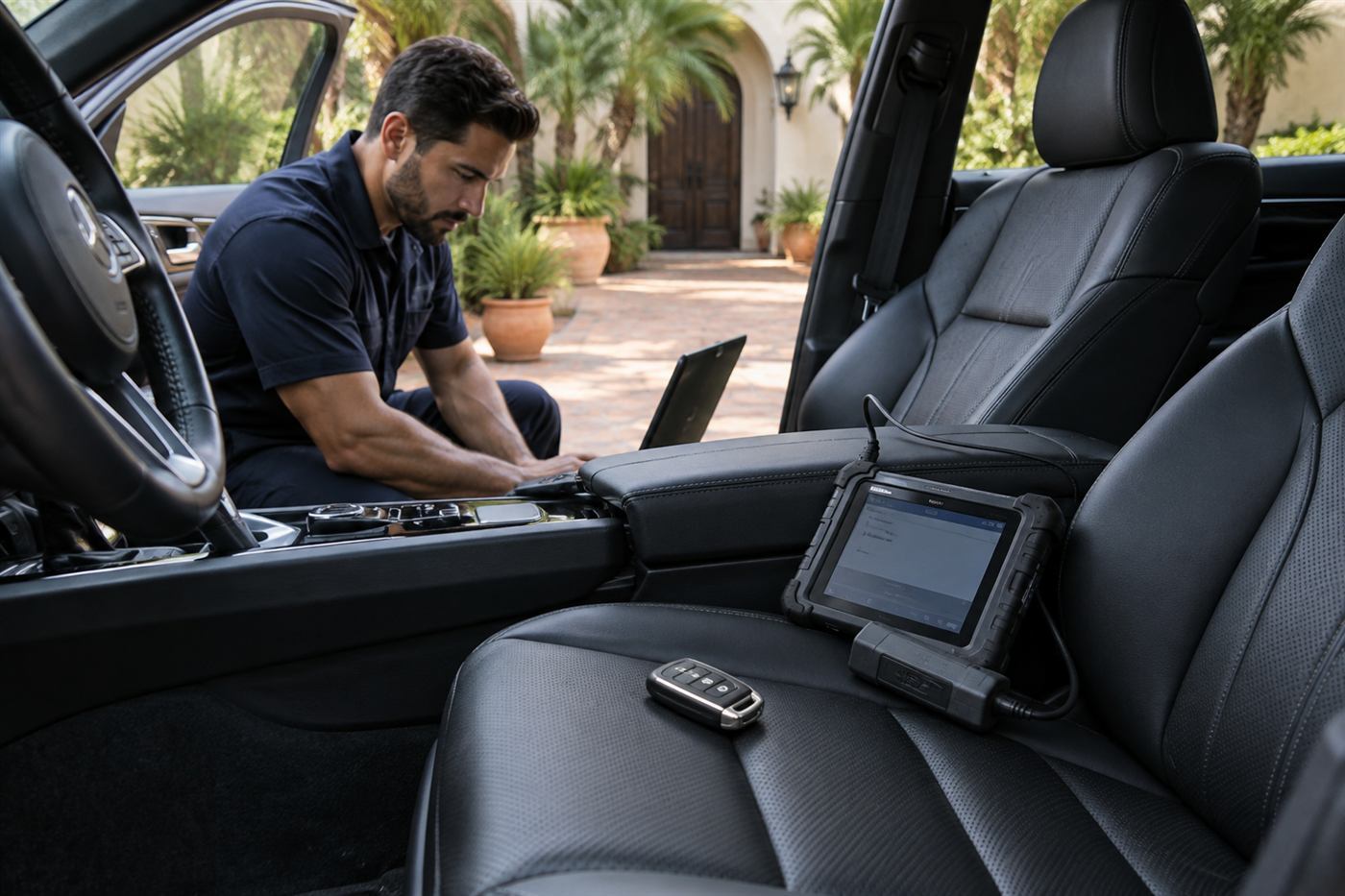
The technician arrives, confirms the vehicle details and checks your identification and registration. They will inspect your existing key and the ignition, and explain which kind of spare your car needs. If the blade must be cut, this is done on a portable machine, often at the vehicle, to match the lock. If the key is an electronic type, the technician connects diagnostic equipment to the car's data port.
Programming proceeds by putting the car into a learning mode and presenting the new key. The car's computer stores the new identity, and the technician tests that it starts the engine and operates the remote functions. Some systems require the old key to be used during the process, and some run a short security wait. None of this requires anything difficult from you beyond staying nearby and keeping the car accessible.
At the end, test every key you now hold. Lock and unlock all doors, open the trunk or tailgate, start the engine, shut it off and start it again. If the key has a panic button or a remote start function, try those as well. It is much easier to fix a small problem while the technician is still present than after they have left.
- The technician confirms the vehicle, your identification and the registration.
- The existing key and ignition are examined, and the spare type is chosen.
- The blade is cut and the electronic key prepared.
- The car is put into learning mode and the new key is programmed.
- You test every function on every key before the job is closed.
Where to keep a spare, and where not to
A spare is only useful if you can reach it when the main key is gone. Keep it somewhere that is both safe and independent of your daily bag. A drawer at home, a lockbox in a trusted location, or with a reliable relative are all common choices. Avoid keeping the spare with the main key on the same ring, because a single lost ring then takes both.
Do not hide the key on the car. A magnetic box under a bumper or wheel arch is one of the first places a thief checks, and it gives access to the whole vehicle. Read our guide on whether to keep a spare in a magnet box for a fuller explanation. A key left inside the car, even in a glove box, defeats the purpose and can lead to a lockout or a theft.
If you travel, think about where the spare lives while you are away. A spare at home does not help if you are on a trip two states away. Some drivers leave a spare with a family member who can send it by courier, while others arrange to carry a plain emergency key in a wallet. Our page on lost car keys on vacation walks through what to do when the spare is far away.
Spare keys for households, drivers and small businesses
Families often share a car, and each driver benefits from a personal key. Teenagers learning to drive, grandparents who borrow the car for appointments, and partners with different schedules all raise the odds that a single key goes missing. A spare for each regular driver spreads that risk and ends the daily argument over who has the key.
For a small business with a van or truck, a spare can prevent a whole day of lost work. If one worker keeps the only key and calls in sick, a vehicle can sit idle. A second key kept in the office, with clear rules about who may use it, keeps jobs moving. Read about work vehicles on our truck and work van key page, and about managing larger groups of vehicles on our fleet page.
Renters, lease drivers and anyone using a financed car should check their agreement before cutting new keys. Some leases ask that you keep keys with the vehicle, return all original keys at the end of the term, or notify the lessor when a key is added. Our guide on leased and financed car keys explains what to ask. When in doubt, call the finance company before the visit.
Questions to ask before you book a spare
A spare is a small job, but a few questions make it go smoothly. Ask whether the technician can cut and program the key at your location, or whether anything must be ordered first. Ask what type of blank will be used and whether it suits your car's chip system. Ask whether the key is new or reconditioned, and whether it will be tested before the technician leaves.
It is also reasonable to ask how many keys your car currently recognises, and whether the technician can remove any you do not know about. If you bought the car second hand, this is a sensible security step. A previous owner may still hold a working key, and removing unknown keys means only the ones you hold can start the engine.
Finally, ask for the quote and the service call charge on the phone before anyone is dispatched. A reputable company explains both up front. If a caller is vague about charges, or promises an amount without asking about your car, treat that as a warning sign and read our guide on questions to ask a locksmith before dispatch.
Common mistakes when adding a spare
The most frequent mistake is waiting until the key is failing. A key with a cracked case, a sticky button or a battery that needs frequent changes is already telling you something. Programming a spare from a key that is close to failing is still possible, but the visit is easier when the original is healthy.
A second mistake is cutting a spare from a very worn key. Over years of use, the edges of a blade wear down, and a copy of that worn shape may bind in a door lock or feel rough in the ignition. A technician can often cut from the vehicle's own information instead, which gives a fresher result. If your key already sticks, mention it during the call.
A third mistake is assuming that an inexpensive blank from a counter will behave like the original. A blank without the right chip may open the doors but fail to start the engine, and you will not find out until you need it. Test every spare thoroughly on the day it is made, and test it again a few weeks later, so any weakness shows up while the technician can still be reached.
When to call and what to expect
The best time to add a spare is now, while you still have a working key. Do not wait for the day the key fails. If your only key is worn, cracked, has a loose button or a failing battery, treat that as a sign. A weakening key can fail suddenly, and then the visit becomes a much longer one.
When you call, describe the car and where it is parked, and say whether you want one spare or several. The dispatcher will explain the service call charge and give a quote by phone. If your car has an unusual security system, the quote may be finalised after an on-site look. You will always hear the details before a technician is sent.
Call when you are ready, and ask any questions you have. We would rather explain the process once than have you guess. A spare programmed today is a small task, and it can save a long, stressful day later.
Questions people ask
Is it better to add a spare now or wait until I lose my key?
It is better to add one now. With a working key, the programming steps are usually shorter and the visit is calmer. After every key is gone, the process involves identification checks and longer procedures, and it often happens at an inconvenient time. A spare in a safe place turns a future emergency into a minor errand.
Does a spare need to come from the dealership?
Not always. A mobile locksmith with the right equipment can cut and program spares for many makes and models at your location. Some vehicles, especially newer or high security ones, may need dealership level access. Describe your car when you call, and the dispatcher will tell you honestly which route is likely to work for your vehicle.
Will adding a key make my old key stop working?
No. Adding a key teaches the car one more approved key while keeping the ones it already knows. Replacing a lost key is a separate step that can also remove the missing key from the car's memory. Tell the technician which you want, so the right procedure is used for your situation.
How many spare keys can I have?
It depends on the vehicle. Many cars store several approved keys, but the limit varies by make, model and year. A technician can check how many your car currently recognises and whether space remains. If the car is full, an older entry may need to be removed before a new key can be added.
What if I do not have any working key right now?
Then the job is a replacement rather than a spare, and it follows a longer path with identification checks and vehicle information. It can still usually be done by a mobile locksmith. Our all keys lost page explains the process. When you call, mention clearly that no working key exists so the right equipment is brought.
Do I need proof that the car is mine for a spare?
Yes, usually. A technician will ask for photo identification and a registration or title before making any key for a vehicle. This protects you as well as the technician. Have the documents ready before the visit, and if you are missing one, tell the dispatcher so you can plan how to handle it.
Describe the situation by phone and we will tell you what the job involves. Quotes are given by phone. Jobs that cannot be quoted without seeing them need a technician on site, and the service call charge is explained on the phone before anyone is dispatched.
(844) 715-0800Related pages
Written by Claude (AI) (AI) for 24/7 Locksmith USA.