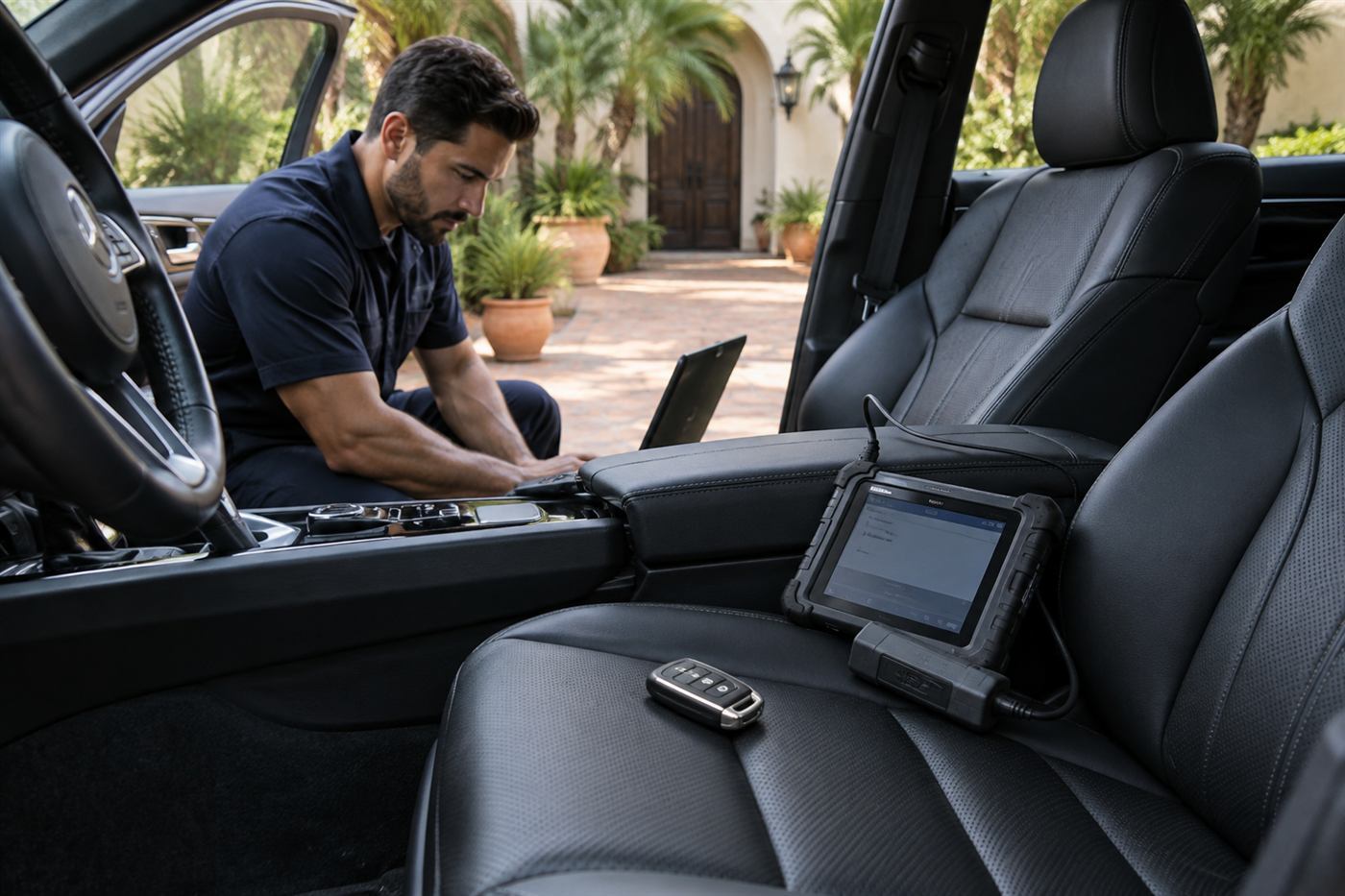
How locksmith calls in Birmingham tend to start
Most calls begin the same way. Someone is standing beside a car in a parking deck near UAB, a shopping center lot in the Highway 280 corridor, or a driveway on a steep street in Homewood or Mountain Brook, and the keys are not where they should be. They are inside the car, lost somewhere along the day, or the fob has simply stopped responding. The caller is usually tired, sometimes late for work or a shift, and wants a straight answer about what happens next.
That is the right place to start, because the next steps are not complicated once you know them. You call, you describe the vehicle and where it is parked, and you answer a few questions about the situation. You are given a quote by phone before anyone is dispatched. If the job turns out to be more involved than it sounded, such as a vehicle with a smart key system that needs a visit to assess, the phone conversation will say so up front rather than after a technician has already driven across town.
This page is written for Birmingham in particular. It covers the building types, the weather and the driving patterns that shape the work here, and it explains each kind of call in plain language so that you know what is normal and what is worth questioning. If your situation is a life-threatening emergency, such as a child or pet locked inside a hot car, call 911 first. Everything else on this page can wait until that is handled.
Hills, parking and why location matters
Birmingham sits in a valley between ridges, and the terrain makes a real difference to how a call goes. Neighborhoods on Red Mountain, in Forest Park, along Highland Avenue and across the southside ridges have steep driveways, narrow curbside parking and street grades that make working beside a vehicle awkward. A technician needs room to open a door fully, to set tools down safely and to stand without being in traffic. Tell the dispatcher exactly where the car is, including whether it is on a slope, in a garage, on a shared street or in a lot with a gate.
Parking decks around the medical district, downtown office buildings and Southside apartment complexes add their own details. Many have height limits, gated access and attendants. If you are in a deck, give the level, the nearest column marker and whether a ticket or a resident pass is needed to get in. Mentioning these things on the first call saves time later and prevents the common situation where a technician is on the way but cannot enter the structure.
If the car is parked on a hill and is not in gear or on its parking brake, do not try to move it yourself while you are stressed. Stay out of the roadway, keep your phone charged and let the technician handle the vehicle once they arrive.
- Say whether the car is on a slope, in a garage, in a deck or on a street.
- Give the nearest cross street or business name, not only a house number.
- Mention gates, permits, tickets or building rules that affect access.
- Stay with the vehicle in a safe spot away from moving traffic.
Car keys: what is usually going on
A modern car key is more than a cut piece of metal. Most vehicles built in the last couple of decades carry a transponder chip in the key head, and many have a remote, a proximity fob or a push-button start system. Each of these has to be matched to the vehicle's computer. That is why a hardware store copy often opens the door but will not start the car, and why a lost key is not fixed by cutting a blade alone. You can read more about the technology in our guide to how car key programming works.
In Birmingham the most common car key calls fall into a few groups. There are the lost key calls, where every key is gone and a new one has to be made from the vehicle itself. There are the single key calls, where one key is lost or broken but a spare still exists. There are the worn key calls, where a key that has been used for years has rounded edges and no longer turns the ignition cleanly. And there are the fob calls, where the remote works some days and not others.
Each of these has a different path. When one working key remains, adding a spare is usually the simpler job. When none remain, the technician generally needs to work from the vehicle identification number and proof that you own the car. That is not a hurdle placed in your way. It is how a responsible locksmith prevents a stranger from having a key made for someone else's vehicle. If you are unsure what that involves, read our page on all keys lost service before you call.
Lockouts: keys inside, engine running, trunk shut
Lockouts are the other major reason people call. In Birmingham, the usual story is a quick stop at a gas station, a grocery pickup or a church lot, a door that swung shut, and a set of keys on the seat. Sometimes the engine is still running. Sometimes the keys are in the trunk after loading bags. Sometimes the fob is in a pocket of a jacket that is now on the back seat.
A trained technician opens the vehicle without damaging the door, the weather seal or the paint, and does not need to disassemble anything in most cases. We do not describe the methods here and we do not recommend that anyone try to open a locked vehicle with improvised tools. Coat hangers and wedges scratch glass, tear seals and can trip airbag or alarm systems. The cost of repairing that kind of damage tends to be far more than the cost of a proper service call.
If a child or a pet is inside the vehicle and it is warm out, call 911 immediately. Do not wait for a locksmith. Birmingham summers are long, and a closed car heats quickly. Emergency responders are trained and equipped for exactly this situation. Once the emergency is over, we can help with the lock and the keys. Our page on car lockout service explains the process in more detail.
Humidity, heat and what they do to keys and locks
Alabama summers are hot and damp, and that environment is hard on keys, fobs and lock hardware. Moisture works its way into door handles, into ignition cylinders and into the small gaps around fob buttons. Over time this causes sticky tumblers, corroded contacts and weak batteries. A fob that has lived on a keychain through several summers of sweat, rain and swimming pool visits is more likely to fail than one that has been kept dry.
Heat itself matters too. A fob left on a dashboard in direct sun can warp, crack its case or drain its battery faster than one kept in a console. Plastic key heads become brittle after repeated heating and cooling, and a head that has been quietly cracking for months can finally snap off in the ignition on an ordinary morning. If you notice a hairline crack, a button that sticks or a key that has started to feel loose in its head, treat it as an early warning rather than waiting for the failure. A broken blade stuck in an ignition is a much bigger problem than a replacement key ordered ahead of time. See our page on worn car key symptoms for the signs to look for.
Thunderstorms are also part of life here. Lightning and surge events can affect a vehicle's electronics, and a car that has been through a heavy storm sometimes has trouble recognizing a key afterward. If your fob or key stops working after a storm, mention it when you call. It gives the technician a useful starting point.
Older homes, steel-era housing and residential locks
Birmingham grew up around iron and steel, and many neighborhoods still have housing from that period. Craftsman bungalows, shotgun-style houses, brick duplexes and early apartment buildings are scattered through Southside, Avondale, Woodlawn, East Lake and Norwood. Doors in these homes are often old, set in frames that have shifted with the years, and fitted with hardware that has been replaced piece by piece by several owners.
That history shapes residential lock calls. A deadbolt that will not throw may be fighting a swollen door rather than a bad lock. A latch that does not catch may need the strike plate adjusted, not replaced. A mortise lock in a vintage door may use a key that is hard to match and parts that are hard to find. A technician looks at the door, the frame and the hardware together before suggesting a repair, a rekey or a replacement.
Rekeying is a common and practical choice after a move, a roommate change or a lost house key. It changes the internal pins so old keys no longer work, without replacing the whole lock. Our page on lock rekey service explains what is involved. If you are choosing new hardware after a break-in or a purchase, read how to choose a deadbolt first. Cars come first on this site, but residential calls are welcome and are handled with the same phone quote and the same on-site check.
Students, hospital staff and shift workers
Birmingham has a large medical district, a university with thousands of students and a steady population of people who work early, late or overnight. Those groups run into locksmith problems at times that suit nobody. A nurse leaving a long shift in a parking deck at dawn, a student who returns to a dorm lot after a late study session, a delivery driver who locks keys in a van between stops: these are everyday calls.
For these callers, a few habits help. Keep a spare key somewhere that is not the vehicle and is not a magnet box under the bumper, which thieves know to check. Consider whether a second programmed key makes sense, since adding a spare while you still have a working key is generally less involved than replacing a lost one. And store the vehicle identification number in your phone, because it is printed on the dashboard and the door jamb but is awkward to read in the dark. Our guide on how to find your VIN shows where to look.
If you work a schedule that makes daytime errands hard, say so on the phone. The dispatcher can tell you what is realistic. We do not promise a particular arrival time, because traffic, weather and distance all play a part, but we will tell you honestly what we can do for your location.
What the quote and the service call charge mean
Many people worry about being overcharged by a locksmith, and the concern is fair. Our approach is simple. Quotes are given by phone only. You describe the situation, the dispatcher asks about the vehicle and location, and you hear a figure before anyone is sent. There is a service call charge for dispatching a technician to you, and it is explained on the phone before dispatch, so it is never a surprise at the door.
Straightforward jobs, such as a standard lockout, can usually be quoted fully on the call. Complicated work, such as an all keys lost situation on a newer push-button vehicle, may need a technician to see the car first. In that case the phone conversation explains why, and the on-site visit is how the final number is set. If the situation on arrival differs from what was described, the technician tells you the revised figure before starting, and you can say no.
We never ask anyone to approve work blind. If a quote sounds very low on one call and very high on arrival, that is a warning sign, and you will find more about it in our guide to how to spot a fake locksmith. Read the service call charge explained if you want the full picture before you call.
What to have ready before you call
A few minutes of preparation make the call faster and the quote more accurate. The dispatcher will want the make, model and approximate year of the vehicle, the exact location, and a short description of what has happened. For a replacement key, you will also need the vehicle identification number and proof that the vehicle is yours. A registration, a title or a matching photo ID with a document in your name is the usual combination. If the car is leased or financed, the paperwork may be in the lender's name, so tell the dispatcher and we will explain what else may help.
Be honest about the situation. If you are not sure whether the key is lost or just misplaced in the house, say so. If the key is stuck, broken or damaged, say that too. The more accurate the description, the more accurate the quote, and the fewer surprises on site.
Finally, think about safety. Move to a well-lit, public place if you are alone at night. Keep your phone charged. Confirm the name of the company when the technician arrives and ask to see identification before any work starts. Our guide on how to prepare for a locksmith visit lists everything in one place. When you are ready, call and tell us where you are in Birmingham and what has happened, and we will take it from there.
- Move somewhere safe and note your exact location.
- Find the vehicle make, model, year and VIN if you can.
- Have your ID and ownership papers within reach.
- Call, describe the situation and ask for the quote and the service call charge.
- Verify the technician's identification when they arrive.
Questions people ask
Can you make a new car key if I have lost every key in Birmingham?
In most cases yes. A technician works from the vehicle identification number and proof of ownership, then cuts and programs a new key at your location. Some newer push-button vehicles need an on-site look first, and the phone conversation will tell you if yours does. Have your ID and a registration or title ready, and the dispatcher will walk through the rest.
How do I know what the job will cost before someone comes out?
Quotes are given only by phone, and the service call charge is explained before dispatch. A simple lockout can often be quoted completely on the call. A complicated job may need an on-site visit, and you will be told that up front. If anything changes on arrival, you hear the revised figure before work begins and can decline.
Will opening my car damage the door or the paint?
A trained technician opens a vehicle without scratching paint, bending the frame or tearing the weather seal, and we do not rely on force. Damage usually comes from improvised tools used by someone in a hurry. If you are tempted to try a hanger or a wedge, call first. The repair for a damaged seal or window is almost always larger than a proper service call.
My fob stopped working after a heavy storm. Is that related?
It can be. Moisture in the fob, a weak battery or a vehicle electrical issue after a storm can all stop a fob responding. Start by checking the battery, since that is the simplest cause. If a fresh battery does not help, call and mention the storm. A technician can test whether the fob, the key or the vehicle receiver is at fault.
Do you work on house locks as well as cars?
Yes. Cars come first on this site, but we also handle home lockouts, rekeys, deadbolt work and lock replacement. Older Birmingham homes often have doors and frames that have shifted, so a technician looks at the whole door before recommending a repair or a replacement. The same phone quote and service call charge explanation apply to residential calls.
What should I do if a child or pet is locked in the car?
Call 911 right away. Do not wait for a locksmith. Emergency responders are trained and equipped to reach the vehicle quickly, and Birmingham summers make closed cars dangerous in a short time. Once everyone is safe, call us and we can help with the lock, the keys or any damage afterward. Your first call in that situation should always be emergency services.
Describe the situation by phone and we will tell you what the job involves. Quotes are given by phone. Jobs that cannot be quoted without seeing them need a technician on site, and the service call charge is explained on the phone before anyone is dispatched.
(844) 715-0800Related pages
Written by Claude (AI) (AI) for 24/7 Locksmith USA.