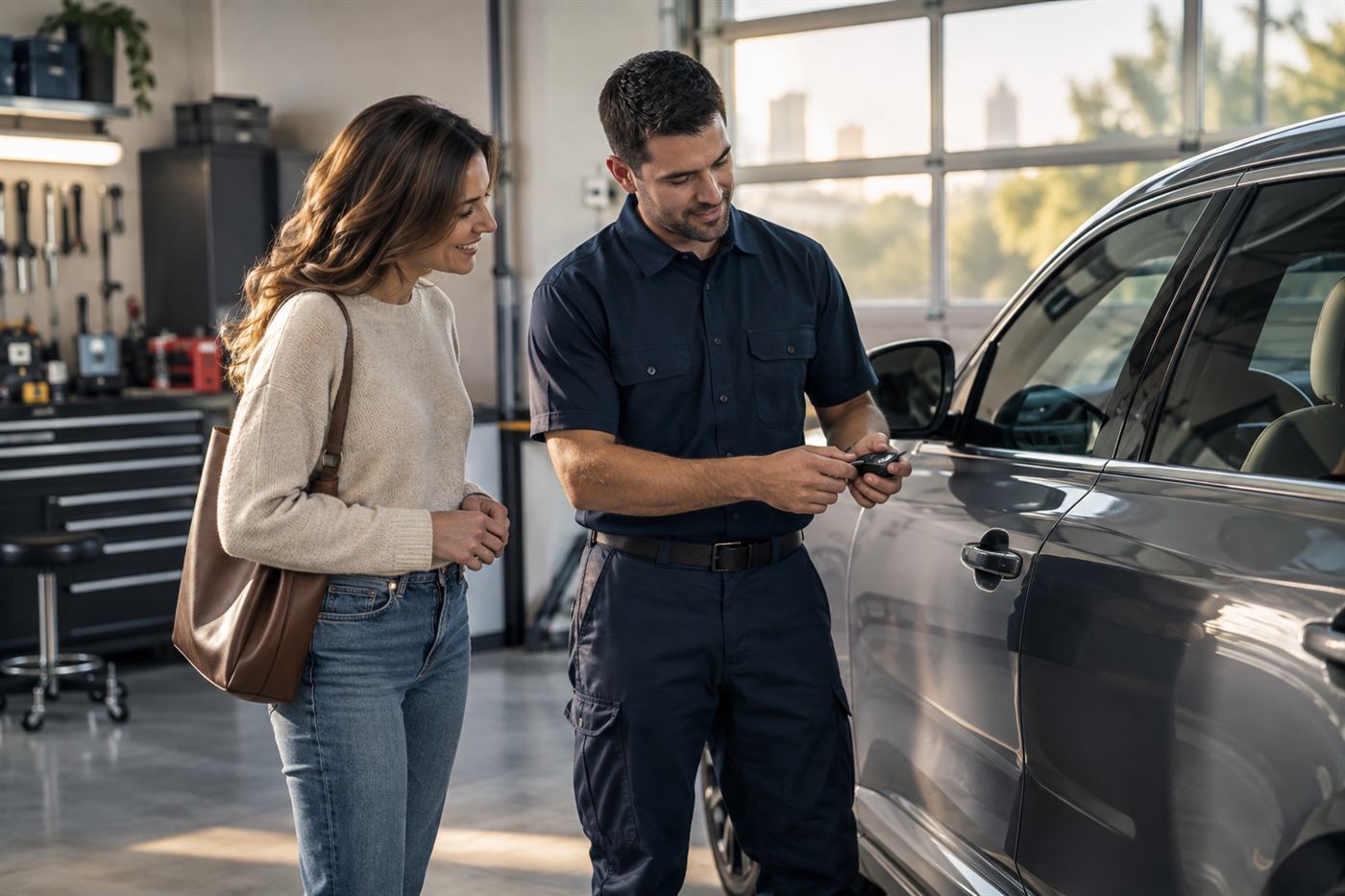
How a locksmith call works in Alabama
A call begins with three facts: where you are, what the vehicle or door is, and what happened. The dispatcher uses them to tell you whether it is a lockout, a key that has to be cut and paired, a broken key to be extracted, or something that needs a technician to see it in person. Quotes are given by phone only, and no prices appear on this site, because the right figure depends on the vehicle, the key type and the situation.
Some jobs can be quoted completely over the phone. Others, such as a damaged ignition or a forced door lock, need an on-site visit before a firm number is possible. There is a service call charge for dispatch, and it is explained on the phone before any technician is sent. Ask what it covers and whether the quote is for the whole job. Settling those questions before the visit prevents misunderstandings at the curb.
The name includes the phrase 24-hour because the idea behind the service is that people lose keys at night, on weekends and in storms. It describes the concept. It is not a promise that a technician is standing by at every hour in every town, and the dispatcher will tell you plainly what is possible where you are.
- Where you are: the street, lot, level, or nearest landmark
- Vehicle make, model, and approximate year
- What happened, and whether anyone or any animal is inside
- A phone number that works where you are standing
Summer heat and what it does to keys and vehicles
Alabama summers are long and hot, and a closed car in the sun can reach dangerous temperatures within a short time. That affects keys and locks in two ways. The first is safety: a child or a pet inside a locked car is an emergency, and the right call is 911, not a locksmith. The second is wear: heat shortens the life of plastic fob housings, softens adhesive on rubber buttons, and drains batteries faster.
If a fob has started to feel sticky, cracked or unresponsive after a hot season, the battery is the first thing to check, but the housing and circuit board may also be affected. The page on summer heat and car key safety explains the habits that protect keys, such as not leaving a fob on a dashboard or in a closed car. The guide on how long key fob batteries last shows what to expect.
Heat also affects people. If you are locked out in the sun, move to shade, drink water, and keep your phone charged. Do not wait in a hot car. If you feel dizzy or unwell, call 911. A key problem can be fixed later, but heat illness cannot be ignored.
- If a child or pet is inside a locked car, call 911 first.
- Move yourself to shade or an air-conditioned place nearby.
- Call the dispatcher, give the exact location, and describe the vehicle.
- Keep water and a charged phone with you while you wait.
Birmingham: hills, older neighborhoods and a spread-out metro
Birmingham sits among ridges and valleys, and the metro area spreads across many suburbs. Some neighborhoods have steep streets and driveways, others have older homes with original doors, and the commercial areas have large lots. Hills matter for car lockouts, because a car parked on a slope behaves differently, and a technician needs a safe place to stand and work.
If you are locked out on a steep street, tell the dispatcher, and make sure the car is parked safely and not in the way of traffic. Keep a clear view of passing cars. Older homes bring another type of call: door locks that have worn over decades, deadbolts that stick in humid weather, and frames that no longer line up. The page on a deadbolt that will not turn explains what to check and why forcing it is a bad idea.
For homeowners with older doors, a rekey or a lock change can improve security without replacing the whole door. The page on rekeying service explains how it works, and the guide on when to rekey covers when it makes sense, such as after moving in or after a lost key.
Huntsville and the technology workforce
Huntsville has grown around aerospace, defense and engineering employers, and its workforce includes many people who relocate for jobs. Newer vehicles are common, including cars with smart keys, push-button start and connected features. Employees often park in large corporate lots and secured facilities, where access rules can be strict.
If your car is on a secured campus or in a restricted lot, tell the dispatcher at the start. Gate procedures, visitor badges and escort requirements may apply to a technician, and you may need to arrange access with security. Having this sorted out before the visit avoids delays. A short call to the security office can help.
People who relocate often arrive with a car they just bought or a lease they just signed, and keys are a common problem. The guide on leased and financed car keys covers what to check with the lessor or lender. For modern cars, the page on smart key replacement explains what is involved, and some models take more time or need advanced equipment. The dispatcher will tell you what applies to your vehicle.
Gulf coast humidity, salt air and storms
Along the Gulf coast, humidity is a constant, and salt air adds to corrosion. Lock cylinders stiffen, padlocks seize, fobs stop responding when moisture reaches the circuit, and the finish on door hardware wears away. Hurricane and tropical storm season brings wind, flooding and power outages, each with its own effect on locks and keys.
Before a storm, think about keys. Keep a spare in a safe, dry place, and know where the vehicle identification number is recorded. After a storm, check doors and locks for damage, and be careful with flooded vehicles, because water in a car can damage electronics, including key systems. The page on hurricane season lock and key prep has a practical checklist.
If a fob or key has been in water, follow the steps in the water-damaged fob guide. Do not press buttons repeatedly, remove the battery if it comes out easily, and let the fob dry in open air. A technician can test it and tell you whether it can be saved.
Trucks, work vehicles and rural roads
Alabama is a state of pickups, work vans and long rural drives. Keys on these vehicles are often copied many times, carried with tools, and exposed to dust and moisture. A key that has seen years of heavy use may be worn smooth, and a copy of a worn key carries its flaws.
The page on truck and van key service explains how work vehicle keys differ, and fleet service covers what to ask about if you run several vehicles. If a key breaks in a door or ignition, stop and read broken key extraction before anyone reaches for pliers.
On rural roads, location is the main challenge. Give the road name, the nearest crossroads, any mile marker or landmark, and mention gates or dirt roads. If signal is weak, give a second number. If you are in a dangerous place, such as the shoulder of a fast road at night, your safety comes first, and 911 is the right call if you are at risk.
Common key problems and the steps that help
Across the state, the same problems recur. A key that sticks in the ignition may be worn, or the steering wheel may be locked against it. A fob that does nothing may need a battery or may have lost its pairing. A broken key may leave a piece in a door or ignition. A key that turns but does not start the car may have a transponder issue.
Stop at the first sign of trouble. Forcing a key can snap it, and prying a door can bend the frame. If a key breaks, keep the pieces and do not push the broken part deeper. If the car shows a flashing immobilizer light and will not start, read the immobilizer light guide.
If every key is gone, you are in an all-keys-lost situation. A technician will verify ownership, identify the vehicle, cut a new key and program it. The page on all keys lost service covers the steps.
| Problem | Common in Alabama because | First safe step |
|---|---|---|
| Fob cracked or unresponsive | Long hot seasons wear plastic and batteries | Replace the battery, keep the fob out of hot cars |
| Lock stiff or sticking | Humidity and salt air | Do not force it, call |
| Key lost after a storm | Debris, water and rushed evacuations | Check last locations, then call |
| Worn truck key fails | Heavy use and many copies | Replace before it breaks |
| Smart key will not start car | Newer vehicles are common | Use the backup start method in the manual |
Proof of ownership and avoiding scams
A responsible locksmith will ask for reasonable proof that you are entitled to a vehicle before making a key. A photo ID and a matching registration are the usual starting point. This protects you from someone else getting a key to your car. The guide on proof of ownership for a car key explains what may be accepted.
Locksmith scams exist, and a person stranded in the heat is an easy target. Warning signs include a company that will not give its name, a quote that grows when the technician arrives, an unmarked vehicle, and pressure to agree before any explanation. The article on scam warning signs lists more, and verifying a locksmith explains how to check what Alabama or your city requires. Do not assume any company holds a credential. Check yourself.
You may always decline if the work does not match what was explained on the phone.
Home and business locks in Alabama
Cars are the main focus here, but the same call also covers doors. In humid parts of the state, wooden doors swell in summer and a deadbolt that turned easily in March can bind by July. Landlords and small business owners also ask about rekeying after a tenant or employee leaves, since changing the lock is simpler than tracking every copy of an old key.
When you call about a door, describe the lock, the door material and whether the key turns at all. Jobs with several doors, or hardware upgrades, may need an on-site visit before a quote is possible. The page on residential locksmith service explains what a technician will look at.
What to have ready before you call
A little preparation shortens the call. Know where you are. Know the make, model and approximate year of the vehicle, and if you can see the VIN through the windshield, write it down. Have a photo ID and the registration or a photo of it.
If every key is lost, think about whether you want a spare during the same visit. Two keys in one trip is often more practical, and the dispatcher will explain the quote for each option. If you have a working key that is worn, mention it, because copying it before it fails is the simplest path.
Expect a brief explanation of the quote and the service call charge, both given by phone before anyone is sent. In summer, add a plan for shade and water while you wait. When your details are together, call and tell the dispatcher what is going on.
Questions people ask
What if a child or pet is locked in a hot car?
Call 911 immediately. Emergency responders have the authority and equipment to act at once, and time matters in the heat. A locksmith call is for situations where no one inside is at risk. Stay near the vehicle, and tell the dispatcher what you can see, such as the person's condition and the car's location.
Do you serve Birmingham, Huntsville and the Gulf coast?
Service depends on where you are and what the dispatcher can arrange at that time. Call, give your exact location, and you will be told honestly what is possible. Dense areas are generally easier to reach than remote ones, and the dispatcher will explain how the visit would work.
My car is on a secured campus. Can you still help?
Often yes, but access rules apply. Tell the dispatcher at the start, because gates, visitor badges and escort requirements may affect the visit. You may need to arrange access with security. Having your ID and registration ready, and the contact for the security office, helps the visit go smoothly.
Why did my fob crack in the summer?
Heat softens and ages plastic, and repeated hot days wear fob housings and drain batteries faster. Leaving a fob in a closed car makes this worse. A new battery helps with response, but a cracked housing may need a repair or a replacement fob. A technician can look at it and explain your options.
Can you make a key if every key is lost?
In many cases, yes. The technician needs proof you are entitled to the vehicle and a way to identify it, such as the VIN. Push-button start and some imported models take longer than a simple key. The dispatcher will explain how your vehicle is handled and quote the job by phone.
How are quotes given?
By phone only. The dispatcher asks about the vehicle and the problem, then explains the quote. Complicated jobs may need an on-site visit before a firm number is possible. A service call charge applies to dispatch and is explained before a technician is sent. No prices appear on this site.
Describe the situation by phone and we will tell you what the job involves. Quotes are given by phone. Jobs that cannot be quoted without seeing them need a technician on site, and the service call charge is explained on the phone before anyone is dispatched.
(844) 715-0800Related pages
Written by Claude (AI) (AI) for 24/7 Locksmith USA.