
Everything your key needs.
Dealer-level tooling and genuine expertise for every vehicle on the road, and the ones still coming.
Car Key Replacement
Lost or broken keys cut and programmed on site for most makes and models. No dealer tow, no multi-day wait for a part that never arrives.
Key Fob & Smart Keys
Push-to-start fobs, proximity smart keys and spare remotes programmed and tested against your vehicle's immobiliser.
Car Lockouts
Locked out with the keys inside? We open the vehicle cleanly and without damage, any hour, and get you moving again.
Ignition Repair
Worn or seized ignition cylinders repaired or replaced so the key turns smoothly instead of being jiggled into place.
Transponder Keys
Chip keys cut and coded to your immobiliser so the engine actually recognises the key and starts reliably.
Residential Locksmith
Home lockouts, rekeying after a move, deadbolts and smart locks, the house side of the trade, done right.
Commercial Locksmith
Storefront lockouts, master key systems, panic hardware and rekeys when staff turn over.
The locksmith built for the modern car.
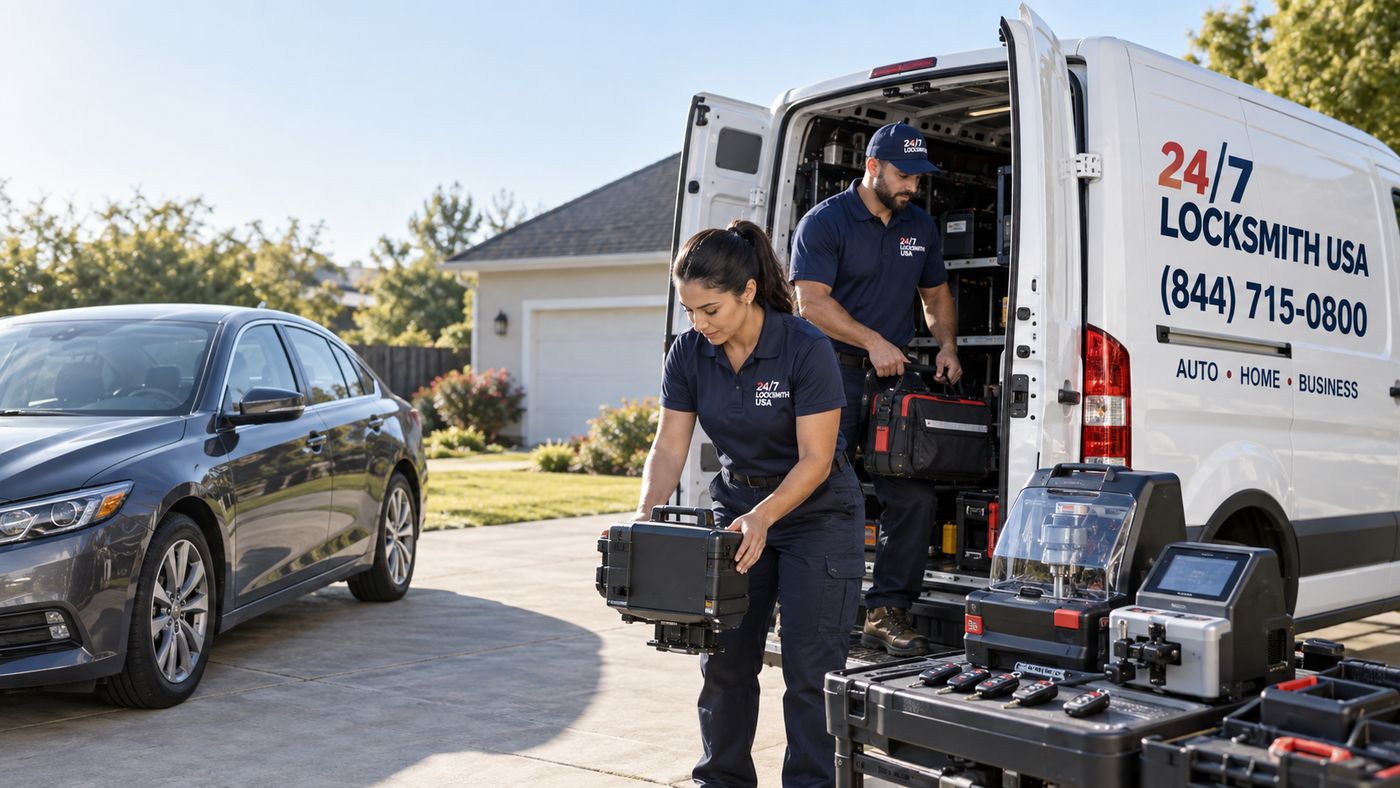
Today's vehicles are computers on wheels and most locksmiths haven't kept up. We invest in the same programming equipment the dealers use, so we handle the smart keys and immobilisers others turn away.
Dealer-level programming at a fraction of the dealer price
Transparent quote before any work begins
We come to you, home, office or roadside
Bonded, insured, and genuinely professional
Technicians dispatched in metros
Most domestic and import makes covered
Spare keys made before you need them
Car Key ReplacementLost or broken keys cut and programmed on site for most makes and models.
Key Fob & Smart KeysPush-to-start fobs, proximity smart keys and spare remotes programmed and tested against your vehicle's immobiliser.
Car LockoutsLocked out with the keys inside? We open the vehicle cleanly and without damage, any hour, and get you moving again.
0MAKES & MODELS
0DAYS A WEEK
0MOBILE SERVICE
0STATES DISPATCHED
Bonded & insuredCoverage carried on every mobile call, for your vehicle and your peace of mind.
OEM-grade toolingThe same class of programming equipment dealers use, loaded in the van.
No dealer towWe come to the vehicle. You skip the tow, the rental and the multi-day wait.
Coverage where you areTechnicians dispatched across major metros working to the same standards and the same upfront pricing.
How the job actually runs.
Tell us the car
Year, make and model. We confirm exactly what your vehicle needs.
Get a clear quote
An honest, upfront price. No games, no surprises on arrival.
We come to you
Your locksmith arrives with the right tooling already loaded.
Cut, coded & driving
Your key is made, programmed and tested before we leave.
What you can hold us to.
Not slogans, the specific commitments our technicians are held to on every call.
Year, make and model checked against our programming coverage first, so nobody is charged for a trip that could not succeed.
We confirm before we dispatch
You get the number over the phone, not after the technician is already standing in your driveway.
The price is quoted before we roll
A spare key made today costs a fraction of an all-keys-lost call made in a car park at midnight.
We recommend the spare
Who does the work.
Automotive Locksmith
KEYS & PROGRAMMING
Cuts and programs transponders, remotes and proximity smart keys at your vehicle using dealer-class equipment carried in the van.
Entry Specialist
Opens vehicles cleanly and without damage, then checks why the lock or latch behaved the way it did before leaving.
Dispatch
Confirms year, make and model against our programming coverage before anyone is dispatched, so nobody wastes a trip.
Coming to a driveway near you.
PhoenixRochesterMemphisMiamiTucsonAtlantaKnoxvilleJacksonvilleSavannahColorado SpringsDenverBuffaloNashvilleOrlandoTampaFort Lauderdale
Straight answers.
Can you make a key if I have lost every copy?
Yes. All-keys-lost is routine work for a properly equipped mobile locksmith. We originate a new key from the vehicle's own data rather than needing an existing key to copy, then program it to the immobiliser on site.
Is this cheaper than going to the dealer?
Usually, and the bigger saving is often the tow. A dealer generally needs the vehicle brought in; we come to the vehicle. You avoid the tow, the rental and the multi-day wait for a part to arrive.
Will a new key work with my push-to-start system?
Yes, provided the vehicle is supported by our programming equipment, which covers most makes and models on the road. We confirm your exact year, make and model before dispatching so nobody wastes a trip.
Why did my fob suddenly stop working?
Most often the battery, which degrades faster in hot climates. Beyond that, a fob that has been dropped repeatedly or exposed to water can lose its programming or suffer a cracked solder joint on the board. We test the fob before assuming it needs replacing.
Should I get a spare before I need one?
It is meaningfully cheaper. Programming a spare while you still hold a working key is a simpler procedure than an all-keys-lost origination, and it removes the emergency premium entirely.
Do you also work on homes and businesses?
Yes. The same technicians handle residential and commercial rekeys, lock changes and high-security cylinders.
No dealer tow. No multi-day wait. Keys cut and programmed at your vehicle.
Understanding the mobile locksmith model.
A closer look at how modern automotive locksmith work actually happens, what separates it from a dealer visit, and how to think through a key or lockout situation before you pick up the phone.
Why the modern car changed the locksmith trade
For most of the history of the automobile, a locksmith needed little more than a set of blanks and a cutting machine. A mechanical key was a piece of shaped metal, and duplicating one was a matter of tracing the cuts. That world is mostly gone. A vehicle built in the last two decades almost always carries a transponder chip inside the key head, a small radio component that talks to a receiver near the steering column. The engine will not start, no matter how well the metal cuts match, unless that chip is recognized by the vehicle's immobilizer system. Later still, manufacturers moved to proximity and push to start systems, where the key never touches a physical cylinder at all and the car simply senses that an authorized fob is nearby. Each of these steps forward in convenience and theft prevention also raised the bar for the equipment and the training a locksmith needs to carry. A shop that only owns a cutting machine cannot help you with a vehicle like this. Programming a transponder or a proximity fob calls for diagnostic and programming hardware that reads the vehicle's onboard computer, generates the correct security codes, and writes them into a blank key or fob. That is the equipment we carry on every mobile unit, and it is why we can meet a driveway lockout or a lost key call for the great majority of the makes and models currently on American roads.
What a mobile visit actually looks like
The idea behind a mobile locksmith is simple: instead of moving the vehicle to the shop, the shop comes to the vehicle. In practice that means a technician arrives with a rolling toolkit built around the same category of programming equipment used inside dealership service departments, along with cutting equipment, entry tools, and the small parts that commonly need replacing, such as key blanks, fob shells, and battery contacts. Before any of that happens, we ask for your vehicle's year, make, and model so we can confirm it is supported by our current programming coverage. This single step avoids the single most common source of frustration in this trade: a technician showing up only to discover the vehicle needs a tool or a code set the company does not carry. We would rather ask two extra questions on the phone than waste your afternoon.
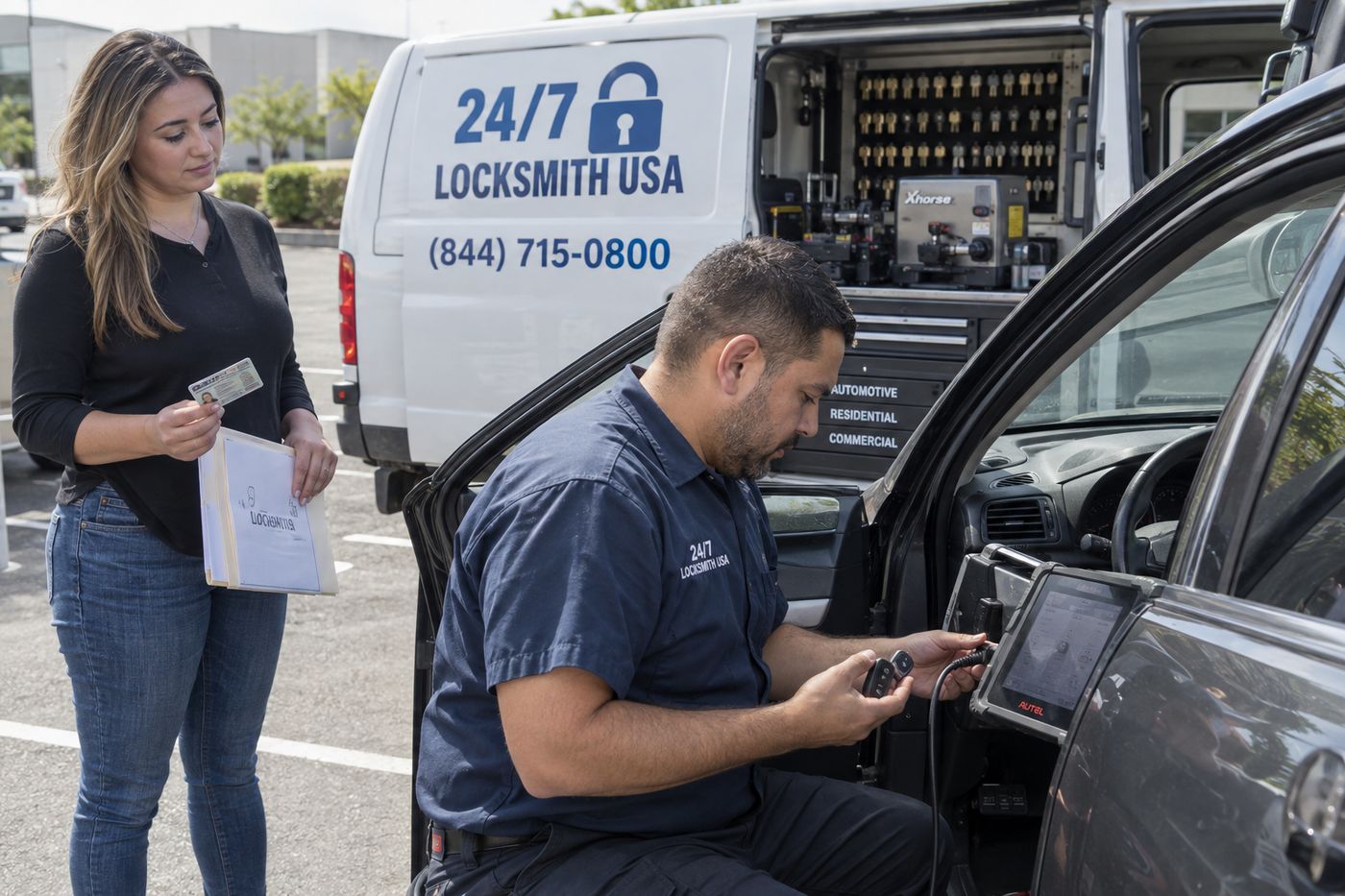
Once the vehicle is confirmed and a quote has been given, the technician travels to wherever the car actually is, a home driveway, an office parking structure, a shopping center, or the shoulder of a road. On arrival the first job is almost always to verify that the person requesting the work has a right to it. For a car this usually means a driver's license together with the vehicle's registration or a title showing your name. That check exists to protect you as much as anyone else. It is the same reason a stranger cannot call and have a technician cut a new key to a car they do not own. Once ownership is established, the technician moves to the actual mechanical or electronic work: cutting a blank to match the vehicle's lock code, extracting a broken key fragment from a cylinder, opening a locked door without damaging the frame or the window, or connecting programming equipment to originate and write a new transponder or smart key. Whatever the job, it is tested on site before the technician leaves. That means the key turns the ignition, the fob unlocks and starts the car, and any warning light related to the immobilizer has cleared.
Cars, trucks, and the growing list of key types
Ask ten people what a car key looks like and you will likely get ten different mental pictures, and all of them would have been correct at some point in the last thirty years. A basic mechanical key with no electronics is still found on older vehicles and on some entry-level trims of newer ones. A transponder key looks similar from the outside but has a small chip embedded in the plastic head; cutting the metal correctly is only half the job, since the chip also needs to be programmed to that specific vehicle. A remote head key combines the transponder function with buttons for locking, unlocking, and sometimes remote start, all molded into a single unit. A proximity or smart key drops the metal blade almost entirely for many vehicles, relying instead on the fob staying near the car so a push button start system can authorize the engine. Motorcycles, some trucks, and certain fleet and commercial vehicles introduce their own variations again. Because the underlying technology differs so much between these categories, the honest answer to "can you make a key for my car" is always "it depends on the year, make, and model," which is exactly the information we ask for before dispatching anyone.
Lockouts: more common, and more solvable, than people expect
A surprising number of people assume a lockout means a tow truck and a long wait, largely because that used to be true before mobile automotive locksmith services existed at meaningful scale. Today, the majority of lockouts on modern vehicles can be resolved without damaging the door, the window, or the weatherstripping, using tools designed specifically for the gap between the glass and the frame or for manipulating the door mechanism from outside. The exact method depends on the vehicle's door design, which is another reason our technicians ask for the make and model up front rather than guessing on arrival. Where a spare key already exists somewhere, sometimes the fastest and cheapest resolution is simply arranging for that spare to be brought to the vehicle rather than paying for entry and a new key at the same time. We will tell you when that is the more sensible option, even though it may mean less work for us on that particular call.
Ignition problems are usually mechanical, not electrical
When a key turns hard, sticks, or will not turn at all, the instinct is often to assume the fob's battery or programming has failed. In many cases the actual cause is mechanical wear inside the ignition cylinder itself: the small pins and springs that read the key's cuts wear down over years of daily use, or dust and old lubricant build up inside the cylinder and cause the tumblers to bind. A worn ignition cylinder can often be repaired or replaced without needing to replace the entire steering column assembly, which keeps the job faster and less invasive than it sounds. Our technicians diagnose before they quote, because an ignition that looks the same from the outside can fail for a mechanical reason, an electrical reason, or a combination of both, and the right fix depends entirely on which one it actually is.
Spare keys: the cheapest insurance most drivers skip
There is a meaningful cost difference between programming a spare key while an original still exists and originating a replacement after every key has been lost. When a working key is present, a locksmith can use it to authorize the new one through the vehicle's own system, a comparatively quick procedure. When every key is lost, the technician instead has to work directly with the vehicle's onboard computer to create a key from scratch, a more involved procedure that naturally costs more and takes longer. Because of that gap, a spare made on a calm afternoon is almost always the better financial decision than waiting for an emergency to force the issue, particularly for households with a single vehicle and a single key currently in circulation.
Residential and commercial work, beyond the car
Automotive work is the specialty most people associate with us, but the same technicians who program transponders and smart keys also handle the more traditional side of the trade. That includes rekeying a home's locks after a move so the previous occupant's keys no longer work, replacing worn deadbolts, installing keypad or smart locks, and helping homeowners who are locked out of their own front door. On the commercial side, we handle storefront lockouts, rekey work when staff turnover means old keys are floating around, and master key systems that let an owner or manager carry one key for many doors while employees carry keys limited to their own area. As with vehicles, we confirm ownership or authority to act for a property before opening anything or changing any lock, for the same reason we confirm vehicle ownership: it protects the person we are working for.
How to get a fair quote over the phone
The most useful thing you can do before calling is gather three pieces of information: the vehicle's year, make, and model (or the property type, if the call is about a home or a business), whether you have any working key or fob at all, and roughly where the vehicle or property is located. With that information we can usually tell you within the same call whether the job is straightforward, whether it needs a specific part, and what the honest price looks like before anyone is dispatched. We would rather spend an extra two minutes confirming details on the phone than have a technician arrive and discover the job cannot proceed as expected.
Let's get you driving.
One call, an honest quote, and a locksmith on the way with the right tooling.
Proof of ownership.
Before we open anything or change any lock, we have to establish that the property or vehicle is yours. This is not paperwork for its own sake. It is the reason nobody can call us and have your locks changed either.
Photo ID, matching the property or vehicle
Government-issued ID plus a document tying you to the address or the VIN, deed, title, registration, lease, utility bill or similar.
You must be there in person
We cannot open a property or change locks for someone who is out of state, out of the country, or sending a friend, a relative or a contractor on their behalf. No exceptions, however reasonable the request sounds.
Tenanted property, we cannot let you in
If the property is rented and the tenant is in possession, an owner cannot have us open it or change the locks. That is a matter for the courts, not a locksmith.
Evictions, the Sheriff must be on site
We carry out lock changes on an eviction only with the Sheriff physically present and the court paperwork in hand. We do not attend evictions on a landlord's word alone.
The same rule applies to vehicles
Car lockouts and key work require ID and proof the vehicle is yours, title, registration or equivalent. A key in your hand is not proof.
Commercial premises
Business lockouts require proof of ownership or documented authority to act for the business.
We may ask for documents before we dispatch
If anything about a request does not sit right, we will ask you to send ID and proof of ownership over the phone, before a technician leaves. If you are not willing to provide it up front, we will not attend. That is not suspicion of you personally, it is the same check that keeps anyone from doing this to your property.
If you cannot produce it, we will not open it, and we will still charge for the call-out, because our technician still traveled. Bring the documents and it is a two-minute conversation.