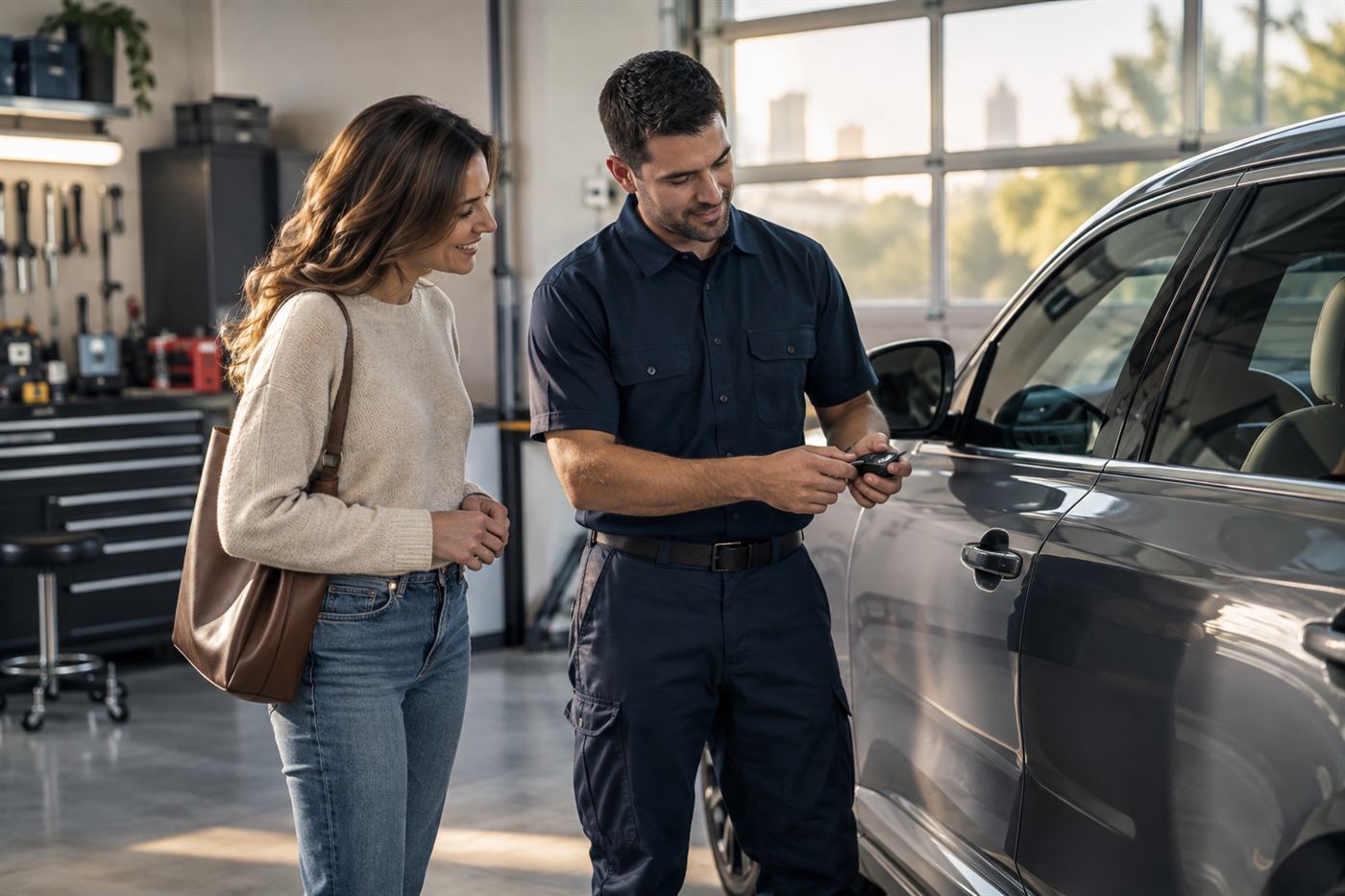
What makes a key smart
A smart key, also called a proximity key or keyless entry fob, communicates with the car by radio rather than by turning in a lock. Antennas in the doors and cabin send out a short range signal, and the fob answers when it is close enough. The car checks the answer, and if it is recognised, the doors unlock when you touch a handle and the engine starts when you press a button with your foot on the brake.
Most smart keys also hide a mechanical blade inside the fob. It slides out to open a door if the fob battery is dead or the electronics fail. A matching emergency slot or pocket in the car lets the system read a weak fob even when its battery is flat. Knowing where that slot is can rescue you from many stranded moments.
Because there is no ignition cylinder to turn, the car relies entirely on the exchange of information. That exchange is protected by encryption designed to prevent copying. It is good for security, but it makes smart keys more complicated to replace than the simple blades of past decades. A replacement needs proper equipment and, on some brands, extra authorisation steps.
Rolling security values and why they matter
Many smart key systems use a rolling exchange. Each time the fob communicates with the car, the information it sends is different, based on a sequence that both devices share. If someone records one exchange and tries to replay it, the car rejects it because the sequence has moved on. This is the main reason smart keys cannot be copied the way a simple blade can.
For a replacement key, that shared sequence has to be set up properly. The new fob must be introduced to the car so both agree on the starting point and on how the sequence will advance. This is not something that can be done with a simple copying tool. It needs diagnostic software that can talk to the car's security module and perform the matching procedure approved for that vehicle.
That is also why a smart key bought from an unknown online seller can fail. Some are poorly made imitations that do not follow the car's expected format, and some are used keys that were previously paired to another vehicle and cannot be reset. Read our page on aftermarket key problems for common patterns, and ask the technician before purchasing a fob yourself.
Signs your smart key is failing
Smart keys rarely die all at once. They usually give warnings. The car may not detect the fob until you hold it close to the door handle. A dashboard message may say that the key is not detected. The buttons may need a harder press or work only some of the time. The range may shrink so that you must be next to the car before it responds.
Often the cause is simply a flat battery, which is an easy fix. Our guide on how to change a key fob battery explains the process, and our page on key fob repair and battery help covers cases where a new battery does not solve the problem. If a fresh battery makes no difference, the board inside may be damaged, or the key may have lost its pairing with the car.
Physical damage also matters. A fob that has been dropped on concrete, sat on, soaked or exposed to extreme heat can develop cracks in its solder joints. These create intermittent faults that seem random. If a key starts behaving unpredictably, consider treating it as a warning. Replacing it before it dies completely is much easier than rescuing a stranded car.
- The car does not detect the fob unless it is held against the handle or start button.
- A dashboard message reports that the key is not found, or the battery is low.
- Buttons work sometimes and not other times.
- The fob has been dropped, soaked or left in a hot car.
- The range has shortened so that you must stand beside the car.
Why a smart key needs diagnostic tools
Replacing a smart key means writing a new identity into the car's security module, and each manufacturer protects that module in its own way. Some allow a new key to be added after a simple sequence, while others require a technician to connect software that requests authorisation. A few require a security gateway to be unlocked with an account held by the technician.
Working through these steps takes the right tools and the right access. A technician needs to know which procedure applies to your exact model and year, because they differ widely between brands and even between generations of the same model. This is why the first phone call includes questions about the vehicle, and why a quote may depend on the answers.
It also explains why some vehicles are simpler than others. A fob for an older push-button system may be programmed in minutes, while a recent luxury model may take longer and need extra checks. An honest technician will tell you where your vehicle falls. Our luxury car key replacement guide covers the more demanding end of the range.
Replacing a smart key when you still have one
If you still have one working smart key, replacement or addition is usually simpler. The existing key can often be used during the process, and the technician does not need to rebuild access from nothing. It is also the ideal time to add a spare, since the equipment is already connected. Our page on spare car key programming explains how adding a key works.
Bring the working key to the visit, and have the registration and photo identification ready. The technician will check the vehicle, confirm the key type, and perform the programming. Afterward, test all functions: unlocking from each door handle, locking, opening the trunk, starting the engine, and any remote features such as panic or remote start.
If a key is damaged but not lost, tell the technician. A damaged fob can sometimes be repaired by replacing the shell or battery contacts, which saves a full replacement. If repair is not possible, the technician can advise whether to remove the damaged key from the car's memory, so it cannot cause confusion later.
Replacing a smart key when every key is lost
When no smart key remains, the process is longer. The technician must confirm that you own the car, obtain the information needed for the new fob, and often work through the manufacturer's security procedure. Because there is no working key to authorise the process, some brands add extra steps or a waiting period. This is normal, and it does not mean something has gone wrong.
The car must also be accessible. If it is locked, the technician will first help you regain entry using approved professional methods, and then continue with the key. Mention in your call that the car is locked, and tell the technician where it is parked. A vehicle in a tight structure or behind a gate may need planning.
Our page on all keys lost car key service walks through the identification steps and the details a technician needs. Have the vehicle identification number ready, along with your registration and photo identification. These are the most common items that slow a visit when missing.
Smart key or phone key: knowing the difference
Some newer vehicles can use a phone or a thin card as a key, in addition to or instead of a traditional fob. These digital keys are managed through the manufacturer's app and account rather than by a physical programming procedure. A locksmith can help with the physical fob, but the digital keys are controlled by the account owner and the manufacturer.
This matters when you are planning for loss. If your phone is your only key and the phone is lost or the battery dies, a backup physical key becomes essential. Our guide on electric vehicle key cards and phone keys explains the backup options these vehicles typically offer.
Whatever type of key your car uses, keep at least one physical backup somewhere safe. Digital convenience is real, but a flat battery or a locked account is not an excuse the car will accept. A plain emergency fob in a drawer at home can save a long and frustrating day.
Protecting a smart key from relay theft
Smart keys have a known weakness. Thieves can use devices that extend the key's signal from inside a house to the car outside, tricking the car into believing the key is nearby. This is called a relay attack, and it has been reported in many places. It is not a reason to avoid smart keys, but it is a reason to store them thoughtfully.
Practical steps are simple. Keep keys away from the front door and from windows, so their signal is harder to reach from outside. Some owners store fobs in a metal box or a signal blocking pouch, which stops the radio exchange. Check whether your fob has a sleep mode that can be activated, and read the vehicle's owner manual for details.
If you suspect a key has been compromised, or a key is lost and might be found by someone else, ask the technician about removing it from the car's memory. Many vehicles support this. It closes the door on a missing key and is a worthwhile step whenever theft is a concern.
Emergency starting when a fob will not respond
If your fob is weak but not dead, most vehicles offer a backup way to start. Many have a marked spot in the center console, cup holder or steering column where you hold the fob against the start button or place it in a small tray. The car reads the chip through close contact, even when the battery is flat. Check the owner manual for the exact spot on your vehicle.
To enter the car, use the hidden mechanical blade. Slide the release on the fob, pull out the blade, and look for a small cover on the driver door handle. Pry the cover gently and the lock cylinder is behind it. This is the intended use of the blade, and it is the lawful way for the owner to enter their own vehicle. The car may sound an alarm when the door opens, and starting the engine usually silences it.
If none of this works, do not force parts or pry at panels. Forcing a handle or cover can break clips and cause damage that costs more than the key. Call for help, describe the symptoms, and a technician can tell you whether the fault is the fob, the car's antenna, or something else. If anyone is trapped inside a locked car, especially a child or pet, call 911 before anything else.
How a replacement visit is planned
Because smart keys involve more steps, a good visit starts with a good phone call. The dispatcher asks about the vehicle, how it starts, what the dashboard shows, and whether any key still works. These answers help decide which equipment to bring and whether the job can be done at your location. If a vehicle is likely to need extra steps, you should hear that before anyone is sent.
On the day, the technician will check identification and the registration, then inspect the car. They will confirm the type of fob, the frequency it uses, and how the car handles new keys. A new fob is prepared and then paired to the car with diagnostic software. Some systems accept the new key quickly, and others have timed delays or require multiple steps.
Allow reasonable time and keep the car accessible. Avoid leaving the engine running, and avoid opening and closing doors during programming unless asked. After the new fob is accepted, test it on every door, the trunk, the push button and any remote features. Ask for a spare while the equipment is connected, since it is easier to add one then than to book a second visit.
Smart keys on used and imported vehicles
A used car brings its own questions. You may not know how many keys the previous owner had made, and some may still be out there. A technician can check how many fobs the car recognises and remove any you cannot account for. This is a sensible step after buying any second hand vehicle with a smart key.
Imported vehicles can add further complications. A fob built for another market may use a different frequency or protocol, and the car may expect equipment that is not common locally. A technician can tell you quickly whether your vehicle is straightforward or likely to need extra preparation. Be ready to share the exact model and the vehicle identification number, so the right fob can be identified before the visit.
Older vehicles that were converted to push-button start by an aftermarket installer are another case. These conversions use their own fobs and wiring, which may not follow the car maker's system. Our page on remote start fob programming describes how aftermarket systems differ, and why a technician needs to know what was installed.
Getting started
When you call, give the make, model and year, describe how the car currently behaves, and say whether you have any working key left. Have your registration and photo identification ready, and the vehicle identification number if you can reach it. Our guide on finding your VIN shows the common places to look.
Quotes are given by phone only. A service call charge is explained before dispatch, and a complicated vehicle may need an on-site visit before a final quote is given. You will know the picture before anyone is sent to you.
Call when you are ready, and we will talk through what your vehicle needs and what the visit will involve.
Questions people ask
Can a locksmith replace a push-to-start smart key?
In many cases, yes. A technician with the right diagnostic equipment can program a new smart key to the car after confirming ownership. Some brands add extra security steps or require dealership level access. Describe your car when you call, and the dispatcher can tell you honestly what is likely for your make, model and year.
My smart key stopped working. Is it just the battery?
Often it is. A weak battery is the most common cause, and replacing it is a simple fix. If a fresh battery does not help, the fob may be damaged or may have lost its pairing with the car. Try the emergency slot or the spot where the car can read a weak fob before assuming the key is dead.
Why are smart keys harder to copy than regular keys?
They use encrypted two-way communication with a changing sequence shared between the fob and the car. A recorded signal cannot simply be replayed, and a new key must be introduced to the car through proper diagnostic procedures. That protects against theft, but it also means replacement needs dedicated equipment rather than a simple cutting machine.
What if I have lost every smart key for my car?
The job is longer but usually still possible. The technician confirms ownership, obtains the information needed for the new fob, and works through the manufacturer's security procedure. The car must be accessible, and some brands add waiting periods. Have your registration, photo identification and VIN ready before you call.
Can I use a smart key I bought online?
It is risky. Some are poor imitations that do not follow the car's expected format, and some are used keys previously paired to another vehicle that cannot be reset. Talk to the technician before buying one. They can often tell you whether a particular fob is suitable and which kind they would use instead.
Should I remove a lost smart key from the car's memory?
If there is any chance someone else could find it, yes. Many vehicles let a technician remove a missing key during programming, so it can no longer start the car. Ask about this when you book, since not every vehicle supports it in the same way, and it is easier to arrange during the visit.
Describe the situation by phone and we will tell you what the job involves. Quotes are given by phone. Jobs that cannot be quoted without seeing them need a technician on site, and the service call charge is explained on the phone before anyone is dispatched.
(844) 715-0800Related pages
Written by Claude (AI) (AI) for 24/7 Locksmith USA.