
Key Services Across Mesa
Ballpark lots, resort parking pads and suburban driveways, all served by a technician who comes to you.
Stadium Lot Key Origination
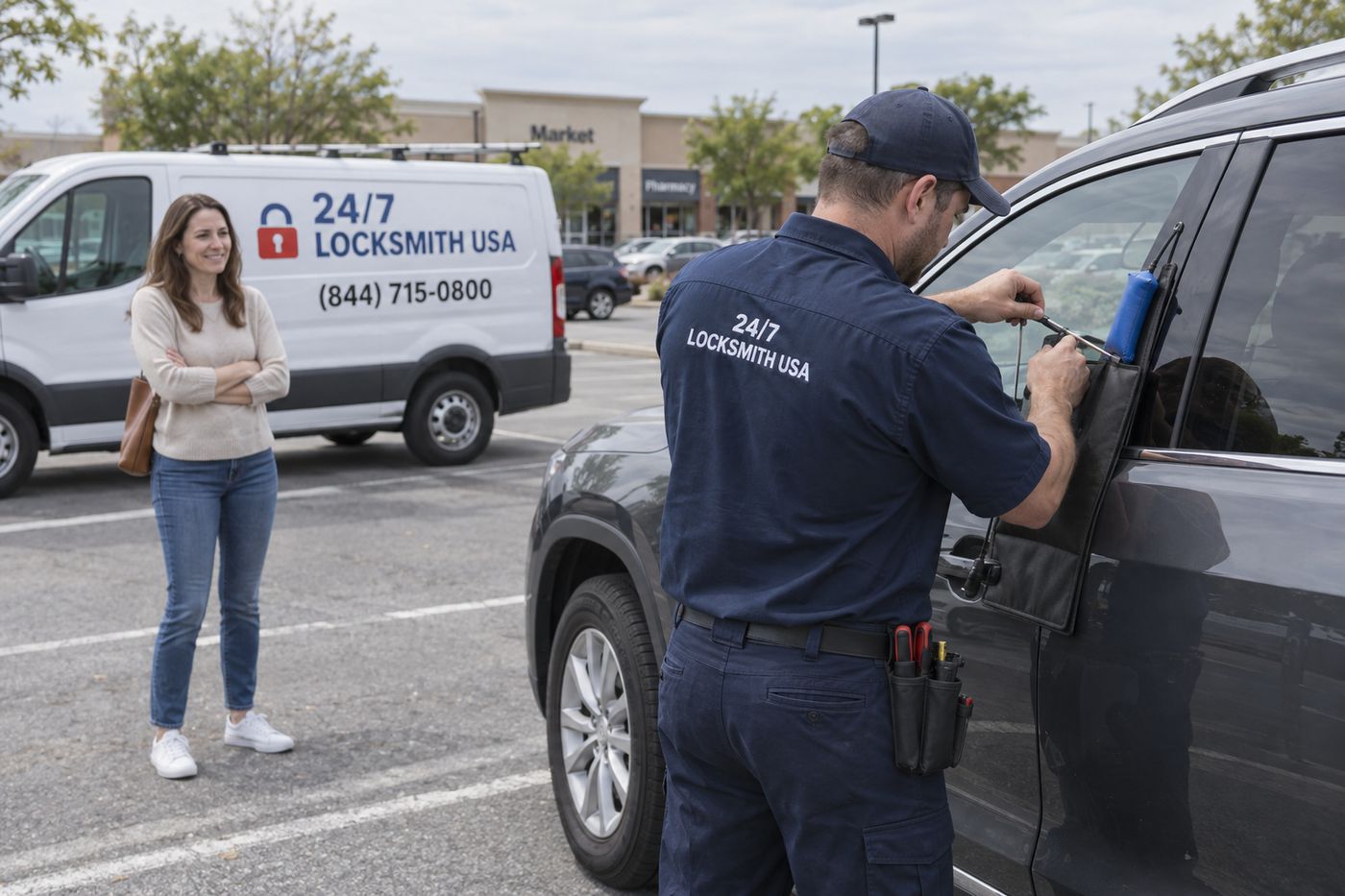
A key lost during a spring training afternoon is replaced right there in the lot instead of leaving the car overnight.
Stored Vehicle Immobiliser Relearn
Cars waking up after a season parked at an east Mesa resort get the security system brought back into a state that accepts a key.
Remote Head Key Replacement
Combined key and remote units for the family sedans around Dobson Ranch are cut, coded and tested together.
Proximity Fob Replacement
Push-button SUVs in Eastmark and Las Sendas get a new smart key paired without a service appointment.
Ignition Lock Replacement
Worn cylinders on high-mileage commuters that run the Superstition Freeway daily are replaced and keyed to match.
Towing Rig and Trailer Vehicle Keys
Trucks that spend the season pulling toy haulers out to Usery Pass get spare keys coded before the next trip.
Mesa Parking, Storage and Season Cycles
The thing that defines Mesa for this work is the sheer size of its parking. Sloan Park and Hohokam Stadium empty tens of acres of surface lot within an hour of the last out, and a key dropped between seats or into a gravel overflow row is not going to be found that afternoon. Meanwhile the driver is stranded in a lot that clears out around them, often in a rental or a vehicle borrowed from family. The city's other signature is the winter resort belt along the Superstition Freeway and out toward Apache Junction, where park-model communities host thousands of visiting vehicles from October through April. Those cars come off the trailer or out of a covered space after months of sitting, and a vehicle that has not turned over since spring behaves oddly: the 12-volt is flat, the security system has lost its learned state, and a key that worked perfectly last season gets rejected. That is a relearn problem, not a key problem, and it needs to be sorted in that order. East Mesa also runs long distances to anything resembling a dealer service department, which is why so much of this work happens in the driveway or the resort parking pad.
What desert sun does to a car key
A car parked in the Arizona sun can become dangerously hot inside, and anything left in it is exposed to that heat for hours. Plastic key cases can warp or crack. Adhesives loosen. Small batteries lose strength, and the rubber pads on remote buttons can turn tacky or brittle. A fob that spent three summers on a dashboard may look fine on the outside and still be on the edge of failing.
This page is general guidance for people in Mesa. It does not describe any particular street, neighborhood or building, and it makes no claim about local conditions beyond the well known fact that the region is hot and dry. The practical lessons follow from that fact: keep the key out of direct sun, replace weak batteries early and do not wait for a fob to quit completely before you act.
If your key has begun to act strangely, treat it as a notice rather than a nuisance. A button that needs two presses, a remote that works only from a few feet away or a case that rattles when you shake it all point to wear. A key checked while it still works can be copied, repaired or replaced on your schedule. A key that has already died forces a decision in the worst possible setting.
Locked out under a hot sun
The most urgent kind of key emergency in a hot place is a lockout with someone inside the car. A closed vehicle heats up much sooner than most people expect, and a child, an animal or an unwell adult inside is in real danger within a short time. If that is your situation, call emergency services first, and do not wait for any other kind of help.
If nobody is inside, the situation is an inconvenience rather than an emergency, but you should still protect yourself. Find shade, drink water if you have it and keep your phone charged. Do not stand on hot asphalt for long. Tell the provider where you are and whether you are waiting at the car or somewhere nearby. The page on car lockout service describes the process in detail.
Resist the urge to force the door. Modern doors contain wiring, sensors and sometimes side airbags, and a wedge or a rod can damage them. A trained technician uses methods intended to open the vehicle without harm. They will also confirm that you are the owner or are authorized, which requires identification and a document connected to the car, so think about where yours are.
Getting your documents in order
Providers check ownership before opening a car or making a key, and that check is a protection for you. If you are asked for a registration and the registration is in the car, think about other proof: a photo on your phone, a digital insurance card, a lender statement, or a family member who can send a picture. Requirements vary among providers, so ask what they accept.
Photo identification is the other basic item. Make sure it is with you, not locked in the car with your wallet. If it is, ask whether any other form of identification would work. Our guide to proof of ownership for a car key describes common cases, including leased and financed vehicles.
If the vehicle belongs to someone else, such as a parent, an employer or a friend who lent it, the owner may have to be involved. A short phone call from the owner to the provider, or a note with the owner's information, can resolve it. Plan for that conversation before the technician arrives, because a missing connection between you and the car can stop the visit.
Reading the VIN and describing the key
Most replacement keys begin with the vehicle identification number. It is a seventeen character code on a plate at the lower corner of the windshield, on a sticker at the driver door jamb and on your registration and insurance documents. Having it ready speeds the call. Read it back carefully, because certain letters and digits resemble each other.
The key itself also needs a description. A key with a plain metal head is simpler than one with a plastic head that hides a chip. A key with buttons is a different job from one without. A push button car uses a smart key. If you are unsure what you have, look for a blade, for buttons and for a thick plastic head, and describe each one as you see it.
Add the year, make and model, and mention anything odd about the vehicle. Has it been modified? Has the ignition been replaced? Has an aftermarket remote start been installed? These details affect the approach. Add on systems such as a remote starter can complicate key work, and telling the provider in advance helps them bring the right equipment.
Programming, copying and the case of all keys lost
If you still have one working key, a copy can be made using that key as a reference. The blade is cut, the chip is programmed and the remote is paired. The work is usually simpler than starting from nothing. If every key is gone, the vehicle number and proof of ownership become the starting point, and the process takes more steps.
The page about all keys lost explains that case, and the page on transponder key programming describes how the car learns to accept a new key. Both are worth reading if you want to understand the quote you are given.
A word about the old key: if one was lost, ask the technician whether it can be removed from the car's memory during programming. On many vehicles it can, which means a lost key cannot start the engine even if someone picks it up. The details depend on the car, so ask about your own. If you suspect the key was stolen, mention it, since that changes the urgency.
Dust, monsoon storms and cars that sit for months
Dry places have their own hazards. Fine dust gets into locks and ignition cylinders, and it mixes with sweat and oils to form a gritty film. A lock that was smooth in spring may be rough by late summer. Monsoon storms add sudden rain and wind blown dirt, and a key pulled from a wet pocket carries moisture into the cylinder.
If a lock starts to feel stiff, do not force the key. Forcing can bend the blade or snap it off. Avoid spraying random oils into the cylinder, because some attract more dust. A technician can clean or service the lock correctly. The page about a car key that will not turn lists the common reasons and what to try.
Storms can also soak a fob. If your key gets wet, avoid pressing the buttons and let it dry in open air. Do not use heat to speed it up. Tell the technician what happened if you call. A soaked fob sometimes recovers, but only if it has time to dry and is not powered while damp.
Some residents spend only part of the year in town, and some visitors arrive for the mild winter. A car that sits unused for months can develop key problems of its own. Key fob batteries drain, car batteries go flat, and a fob that has not been used may need a fresh battery before it responds at all.
If you are returning to a car that has been parked for a long time, replace the fob battery first and check the car battery. A dead car battery can make a working key look broken, because the car cannot power its receiver. The page on a car that will not unlock with the fob explains the usual causes in order.
If you keep a car at a second home, leave a spare key with a trusted person nearby and write down the vehicle details for them. That way a lost or dead key does not strand you on arrival. Be cautious about hiding a key on the vehicle, since a hidden key can be found by the wrong person and can fall off in transit.
Shared driveways, apartment lots and property rules
Many people live in apartments, townhomes or communities with shared parking. Those places often have rules about who may work on a vehicle on the property, and about towing and guest parking. If you need a locksmith on a property that is not yours, check what the management allows before the visit.
Requirements vary from one property to another, so ask the office or the security desk. A call before the technician arrives is better than a surprise at the gate. If the property has a gate code or a guard, give the provider the information they need to enter, and tell them where in the lot the car is found.
The same applies to your home locks. If your house key was lost along with the car key, think about rekeying, and ask your landlord first if you rent. The page on lock rekey service explains the idea. Property managers should keep a record of any lock changes so that residents and staff know which keys are current.
What a good visit looks like from start to finish
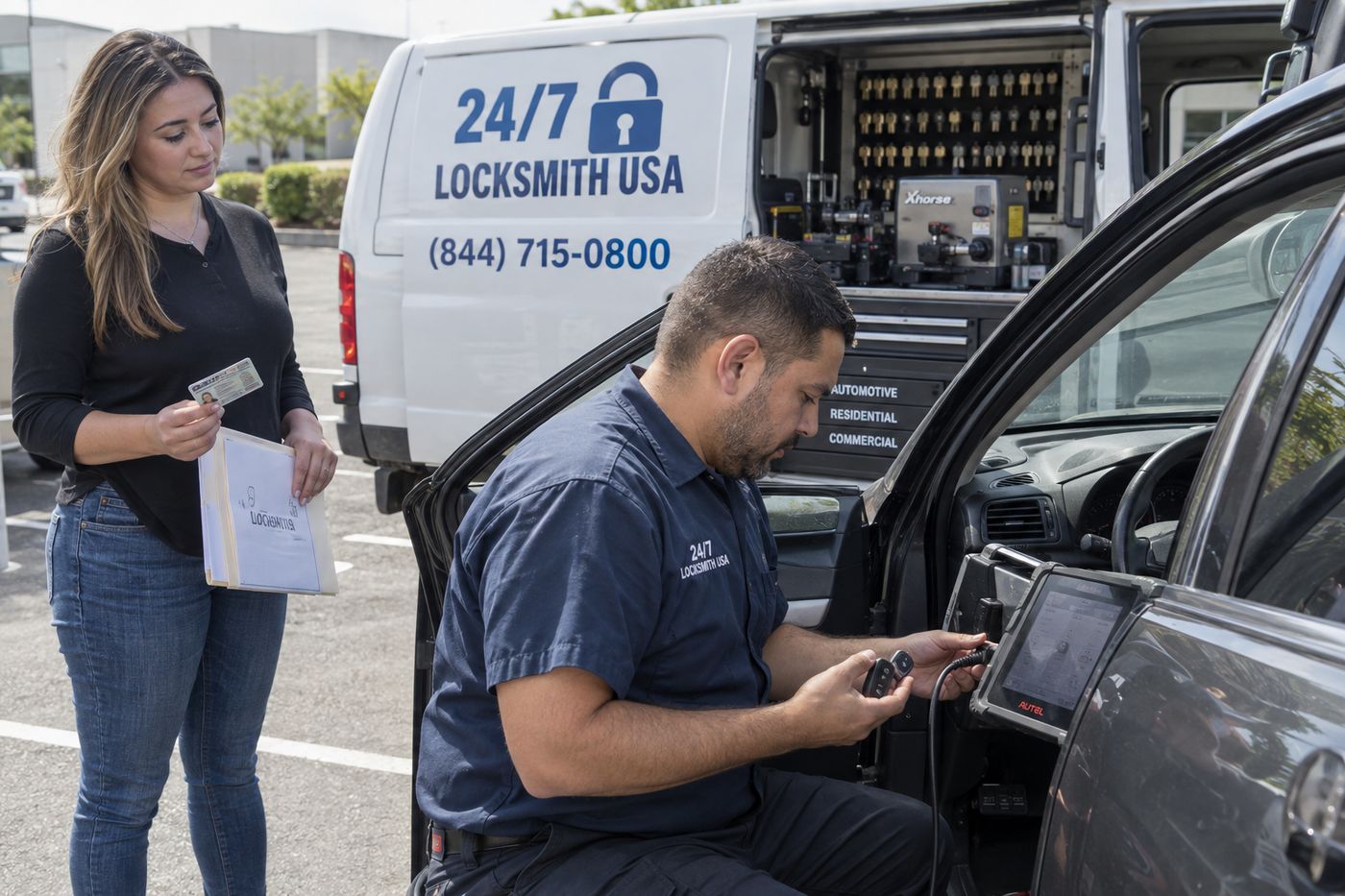
Picture the visit in order, because knowing the order removes a lot of worry. First comes the call, where you describe the vehicle and the key, give your location and receive a quote that includes the service call charge. Next the technician arrives, introduces themselves and asks to see identification and a document tied to the car. They may also compare the VIN on the vehicle with your papers.
Then the work begins. The blade is cut if one is needed. The key is programmed to the car using equipment connected to the vehicle, and the remote is paired if it has buttons. During this stage, stay close but do not crowd the technician, and ask questions if you wonder what a step is for. Most professionals are happy to explain, since an informed customer is an easier customer.
Finally, you test. Lock and unlock the doors with the key, start the engine, shut it off and start it again, open the trunk and try every remote button. Ask whether older keys have been removed from the car's memory, ask what to do if a problem appears later, and keep your receipt. If something does not work, say so at once, while the technician is still beside you and the cause is easiest to find.
Mobile service or the dealership
There are two main routes to a new key. A mobile provider comes to your location and often finishes the work at the car. A dealership uses factory tools but generally needs the vehicle brought in, which can mean a tow if you have no key. Each route has a place, and the right one depends on the vehicle and the situation.
Some newer or unusual models restrict who can program a key, and for those the dealer may be the only option. Most common vehicles, however, are handled by mobile technicians routinely. The page on dealership versus locksmith keys sets out the factors, and it is worth reading before you decide.
Whichever you choose, ask clear questions. Ask whether the work can be done where the car is, what the quote includes, what documents you need and what could change the total. Write down the answers. A provider who explains plainly deserves your attention, and one who dodges the questions deserves a second look.
Staying clear of trouble
Stressful moments attract bad actors. A very low advertised price, no clear business name, a refusal to explain the service call charge and pressure to decide immediately are all signals to slow down. None of them proves wrongdoing alone, but together they should make you cautious.
Read the guide on how to spot a fake locksmith and the explanation of the service call charge before you call if you can. Both take a few minutes and give you vocabulary for the conversation. A phone quote should be clear, and the service call charge should be explained before anyone is dispatched.
On arrival, confirm that the person matches what you were told and that the quote has not changed without explanation. If something is wrong, you may decline before work starts. Keep your keys and papers in your hands until you are satisfied. Waiting for a different provider is inconvenient, but it is usually less costly than a bad job.
Planning ahead for the next hot summer
After you have a working key, use the opportunity to improve your setup. Make a spare and store it at home. Replace the fob battery on a schedule. Keep the fob out of the sun, and think about a small pouch to protect it. Take a photo of your registration and VIN and save it on your phone.
If you drive to other cities, you may find the pages for Phoenix and Chandler useful, and the Arizona overview gathers general guidance in one place. Rules and requirements vary, so ask when you call.
The goal of all this preparation is to turn a possible emergency into a small, manageable errand. A key problem is common, understood and solvable. With a calm head, a few facts and the right questions, you can handle it and get back to your day without losing more than you have to.
Finally, remember that sun and heat are not the only teachers here. Most key trouble begins with a small habit: a fob left in a cup holder, a spare that was never made, a battery that was never replaced. Each habit is easy to change once you see it. Choose one this week, such as making a spare or storing the fob in a pouch, and the next key emergency will probably be smaller, calmer and shorter than this one.
Common questions
Can desert heat really make a key fob stop working?
Heat can warp the case, loosen the glue that holds it together and weaken the small battery inside. A fob left on a dashboard through a summer is especially at risk. Keep it out of direct sun, replace the battery when range fades and have a spare made while the original still works.
What should I do if a child or pet is locked in a hot car?
Call emergency services immediately and say exactly where the car is. A closed vehicle heats up much sooner than most people expect, and a locksmith visit is not the right first step. Stay near the car and follow the instructions the emergency operator gives you.
I returned to a car that sat for months and the fob is dead. What now?
Replace the fob battery first, then check whether the car battery is also weak, since a flat car battery can make a good key seem broken. If both are fine and the key still fails, it may need reprogramming. Ask a technician to test it.
Can I get a key made if I live in an apartment complex?
Usually yes, but the property may have rules about outside service providers. Ask the office or security desk what is required, give the provider any gate instructions and tell them where the car is. Rules vary by property, so confirm before the visit.
Will the quote include programming?
Ask directly. A good quote lists the key, the cutting, the programming and the service call charge, and explains what could change the total. If the vehicle uses a chip or a smart key, programming is part of the job. Get the figures by phone before anyone is dispatched.
How do I know which key I have?
Look at the head. A plain metal key suggests cutting only. A thick plastic head usually holds a chip and needs programming. Buttons mean a remote that may need pairing. A push button start car uses a smart key. Give the year, make and model on the call, and the provider can confirm.