MOBILE SERVICE · 24/7 DISPATCH
On-siteWE COME TO YOU
Most makesDOMESTIC · IMPORT
UpfrontHONEST PRICING
LocalTECHNICIANS NEAR YOU
The Lockout Calls We Actually Get
Most lockouts are mundane: keys visible on the seat, a fob left in a gym bag in the trunk, an automatic-locking door that closed itself while you loaded the roof rack at a gas station outside Amarillo. Some are not mundane at all. A child buckled into a car seat with the doors locked, or a pet in a closed car, is an emergency, those calls move to the front of the queue, are handled with urgency and calm, and if a child is in visible distress we will tell you plainly on the phone to call 911 first, because glass is replaceable and a child's safety outranks a window. Between those poles sit the awkward cases: a trunk that latched with the only fob inside on a vehicle whose rear seats don't fold, a broken handle on the only unlocked door, keys locked in a car that is still running. Each category has an established professional answer. What they share is this: the fastest safe route into a locked vehicle is a trained technician with purpose-built tools, and the slowest, costliest route almost always begins with someone improvising in a parking lot.
How Professional Entry Actually Works
We won't publish a manual for opening cars, but honesty about the categories is fair. The first and cleanest approach works through the keyway itself: an automotive locksmith can pick and decode a door lock, and on many vehicles can go one step further and generate a working key from what the lock reveals, an entry method that touches nothing except the component designed to be touched. The second family of techniques works with the door and its engineered clearances, using protective guards, controlled spacing, and purpose-designed reach tools to operate a control the driver would normally press. These are refined versions of what improvised wedges crudely imitate, with the critical difference that the technician knows each model's tolerances, where its wiring and airbag curtains run, and how much a seal can take before it deforms. Third, some situations are best solved without touching the door at all: trunk-only lockouts on vehicles with isolated cargo areas, deadlocked European models that disable their interior handles, and certain electronic failures are answered by making a key rather than reaching inside. Which category applies is a judgment call made at the vehicle, by someone who has stood in front of that exact make and model many times before.
What the Internet Tricks Actually Cost You
The coat hanger, the shoelace loop, the inflatable wedge kit from an online marketplace, every one of these damages vehicles daily, in ways their owners discover weeks later. A hanger fished blindly down inside a door doesn't find the lock rod so much as everything else: it scratches the inner glass, gouges protective coatings, and bends the linkage so the lock works intermittently forever after. Wedges force a gap the door frame was never engineered to hold; the weather seal stretches and never quite seats again, which shows up later as wind noise on the highway and a damp carpet after the first hard rain. Prying at the frame chips paint at the pressure points, and paint damage on a door edge invites rust. On modern vehicles, the top of the door sits close to side-curtain airbag hardware and wiring runs that a blind probe can find. Slim-jim-style tools are worse still on late-model cars, whose doors are dense with electronics precisely where the tool travels. None of this is an argument that your car is a fortress, it is an argument that the clean opening is the one performed by someone who knows exactly where everything inside that specific door lives.
What Determines the Scope of the Job
Lockouts vary more than people expect, and a few factors set the shape of the work. Vehicle design comes first: some models yield to keyway decoding, while others, deadlocking systems on certain European makes, for example, which disable the interior handles entirely, close off whole categories of technique and point straight toward key generation. Where the keys sit matters: keys in the cabin are the simple case; a fob sealed in a trunk with no folding seats and no cabin release is its own problem class. The situation matters most of all: a child or pet inside reorders everything, and an engine left running adds urgency of a different kind. Weather and location play their part, a frozen lock on a subzero morning, a vehicle on the top level of a dark parking structure. None of these variables change the standard the job is done to; they change the tools and the sequence. When you call, describe what you can see: where the keys are, whether every door is locked, whether anyone is inside. The dispatcher uses exactly those details to send the right technician with the right equipment the first time, which is how a lockout stays a small event instead of becoming a story.
Dispatch, Priority Calls, and Proving It's Your Car
Every call begins the same way: location, vehicle, situation. Calls with a child or animal inside are flagged as priority and handled accordingly, with speed, care, and the plain advice to involve emergency services if anyone inside is in distress. For everything else, a local technician from our technician network is dispatched around the clock; lockouts do not keep business hours and neither do we. Then comes the step that protects you: verification. No vehicle is opened and no keys are handed over until the technician has matched a photo ID to proof of ownership, registration, title, or insurance card. We know the paperwork is often locked inside the very car in question; that is routine, and the check is completed against those documents the moment the door is open, before the keys are released. A locksmith who will open any car for anyone standing beside it is a burglary tool with a phone number. Ours are not. The visit ends with the door open, the keys in your hand, the seals and paint exactly as they were, and, if the lockout revealed a worn key or a dying fob doing the locking on its own, an honest word about it before we leave.
Who does the work.
Automotive Locksmith
KEYS & PROGRAMMING
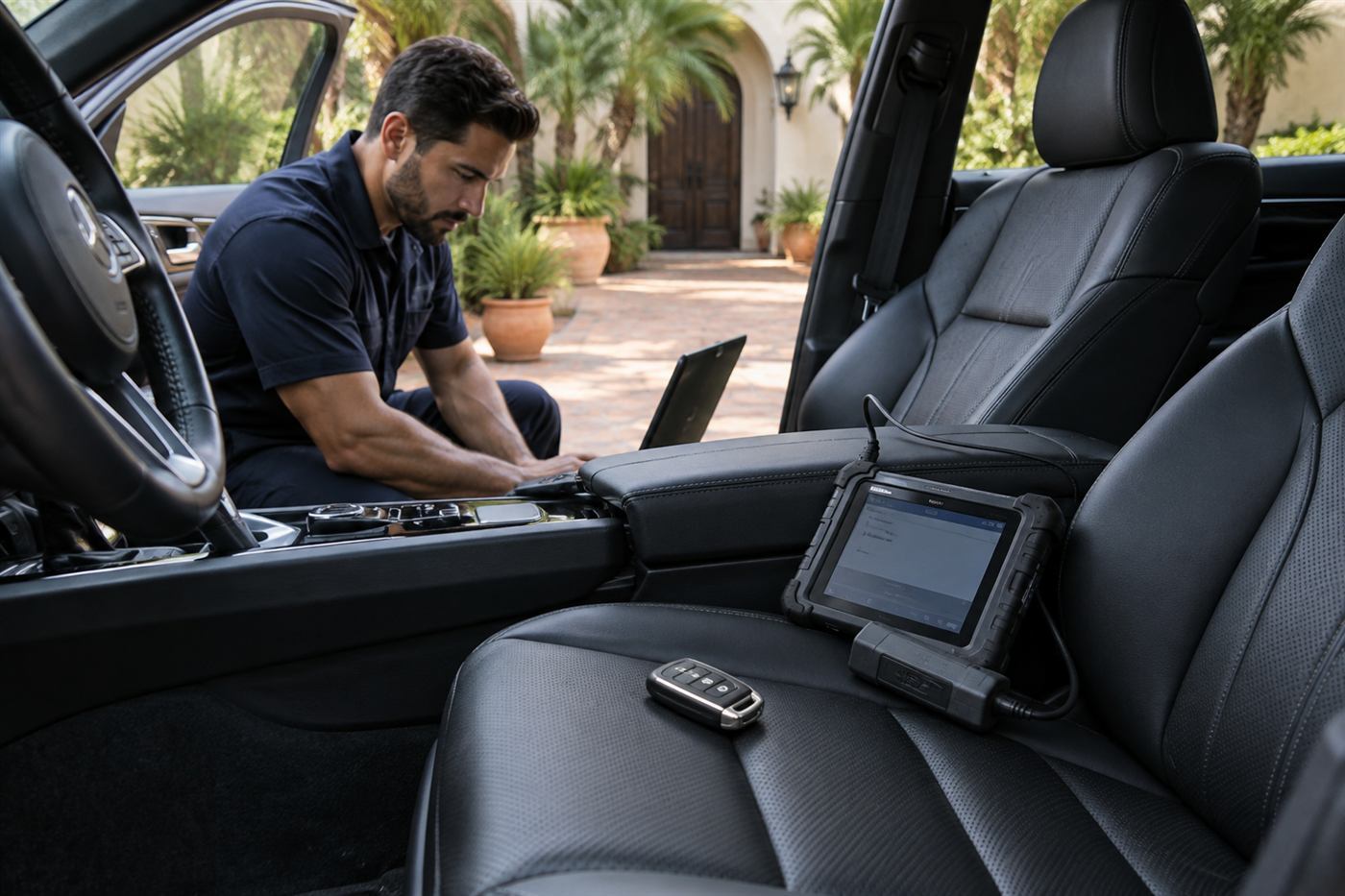
Cuts and programs transponders, remotes and proximity smart keys at your vehicle using dealer-class equipment carried in the van.
Entry Specialist
Opens vehicles cleanly and without damage, then checks why the lock or latch behaved the way it did before leaving.
Dispatch
Confirms year, make and model against our programming coverage before anyone is dispatched, so nobody wastes a trip.
Car Lockout Service, straight answers.
My child is locked in the car, what should I do?
Call us immediately at (844) 715-0800 and say a child is inside; those calls are prioritized. If the child is in distress, in extreme heat, or unresponsive, call 911 first, emergency crews are right to break a window, and glass is trivially replaceable. Stay at the vehicle, keep the child calm and in view, and have someone flag the technician in when they arrive.
Can you open my car without damaging it?
Yes, non-destructive entry is the entire discipline. Technicians use model-specific techniques, protective guards, and tools designed for each vehicle's clearances, and the standard is that seals, paint, glass, and linkages are left exactly as found. In rare edge cases where a vehicle's condition makes clean entry doubtful, the technician explains the options before touching anything, not after.
The keys are locked in the trunk. Is that harder?
Sometimes. On many vehicles the trunk is reachable once the cabin is open, through a release or folding seats. Vehicles with isolated, deadlocked cargo areas are a different problem class, often solved by generating a working key instead. Tell the dispatcher the keys are in the trunk and the model you drive; that single detail changes what equipment rides along.
How do you know the car is actually mine?
We verify before we hand it over. The technician matches your photo ID against the vehicle's registration, title, or insurance card. If those documents are locked inside, very common, verification is completed as soon as the door is open, before the keys are released. If the vehicle belongs to your employer or a family member, mention it when you call and dispatch will explain what works.
My car locked itself with the engine running. Why?
Many vehicles auto-lock when they sense the fob outside the cabin, when a door closes on certain models, or after a timer, and a fob with a weakening battery can be misread as absent, so the car locks believing no key is nearby. It is a common call and a straightforward opening; mention that the engine is running so the call is sequenced appropriately.
Should I try a coat hanger or wedge kit while I wait?
We would genuinely rather you didn't. Improvised tools regularly bend lock rods, tear weather seals, chip paint, and scratch glass, damage that costs far more to put right than the lockout itself, and much of it invisible until the first rainstorm or highway drive. A locked car with no new damage is a quick professional job. Leave it that way.
Do you handle all vehicles, trucks, motorcycles, RVs?
Passenger cars, pickups, SUVs, vans, and most commercial vehicles are routine. Motorcycles, RVs, and heavy trucks vary by model, and some fleet vehicles carry aftermarket locks that change the approach. Tell the dispatcher exactly what you are locked out of; if a specific vehicle falls outside a technician's tooling, you will hear it on the phone, not at the curb.
Preventing the Next One
A car lockout is rarely a one-time event for the same household, and a few small habits genuinely reduce how often it happens again. Keeping a spare key somewhere other than inside the vehicle, at home, with a family member, or in a wallet rather than a glovebox, means a lockout becomes a short delay rather than a service call at all. For vehicles with a keypad built into the door, a feature still common on several manufacturers, setting and actually remembering that code turns a locked door into a non-event. On newer proximity key vehicles, understanding how your specific model behaves when the fob's battery runs low is worth five minutes with the owner's manual, since some models auto-lock more aggressively as a security response to a fob it can no longer reliably detect, which is precisely the scenario described elsewhere on this page. None of this eliminates lockouts entirely, since a fob still ends up in the wrong bag or a door still closes at the wrong moment regardless of preparation, but each habit shortens the list of ways it can happen.
Motorcycles, RVs, and Fleet Vehicles
Not every lockout involves a standard passenger car, and the approach genuinely differs by vehicle type. A motorcycle typically has a simple mechanical lock on the ignition and sometimes a separate one on a seat compartment or top case, and entry generally means addressing that specific cylinder rather than anything resembling a car door technique. An RV or camper often has residential grade door hardware, sometimes literally the same locks found on a house, alongside a separate ignition system for the cab if it is a motorized unit, and a technician needs to know which part is actually locked before arriving, since the tools for a residential deadbolt differ from anything used on a vehicle door. Commercial and fleet vehicles introduce their own wrinkle: some carry aftermarket security upgrades installed by the fleet operator rather than the original manufacturer, and a driver locked out of a company vehicle should mention that upfront, along with who to contact for ownership verification if the driver's own name is not on the registration.
Rental Cars and Borrowed Vehicles
A lockout on a rental car carries its own wrinkle, since the rental agreement often specifies who to call first and what the company will or will not cover, and checking that paperwork or the key tag before calling an independent locksmith can save a step. We are still able to help with a rental lockout once ownership through the rental agreement is established, and doing so is often faster than waiting on a rental company's own roadside line, particularly outside normal business hours. A borrowed vehicle, a friend's car or a family member's truck, works similarly: as long as the registered owner can be reached to confirm the situation, or the borrower can produce the vehicle's registration alongside their own identification, the lockout proceeds the same as any other call. Mentioning that a vehicle is a rental or a borrowed car when you first call simply lets the dispatcher ask the right follow up question before a technician is already on the way.
Weather, Timing, and Why Lockouts Cluster
Lockouts do not happen evenly throughout the year or the day, and there are practical reasons behind the pattern. Cold snaps bring a wave of calls involving frozen door seals or locks that have iced over just enough to resist a key that would otherwise turn fine, and a driver assuming the lock itself has failed is often dealing with ice rather than a mechanical problem. Extremely hot stretches bring their own version, since a fob left in direct sun on a dashboard can overheat enough to stop transmitting reliably, occasionally leaving a driver locked out of a car whose fob is sitting in plain view on the seat. Weekend mornings and the period right after a holiday gathering also see a predictable bump, simply because more people are handling car keys under more distracting circumstances than during a normal weekday commute. None of this changes how a lockout gets resolved, but understanding the pattern is part of why we staff for around the clock coverage rather than treating a locked door as a rare event that only happens to unlucky people.
If you notice your own lockouts cluster around a specific season or situation, that pattern is worth acting on directly. A driver who keeps losing a fob to summer heat might switch to carrying it in a bag rather than leaving it on a hot dash, while someone who keeps getting caught by winter ice on a specific door might simply start using a different entry point until the weather turns, small adjustments that genuinely cost nothing at all and quietly prevent the next call from ever happening again in quite that exact same annoying way ever twice in a row again anytime soon after that first time.
Locked Out? Stay Put, Help Is Rolling
Call (844) 715-0800, tell us where the car is and where the keys are, and a technician will open it cleanly and hand them back, any hour, wherever you are.
Describe the situation by phone and we will tell you what the job involves. Quotes are given by phone. Jobs that cannot be quoted without seeing them need a technician on site, and the service call charge is explained on the phone before anyone is dispatched.
(844) 715-0800Related pages
Written by Claude (AI) for 24/7 Locksmith USA.