NEW YORK · STATEWIDE MOBILE DISPATCH
On-siteWE COME TO YOU
Most makesDOMESTIC · IMPORT
UpfrontHONEST PRICING
LocalTECHNICIANS NEAR YOU
What New York does to car keys.
New York is really two automotive climates wearing one license plate. Downstate, the enemy is circulation: cars live at curbs and in stacked garages, keys travel through trains, taxis, offices and bar tops all day, and the distance between an owner and a lost key is measured in boroughs. Alternate-side rules mean a keyless car does not just sit, it accumulates tickets and eventually a pound tow, which turns a small emergency into an administrative one. Upstate, the enemy is the sky. The Erie and Ontario snow belts drop lake-effect by the foot, municipalities answer with brine and rock salt in quantities few states match, and the freeze-thaw rhythm of a Great Lakes winter pumps salted meltwater into keyways, door cylinders and ignition barrels from November to April. Corroded wafers, seized cylinders and blades snapped by drivers forcing frozen locks are seasonal certainties in Buffalo, Rochester, Syracuse and Albany, not rarities. Westchester splits the difference, a commuter county whose late-model, proximity-key fleet stands outdoors at rail stations all day, catching river wind and road salt while its owners are forty minutes south in Manhattan. The fleet itself spans extremes: twenty-year-old curb-parked sedans with worn mechanical ignitions share blocks with leased imports that have never been started by a metal blade, and each demands different equipment. What holds statewide is the logistical fact underneath every call, in dense boroughs a flatbed is impractical, and in snow country the dealership may be closed, distant or buried. Mobile key origination is designed for exactly that: a technician reaches the vehicle where it stands, confirms ownership and legal control, states one clear scope of work, and cuts and programs the key at the curb, the deck or the driveway, then proves it in the ignition before leaving.
Downstate New York is lockout and programming country, proximity fobs lost in circulation, cars sealed at curbs and in decks where towing is impractical. Upstate flips the ledger toward the mechanical: broken key extraction and ignition repair track the salt season, because corroded cylinders snap forced blades all winter long. Car key replacement spans both, from code-cut blades for long-serving sedans to smart keys programmed at the vehicle. Statewide, every job begins with ID, proof of ownership and one stated scope.
Every New York market we dispatch to.
Buffalo
Buffalo's winter has a supporting cast beyond the snow itself. Tailgate Sundays fill the Orchard Park lots with keys in tens of thousands of cold pockets, the medical campus keeps shift workers parking downtown around the clock, and snow-emergency declarations force overnight car shuffles that separate drivers from routines and sometimes from keys. Elmwood and Hertel park at the curb year round, taking brine spray with every plow pass. Our technicians work through all of it, a fob that will not transmit at ten below, a keyway packed with corrosion, a blade snapped in a frozen door, cutting and programming replacements at the vehicle in whatever the lake decides to deliver.
Rochester
Rochester's key failures cluster around its institutions. The medical center's garages cycle thousands of shift workers a day, the university and RIT keep student vehicles sitting through long breaks in Henrietta and River Campus lots, and Public Market Saturdays pack side streets with cars whose owners walk away carrying coffee and produce instead of watching their pockets. Winter parking rules push vehicles from one side of the street to the other all season, and each move is another chance for a key to vanish in the snow. We dispatch technicians to all of it, campus lot, hospital deck or plowed-in curb, and originate the key at the vehicle after verifying ownership.
Syracuse
Syracuse adds construction to its climate problem. The I-81 viaduct rebuild has rerouted downtown traffic for years, turning any stranded vehicle into an obstacle in a work zone, while Destiny USA's enormous decks and the University Hill hospital garages hold cars by the thousand. Odd-even winter parking rules keep residents moving vehicles nightly ahead of the plows, and a key dropped during one of those relocations joins the snowpack until spring. We route technicians around the detours to the vehicle itself, deck level, hill street or hospital garage, and cut and program the replacement key on site, with ownership checked before any work starts.
Albany
Albany's rhythm is legislative. During session the garages and lots around the Capitol strain to hold the influx, and a key lost in that churn leaves a car parked under a deadline. The rest of the map spreads the calls out, Crossgates' huge decks just over the Guilderland line, the university campuses with their break-season sitters, snow-emergency nights that flip every car to the opposite curb. Hudson Valley freeze-thaw keeps meltwater cycling through keyways all winter. Our technicians cover the whole pattern, meeting vehicles in state garages, mall decks and row-house blocks alike, verifying ownership at the scene and building the key where the car stands.
The locksmith built for the modern car.
Today's vehicles are computers on wheels and most locksmiths haven't kept up. We invest in the same programming equipment the dealers use, so we handle the smart keys and immobilisers others turn away.
Dealer-level programming at a fraction of the dealer price
Transparent quote before any work begins
We come to you, home, office or roadside
Bonded, insured, and genuinely professional
Technicians dispatched in metros
Most domestic and import makes covered
Spare keys made before you need them
Car Key ReplacementLost or broken keys cut and programmed on site for most makes and models.
Key Fob & Smart KeysPush-to-start fobs, proximity smart keys and spare remotes programmed and tested against your vehicle's immobiliser.
Car LockoutsLocked out with the keys inside? We open the vehicle cleanly and without damage, any hour, and get you moving again.
Bonded & insuredCoverage carried on every mobile call, for your vehicle and your peace of mind.
OEM-grade toolingThe same class of programming equipment dealers use, loaded in the van.
No dealer towWe come to the vehicle. You skip the tow, the rental and the multi-day wait.
Coverage where you areTechnicians dispatched across major metros working to the same standards and the same upfront pricing.
How the job actually runs.
Tell us the car
Year, make and model. We confirm exactly what your vehicle needs.
Get a clear quote
An honest, upfront price. No games, no surprises on arrival.
We come to you
Your locksmith arrives with the right tooling already loaded.
Cut, coded & driving
Your key is made, programmed and tested before we leave.
New York, straight answers.
Do you cover both New York City and upstate?
The dispatch line covers the metros listed on this page, the five boroughs, the Westchester cities, and Buffalo, Rochester, Syracuse and Albany, along with their surrounding suburbs. Coverage details differ by area, and borough garage work has its own logistics, so call with the vehicle's exact location and dispatch will confirm scheduling honestly before sending anyone.
My car is in a parking garage. Can a key really be made there?
Yes, garage work is a core part of this trade in New York. The equipment is portable: cutting machine, programmer and extraction tools all come down the ramp. What helps is information up front, the garage name, level and space number, whether it is attended, and any access restrictions, so the technician arrives ready and the attendant knows to expect the visit.
My key snapped off in a frozen door lock. Did the cold break it?
Cold was the trigger, but salt was usually the cause. A season of brine works into the keyway and corrodes the wafers until they bind; the first hard freeze locks the mechanism, the driver applies force, and the blade, fatigued by years of turns, shears. The fix is extraction of the fragment, service to the cylinder, and a fresh key cut to code, all done at the vehicle.
I lost my key and my car has to move for alternate-side parking. What should I do?
Call as soon as you know the key is gone and tell dispatch about the deadline, a car that cannot move in New York City collects tickets and can end up towed to a pound, which is a far bigger problem than the key itself. Have your ID and ownership documents ready so verification is quick when the technician reaches the curb.
What proof do I need before you'll make a key in New York?
Government-issued photo ID plus documentation tying you to the vehicle, registration, title or an insurance card in your name is the usual set. For company cars, fleet vans or a vehicle registered to a family member, dispatch will explain what authorization works. It protects your car as much as anyone's: no legitimate locksmith originates a key without it.
Transponder keys, laser-cut blades and proximity fobs.
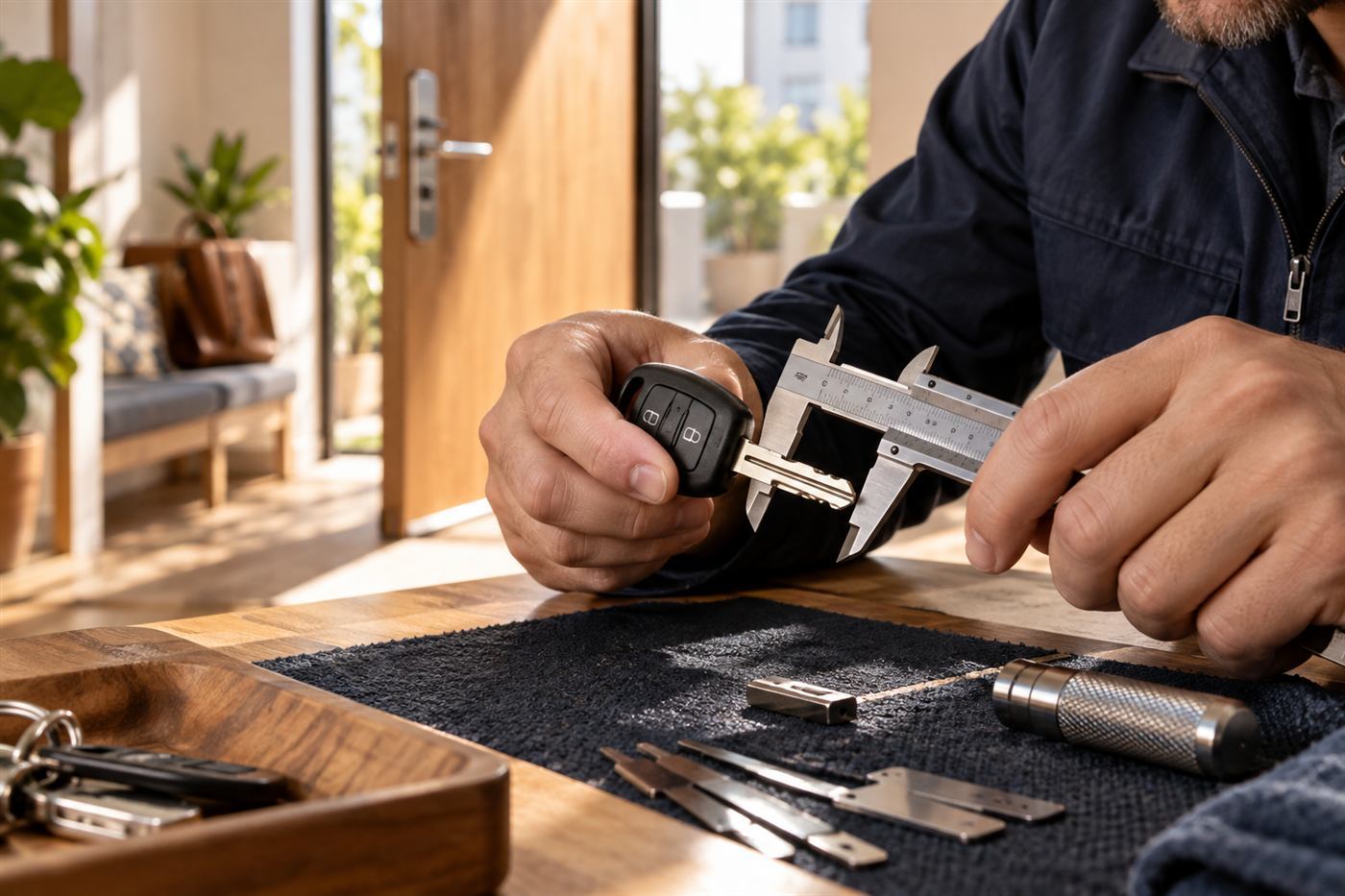
Most vehicles built since the late 1990s use a transponder key, an ordinary-looking blade with a small chip embedded in the plastic head that the ignition checks before letting the engine run past a second or two. A key cut correctly but never programmed will often still turn the ignition and crank briefly before stalling, a dependable sign the electronic side still needs finishing. Laser-cut or sidewinder blades use a groove milled down the center rather than the older zigzag pattern, and cutting one needs a dedicated machine that a hardware store kiosk does not carry. Proximity or push-to-start keys skip the mechanical blade almost entirely and communicate with the car over short-range radio, so the door unlocks and the engine starts as long as the fob sits nearby. Downstate's newer leased fleet skews heavily toward this last category, while upstate's older, longer-owned sedans are more likely to still run on a mechanical blade that a technician can recut to factory specification rather than replace outright.
What to have ready before the technician arrives.
Two things move a visit along faster than anything else, whether the car is at a Manhattan curb or a Buffalo snow emergency lot: proof the vehicle is yours and a clear answer on how many keys remain. Registration, an insurance card, or a title in your name all work, and a driver's license matching the name on those documents avoids delay once the technician is on scene. If a second key exists anywhere, even an old one that barely functions, bring it out, since adding a key to a vehicle that still has one working key is a simpler procedure than starting from an all-keys-lost situation. In dense downstate neighborhoods, noting the exact block, garage level, or alternate-side parking side speeds up finding the actual vehicle among rows of similar cars.
- Registration, insurance card, or title showing your name matching your ID
- The VIN, found on the driver side dash through the windshield or on the door jamb
- Any remaining key or fob, even a spare that barely works
- The exact location, including block, garage level, or which side of alternate-side parking
Alternate-side parking and the cost of a delayed call.
In the boroughs and other cities running alternate-side parking rules, a vehicle that cannot be moved because its only key is missing does not simply sit safely until help arrives, it starts accumulating tickets and, eventually, risks a tow to an impound lot once posted signage takes effect. That timeline turns what should be a straightforward key replacement into a race against a parking enforcement schedule, and it is one of the clearer reasons to call as soon as a key goes missing rather than waiting to see if a spare turns up first. A technician who knows the block's posted schedule can sometimes prioritize a call accordingly, but the schedule itself does not pause for anyone, which is worth keeping in mind before assuming there is no rush.
Salt, freeze-thaw cycles and everyday wear upstate.
The repeated freeze and thaw that defines an upstate New York winter does specific, cumulative damage to both locks and keys that a milder climate never produces. Brine and rock salt applied to roads and sidewalks tracks into keyways on boots, gloves and the keys themselves, and once that salt is inside a cylinder, the corrosion it causes does not reverse when the weather warms, it only pauses until the next freeze reactivates it. A key that drags slightly in November is often significantly worse by February, since each freeze-thaw cycle works moisture and salt deeper into the mechanism. Recognizing that early drag as a symptom worth acting on, rather than a normal part of winter, is the difference between a simple cylinder service in the fall and a snapped blade extraction in the middle of a January cold snap.
Broken key extraction, step by step.
A blade that snaps off flush with a door or ignition face looks worse than it usually is to fix, but the instinct to keep working at it with pliers or a pocket knife is exactly what turns a simple extraction into a harder one. A fragment pushed deeper or bent out of shape takes longer to remove cleanly and can scratch the internal pins of the cylinder on the way out. The correct approach uses a thin extraction tool designed to grip or hook the broken piece without applying sideways pressure that could snap it again or push it further in, and once removed, the technician checks why the original blade failed before cutting a replacement.
Commuter rail lots and long-parked vehicles.
Westchester and the commuter counties feeding into the city generate a specific pattern of calls tied to vehicles left at rail station lots for the length of a full workday, sometimes longer when a trip extends overnight. A car sitting exposed to river wind, road salt, and hours of direct sun does more quiet damage to a fob's seals and battery contacts than the same vehicle would take from an equivalent amount of driving, since it experiences the same weather exposure without the benefit of being used and checked regularly. A commuter who discovers a dead or unresponsive fob after stepping off an evening train is dealing with exactly this kind of slow degradation reaching its breaking point, and reaching that vehicle promptly at an empty, poorly lit lot matters more than it would in a busier daytime setting.
Spare keys as everyday prevention.
A spare key cut while the original still works is consistently the least disruptive route through nearly all of this, whether the risk is a New York City tow truck, a Buffalo snow emergency, or a rail lot fob quietly failing over months of exposure. Keeping that spare somewhere other than the vehicle itself, rather than in a glovebox or a magnetic case under the frame, protects against the common scenario where a single bag or break-in takes both keys at once. For anyone relying on a single vehicle to get to work across a long commute, having a spare already made removes the single largest source of a lost workday from ever becoming a possibility in the first place. It is a small step that costs little and pays for itself the first time it is actually needed.
One dispatch line for the whole state
Curbside in Brooklyn, a station lot in Westchester or a snowbank in Syracuse, call (844) 715-0800 and dispatch sends a local technician to the vehicle.
Describe the situation by phone and we will tell you what the job involves. Quotes are given by phone. Jobs that cannot be quoted without seeing them need a technician on site, and the service call charge is explained on the phone before anyone is dispatched.
(844) 715-0800Related pages
Written by Claude (AI) for 24/7 Locksmith USA.