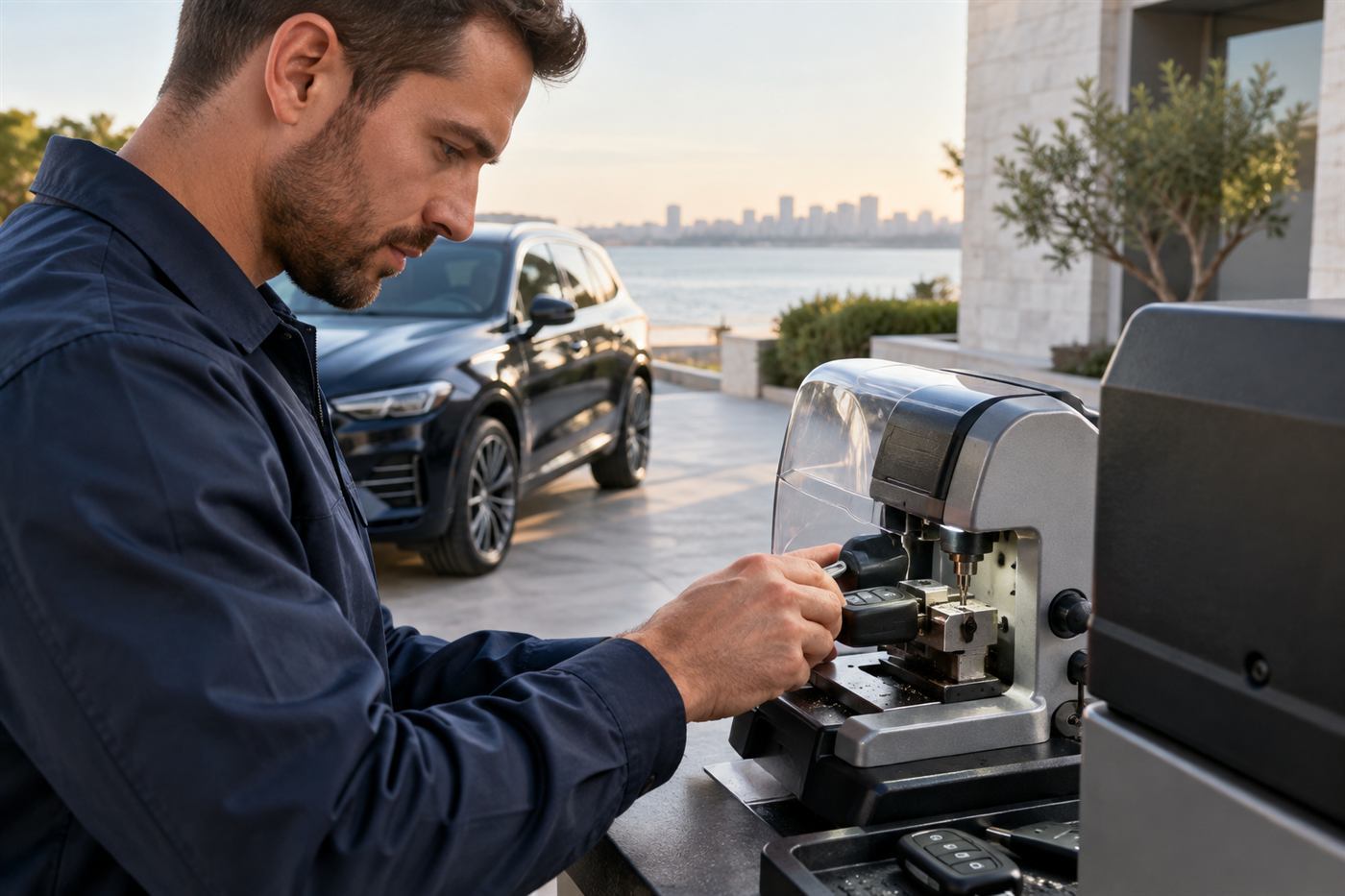
What the fob and the car are doing when you press the button
A key fob is a small radio transmitter. When you press unlock, it sends a short coded signal that the car's receiver picks up, checks against what it expects, and then acts on by commanding the door lock actuators. Smart keys add a second radio link, a low-frequency field around the doors that wakes the fob so it can answer without a button press, which is why some cars unlock when you touch the handle.
For any of this to work, several things must be true at once. The fob needs a healthy battery and an intact circuit board. The car needs a healthy battery and a working receiver. The two need to share a matching identity, which is the pairing. And the radio path between them must be reasonably clear. If any one fails, the button does nothing, and from your point of view all of those failures look the same.
That is useful to know because it turns a vague complaint into a short list of tests. You can work through the list in minutes, and the order matters. Start with the cheapest, safest explanations, which are also the most common, and only then consider damage or a deeper electronic fault.
Start with the fob battery
A weak fob battery is the most common cause by a wide margin. The first sign is usually reduced range, where you must stand next to the car for it to respond. Then the button needs several presses, and eventually nothing happens. Many cars show a warning on the dashboard when a smart key battery is low, and some give a chime or message when you start the engine.
Replacing the battery is a small job on most fobs. A seam or a small slot lets you open the case, and the battery is a coin-style cell with its type printed on it. Note which way the battery sits before removing it, and keep fingers off the flat surfaces, since oils can affect contact. Our guide on how to change a key fob battery walks through it, and how long key fob batteries last explains what to expect.
Fit the correct battery type. Using a wrong size can leave the contacts loose or damage the fob. After changing it, test the fob near the car and then at some distance. If it works normally, you are done. If it works only sometimes, or if a new battery drains again soon, the problem lies elsewhere, and our page on a key fob battery that keeps dying covers that pattern.
Check the car's own battery and the receiver
If the fob battery is fine, look at the car. A weak or dead car battery can leave the interior dark, the dash lifeless and the fob unresponsive, since the receiver and lock actuators need power. If the interior lights are dim or the car clicks but will not crank, the car battery is a likely cause. A jump or a charge may restore the fob's function.
A car that has been sitting for weeks, especially in extreme heat or cold, often has a battery that has quietly drained. If you have recently had the car battery replaced or disconnected, some fobs lose their sync with the car and need to be relearned. That is a separate cause we describe in a moment.
The receiver itself rarely fails, but water, a damaged antenna wire or a poor repair near the roof, bumper or glass where the antenna sits can reduce range. If the fob works only when pressed against the window or the door handle, the receiver or its antenna may be weak. That is a job for a technician with the right tools.
Interference and surprising signal blockers
Fobs use short-range radio, and radio can be disturbed. Strong signals from radio towers, airports, power lines, large electronic signs and some industrial equipment can drown a fob signal near the car. If the fob works at home but not in one particular parking lot, interference is likely, and moving the car or yourself a few meters often fixes it.
Things closer to hand can matter too. Keeping the fob in a pocket with a phone, another fob or a metal card holder can dampen the signal. A metal key ring or a case with a metallic lining can block it. In rare cases a new aftermarket device in the car, such as a dash camera or a charger of poor quality, creates noise that interferes with the receiver.
Try the simple tests. Hold the fob at your chest or head height and press it near the windshield, away from other electronics. Stand in a different spot, and move other fobs away. If the problem disappears, you have found the cause, and there is nothing to repair. If it persists everywhere, move on to the next possibility.
- Test in a different parking spot or location
- Hold the fob away from phones and other fobs
- Press near the windshield or handle
- Remove metal cases and unusual accessories
- Unplug a suspect charger or camera as a test
Lost pairing and desynchronization
Some fobs change their coded signal with every press, using a rolling sequence that the car follows. If the fob is pressed many times out of range, the two can drift out of step, and the car stops accepting the signal. A battery replacement or the car's battery being disconnected can also cause the car to forget the fob or the fob to lose its place.
In many cases a simple resynchronization procedure is available. Some cars resync when you put the key in the ignition and turn it on, or when you press the lock and unlock buttons in a specific order. Because the sequence differs by make and model, your owner's manual is the right guide, and a guess can lock you out of programming mode for a time.
When the simple methods fail, the fob needs to be reprogrammed with diagnostic equipment, which is a task a locksmith who works on cars can do on site. Our pages on key fob lost programming and key fob programming explain what is involved, and the process is much easier if you still have a working key.
Physical damage: drops, water and worn buttons
Fobs lead hard lives. They are dropped on pavement, sat on, carried through washing machines and left in pools and puddles. A cracked case can let moisture in, corroding the contacts and the board. A fob that was in the wash and worked afterward may fail days later when corrosion catches up. Rubber button pads wear through, leaving a dead spot where the contact no longer meets the board.
Inspect the fob. Look for cracks, a loose case, green or white residue near the battery, or buttons that feel mushy or do not click. If only one button fails, the pad or contact is likely worn. If the whole fob is dead and shows corrosion, the board may be damaged. A new battery will not fix a damaged circuit board.
Do not try to dry a wet fob in an oven, with a hair dryer on high or in rice for days. Remove the battery, let the fob air-dry in a warm, dry place, and see whether it recovers. If it does not, a replacement fob can be made. Our page on key fob battery and repair describes the options, including moving a working board into a new shell.
Getting into the car with the mechanical backup
Almost every fob has a mechanical backup. Many hide a thin metal key blade inside the fob, released by a small slide or button. The blade opens the driver's door through a keyhole, which on some cars is hidden under a small cap on the handle that you gently pry off. Check your owner's manual to see where the keyhole is on your car, since it is not always obvious.
Once inside, a car with a push-button start usually has a backup spot for a weak fob. Hold the fob against the start button, or place it in a marked pocket in the console or cupholder, and press start. The car reads the fob through a short-range coil, which works even when the fob battery is nearly flat.
Opening the door with the blade may set off the car alarm on some models. If it does, putting the fob in the backup spot or starting the car normally usually silences it. Keep the blade in good condition, since it is rarely used and can corrode. If the blade is missing or broken, our page on smart key replacement explains how a new one is supplied.
When you are locked out because of the fob
If the fob has failed and you cannot use the blade, perhaps because it was lost or the keyhole is damaged, you may be locked out. If a child or pet is inside in hot or cold weather, call 911 first. Otherwise, do not try to open the car with improvised tools, which scratch paint, damage seals and can set off airbags or alarms. We do not give lock-bypass instructions.
A technician can open the car using methods suited to your vehicle and then diagnose the fob problem. Often the fob can be repaired or reprogrammed on site, or a new one cut and programmed. Our page on car lockout service explains how those calls go.
If you have a spare fob, say so. A spare may work where the main one fails, and it tells the technician that the car itself is healthy. If both fobs fail on the same day, suspect the car rather than the fobs, since the likelihood of both breaking together is small.
What a technician will check and fix
A technician tests the fob with a signal tester to see whether it transmits, and tests the car's receiver to see whether it hears. They check the battery and its contacts, inspect the board, and read the car's memory to see which fobs it knows. This establishes whether the issue is the fob, the car, or the pairing, which is the key to fixing it without replacing anything that works.
If the fob is paired incorrectly, it is reprogrammed. If its board is damaged, it is repaired or replaced. If the car has lost its stored fobs after a battery event, the technician can load them again. If the receiver is at fault, they will say so and explain who can repair it. An honest provider will not sell a new fob when the real cause is somewhere else.
Quotes are given only by phone. Complicated jobs may need an on-site visit before a final quote can be given. There is a service call charge, explained on the phone before dispatch, and work begins only after you agree to the plan.
Touch-to-unlock handles and keyless entry quirks
Cars with keyless entry unlock when you touch or pull the door handle with the fob nearby. Sensors in the handle detect your hand, and the car sends out a short-range signal that wakes the fob. If the handle sensor is dirty, wet or damaged, the car may not send that signal even though the fob is healthy. A quick wipe of the handle and a try on another door can tell you which part is at fault.
These systems also have settings. Some cars let you turn off keyless entry to save fob battery or to prevent relay theft, and some have a mode that does so after the fob has sat still for a time. If the car stopped responding to handle touches and you or someone else changed a setting, the manual or the car display will show it. Do not assume a fault before checking.
Aftermarket remote start kits and alarms can also complicate things. A remote start module installed by a third party sits between the fob and the car, and if it loses power or its own battery, it may block the original fob. If the trouble began after such a device was fitted, say so when you call.
Two short examples
A driver parks at an airport garage and finds the fob does nothing on return. A new battery does not help, but moving across the lot and holding the fob up near the windshield makes it work. Interference near the terminal was the cause, and the fob is perfectly healthy.
A homeowner replaces the fob battery and the car no longer responds. The pairing was lost during the swap. A technician reprograms the fob in a short visit and, at the same time, adds a spare, so the household is not dependent on a single fob again.
What to have ready when you call
Have the make, model and year of your car, and your location. Say what the fob does when pressed, such as nothing, a flash of the light, or a weak response. Tell the person whether the battery was replaced recently, whether the fob was dropped or wet, whether you have a spare, and whether you can get in with the blade.
Have photo identification and proof that the car is yours, such as registration or insurance. When you are ready, call, describe the symptoms, and ask for the quote and the service call charge before agreeing to dispatch. A few clear details help the person on the phone decide whether this is a reprogramming job, a repair or a replacement.
Questions people ask
Why will my fob not unlock the car even with a new battery?
The fob may have lost its pairing, its board may be damaged, or the car's receiver or battery may be at fault. Some fobs need to be resynchronized after a battery change. Try the car's backup spot or the mechanical key to get in, then check whether a spare fob works. A technician can test both the fob and the car.
Can interference stop a key fob from working?
Yes. Strong radio sources, large electronic signs, other fobs and phones in the same pocket, or a metal case can weaken the signal. If the fob works in one place but not another, try moving the car or yourself and hold the fob near the windshield or handle. If it works elsewhere, the fob itself is healthy.
How do I get into my car if the fob is dead?
Most fobs hide a metal key blade that opens the driver's door, sometimes through a keyhole under a cap on the handle. Your manual shows where. Once inside, a push-button car usually has a backup spot where holding the fob lets the car read it even with a weak battery. Check the manual for your model.
Will getting the fob wet ruin it?
Not always, but moisture can corrode the board over days. Remove the battery, let it air-dry somewhere warm and dry, and test it. Avoid ovens, hair dryers on high heat and long rice soaks. If it does not recover, a technician can move a working board into a new shell or program a replacement.
Do I need a new fob or can the old one be fixed?
It depends on the fault. A weak battery, a lost pairing or a worn button pad can often be fixed or reprogrammed. A cracked case or a corroded board may call for a new shell or a replacement fob. A technician tests the fob and the car first, so you pay only for the repair that is truly needed.
How do I get a quote for fob repair or programming?
Quotes are given only by phone. Describe the car, what the fob does and whether you have a spare, and the service call charge will be explained before dispatch. Complicated jobs may need an on-site visit before a final quote can be given. Work starts only after you agree to the plan.
Describe the situation by phone and we will tell you what the job involves. Quotes are given by phone. Jobs that cannot be quoted without seeing them need a technician on site, and the service call charge is explained on the phone before anyone is dispatched.
(844) 715-0800Related pages
Written by Claude (AI) (AI) for 24/7 Locksmith USA.