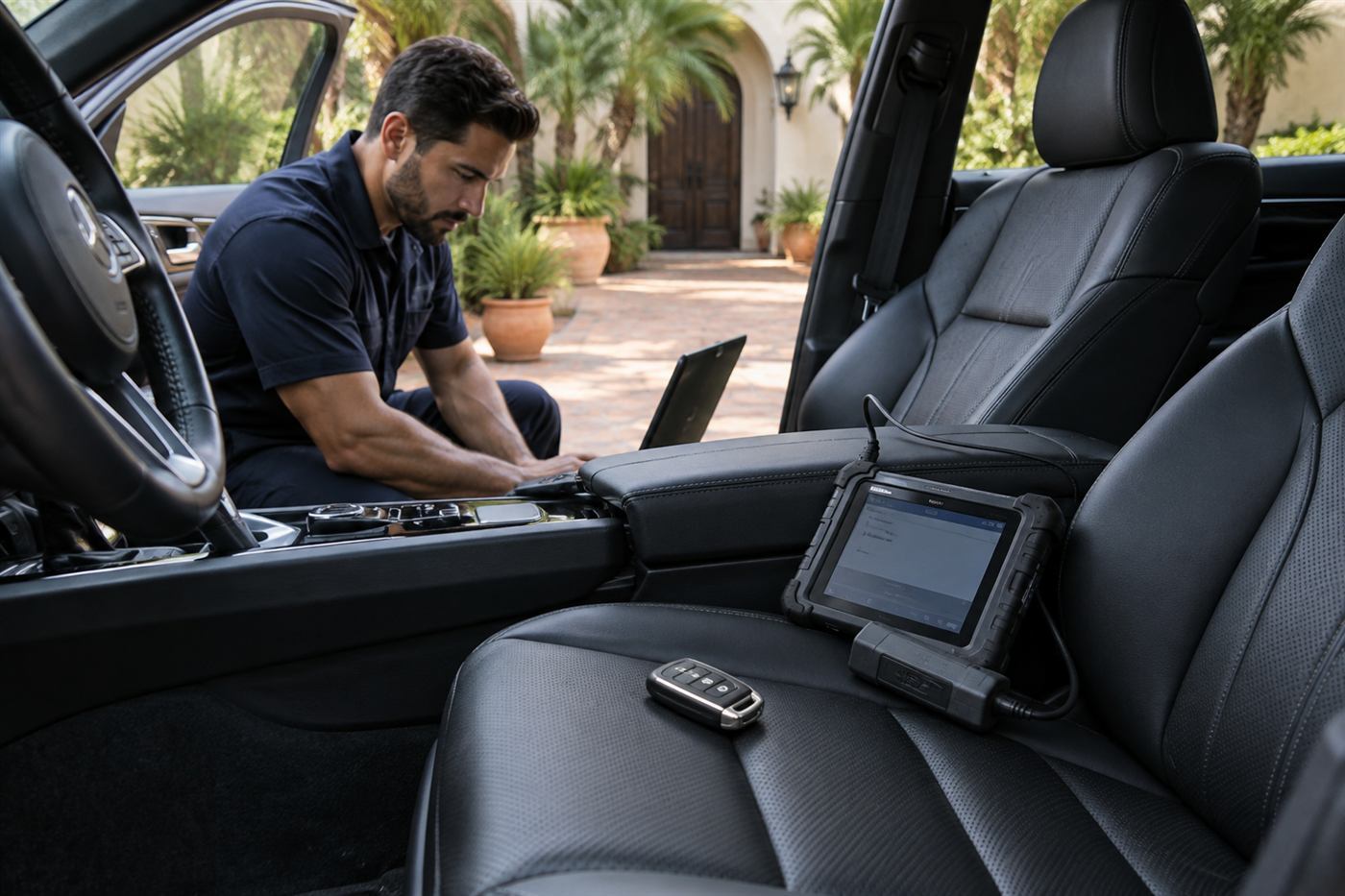
Why the search itself is the risky part
People who need an auto locksmith are usually in a hurry, a little scared, and holding a phone. They type something like auto locksmith near me, tap the first result and call. That is exactly the situation that sloppy and dishonest operators try to exploit. Some listings show a local address that is not a real shop. Some phone numbers route to a call center that sends whichever technician is available. Some companies advertise a very low price to get you on the phone, then add charges once the work begins.
That does not mean every result is bad. Many auto locksmiths are honest, skilled people who run small mobile businesses and do good work. The problem is that, in a quick search, it is hard to tell them apart from the others. A little care in the first two minutes of the call separates them clearly, and costs you nothing but a short conversation.
The goal of this page is to give you a simple routine you can follow even when you are stressed. It starts with where you are and whether you are safe, moves to the questions to ask, and ends with what to check when the technician arrives. None of it requires technical knowledge. It only requires that you slow down by a minute and refuse to be rushed.
If you can, do some of this before you ever need it. Save the number of a reputable auto locksmith in your phone, along with your roadside assistance and insurance numbers. A name you chose calmly in daylight is a far better starting point than one you picked from a search at midnight in a car park.
First, make sure you are safe and check the easy options
Before searching, check your surroundings. If you are in a dark or isolated place, if the weather is dangerous, or if anything feels wrong, move to a safe, well-lit, populated location if you can. If a child or pet is locked inside the car, or there is any risk to a person, call emergency services first. Do not wait for a locksmith in that situation.
Then check the simple things. Do you have a spare key at home, with a family member or at work? Is there a roadside assistance plan through your insurer, your car maker, a credit card or a membership club? Some include lockout help, and some will send a locksmith they work with. Our page on insurance and roadside assistance for lockouts explains how to check.
If the car has a smartphone app or a connected service that can unlock it remotely, that may solve a lockout quickly. Many newer vehicles offer this through the maker's app, though it needs a working account and a connection. Do not try to open the car with improvised tools, since modern doors contain airbags, wiring and electronics that are easy to damage, and a scratch or a bent door frame costs more than a call.
If none of that works, then it is time to search. Try to give yourself a minute to note the car's make, model, year and color, the exact location, and whether the key is lost, locked inside, broken or simply not working. You will be asked all of these questions, and having them ready makes the call efficient.
What to type and what the results mean
Searches like auto locksmith near me, car key replacement near me or locked out of car are all reasonable. Results often include paid ads at the top, a map with business listings, and ordinary website results below. None of those positions proves quality, and a paid position only means somebody paid for it.
On a map listing, look for signs of a real local business. Does it show a street address you can verify? Do the photos show a real van, a real shop or a real person, rather than stock images? Are there reviews that read like actual customers describing specific jobs, rather than generic praise? Does the listing name match the name on the website and the name the person uses on the phone? Mismatches are a warning.
On a website, look for a clear company name, a physical location or service area description, and a plain explanation of how pricing works. Be cautious of pages that promise a specific low price for every job, claim to be everywhere at once, or use several different company names. Our guide on how to spot a fake locksmith goes through these signs.
Remember that a listing's address may not be where the technician starts from. Many legitimate mobile locksmiths work from a van and have no storefront. That is normal. What matters is that the company can tell you its name, its service area and who will arrive, and that these details stay consistent.
Questions to ask on the phone
A good locksmith will answer these calmly. If anyone dodges them, hang up and try another. First: what is the name of your company, exactly? A legitimate business answers with its full name, not a generic phrase such as locksmith service. Write it down.
Second: how does pricing work? You should be told how the quote is given, whether there is a service call charge, what it covers and when it applies. Quotes are given by phone for straightforward jobs, and the service call charge is explained before anyone is dispatched. If the person refuses to discuss any pricing before arrival, or only says that the price depends, walk away.
Third: who will be coming, and what will they arrive in? Ask for the technician's name and the vehicle description. A marked vehicle is a good sign but not a requirement, since some good locksmiths drive unmarked vans. Ask whether the technician will carry identification and be willing to show it.
Fourth: can you handle my kind of key? Describe the car and the key type, such as a transponder key, a smart key or a key fob. Not every technician has equipment for every make. A straight answer is better than a confident yes. Our guide on questions to ask a locksmith before dispatch gives a fuller list you can keep in your phone.
Fifth: what will you need from me? You should expect to be asked for proof that the car is yours. If nobody mentions this, be suspicious, since a technician who makes a key without checking is a risk to everyone.
Warning signs that should make you hang up
Several patterns recur in complaints about bad service. The first is a very low quoted price that rises sharply on arrival, with the technician claiming that the job turned out to be harder than described. A real quote may change if the facts change, but a company that quotes artificially low to get you to agree is playing a game.
The second is a company that answers with a generic greeting, such as locksmith services, rather than a business name. This often means a call center that dispatches subcontractors, and you may have little control over who arrives or what they charge. The third is a technician who arrives in an unmarked car with no identification, or who refuses to give a name or a company name.
The fourth is pressure to drill or replace a lock when a gentler method is likely to work. A car lock is rarely drilled for a simple lockout. The fifth is a demand for payment in an unusual form before work starts, or a refusal to give a written invoice. The sixth is a technician who does not ask for proof of ownership and is willing to make a key for anyone.
If you feel uneasy when the technician arrives, you can decline and send them away, though you may owe the stated service call charge if one was agreed. Our page on locksmith scam warning signs provides more detail. Trust your instincts. A calm refusal is better than an expensive mistake.
What a good visit looks like
A well-run visit has a clear pattern. The technician arrives, introduces themselves by name and company, and shows identification. They confirm your location, the vehicle and the problem. They ask for proof that the car is yours, such as a driver license and registration or title, matched to the vehicle. This step is a sign of professionalism and not an insult.
They then explain what they plan to do and confirm the price that you agreed on the phone, or explain any difference and why. If the work needs more than was described, they stop and talk to you before continuing. For a lockout, the technician opens the vehicle using methods suited to the make, without damage. For a key replacement, they identify the key type, cut or program the key, and test it.
You should see the key tested in the door, the ignition and any remote functions before you pay. The technician should explain what they did, tell you how many keys they made, and hand over all keys. They should give a written invoice with the company name, the work performed and the amount, and answer any questions about it.
If anything about the work seems incomplete, say so before the technician leaves. If you are unsure about the technology, such as a smart key that has to be registered to the car, ask them to demonstrate it. A good locksmith will not be offended. Our guide on how car key programming works explains what is happening behind the scenes.
Proof of ownership: why you will be asked
A technician who makes a car key without checking ownership could be helping a thief. This is why professional auto locksmiths ask for identification and proof that the car belongs to you. Typically this means a driver license and a registration or title in the same name, or a rental agreement or letter from the owner if it is not your car. Some will also check the vehicle identification number against the paperwork.
If you are locked out of a car that you own but the documents are inside it, you may need another way to show ownership. A photo of the registration on your phone, an insurance card in your wallet, an app showing the car, or the vehicle identification number combined with your license may be accepted. Tell the technician on the phone, so you know what is required.
If you are driving a borrowed or company car, call the owner and have them speak to the locksmith, or have them send documents. A leased car is likely owned by the leasing company, and a rental by the rental company, which may have its own rules and its own roadside assistance. Our guide on proof of ownership for a car key covers these cases.
Some people feel embarrassed or frustrated by this step, particularly in the middle of a stressful day. It helps to remember that the same checking protects your own car from being keyed by someone else.
Saving a trusted contact before you need one
The best time to find an auto locksmith is when you do not need one. On a calm afternoon you can read reviews properly, make a phone call, ask the questions in this page and note how the person answers. Whoever sounds clear, patient and willing to explain pricing is worth saving in your phone under a name you will remember. When a lockout happens, you can call without searching, which removes the main risk of choosing in a panic.
Share the contact with the people who drive your car. A partner, a teenager or an older relative may be the one stranded, and they will need the number and a short note of what to say, such as the car's make, model and year. Put a photo of your registration and insurance card on your phone, and keep the vehicle identification number somewhere you can find it. Those small preparations shorten the proof-of-ownership step considerably.
Think about the spare key too. A properly programmed spare kept at home or with someone you trust is the simplest solution to the most common lockouts, and it protects you from the worst case of losing every key. Our page on spare car key programming explains how a spare is made, and why doing it before you lose the last key is simpler than doing it after.
If you travel or drive in unfamiliar areas, check your roadside plan and what it covers. Know the number to call, the information they will ask for and whether they send their own technician or reimburse you for one you choose. A plan made in advance turns a stressful moment into a routine call, and you can say with confidence which company you will trust.
Getting ready and making the call
When you call, have a short list ready. Your exact location, including nearby landmarks. The car's make, model, year and color. The type of key, if you know it. What has happened: lost, stolen, locked in, broken or not working. Whether anyone or any pet is inside. Your own name and a phone number that works.
Have your identification and ownership documents ready, or know where they are. If the vehicle identification number is visible through the windshield, note it, since it helps the locksmith plan the key. Our guide on how to find your VIN shows the usual places to look.
Stay in a safe place while you wait. Keep your phone charged and your volume up. Do not give out card numbers or personal details over the phone to someone you have not verified. Do not agree to pay for work you have not seen. A reputable company will let you wait until the work is done and the key is tested.
If you are in a hurry, remember that a few minutes spent asking good questions is worth far more than the minutes saved by agreeing quickly. When you are ready, call and tell the technician what has happened, what car you have and where you are.
Questions people ask
How do I know a locksmith near me is real?
Check that the company gives its full business name on the phone, that the name matches its website and listing, and that it can describe its service area. Ask for the technician's name and vehicle, and ask for identification on arrival. Consistent details and a willingness to explain pricing are good signs.
Is a very low advertised price a good sign?
Usually not. Some companies quote a low figure to get the call, then raise it after arrival. A trustworthy company explains how quotes work, gives a quote by phone for straightforward jobs, and explains any service call charge before anyone is dispatched. Be cautious of any quote that sounds too good.
Will the locksmith ask for proof the car is mine?
A professional will. Expect to show identification and registration, title, or a rental or owner authorization. This protects you, because a technician who makes keys for anyone could be helping a thief. If your documents are inside the car, ask what other proof is accepted.
Should I try to open the car myself first?
It is better not to use improvised tools. Modern doors contain wiring, airbags and sensitive parts, and damage can cost more than a locksmith call. Check for a spare key, roadside assistance or a manufacturer app first. If a person or animal is trapped inside, call emergency services immediately.
Can a mobile auto locksmith make keys at the roadside?
Often yes, depending on the make, model and key type. Many transponder and smart keys can be cut and programmed on site with the right equipment. Some vehicles need professional tools or have more complex requirements, so describe your car on the phone and ask whether the technician can handle it.
How does pricing work for an auto locksmith?
Quotes are given by phone only. For a straightforward lockout or key job, a quote can be given before dispatch. A service call charge applies for the technician's visit and is explained on the phone before anyone is sent. If the work turns out to be different from what you described, the technician should explain before continuing.
Describe the situation by phone and we will tell you what the job involves. Quotes are given by phone. Jobs that cannot be quoted without seeing them need a technician on site, and the service call charge is explained on the phone before anyone is dispatched.
(844) 715-0800Related pages
Written by Claude (AI) (AI) for 24/7 Locksmith USA.