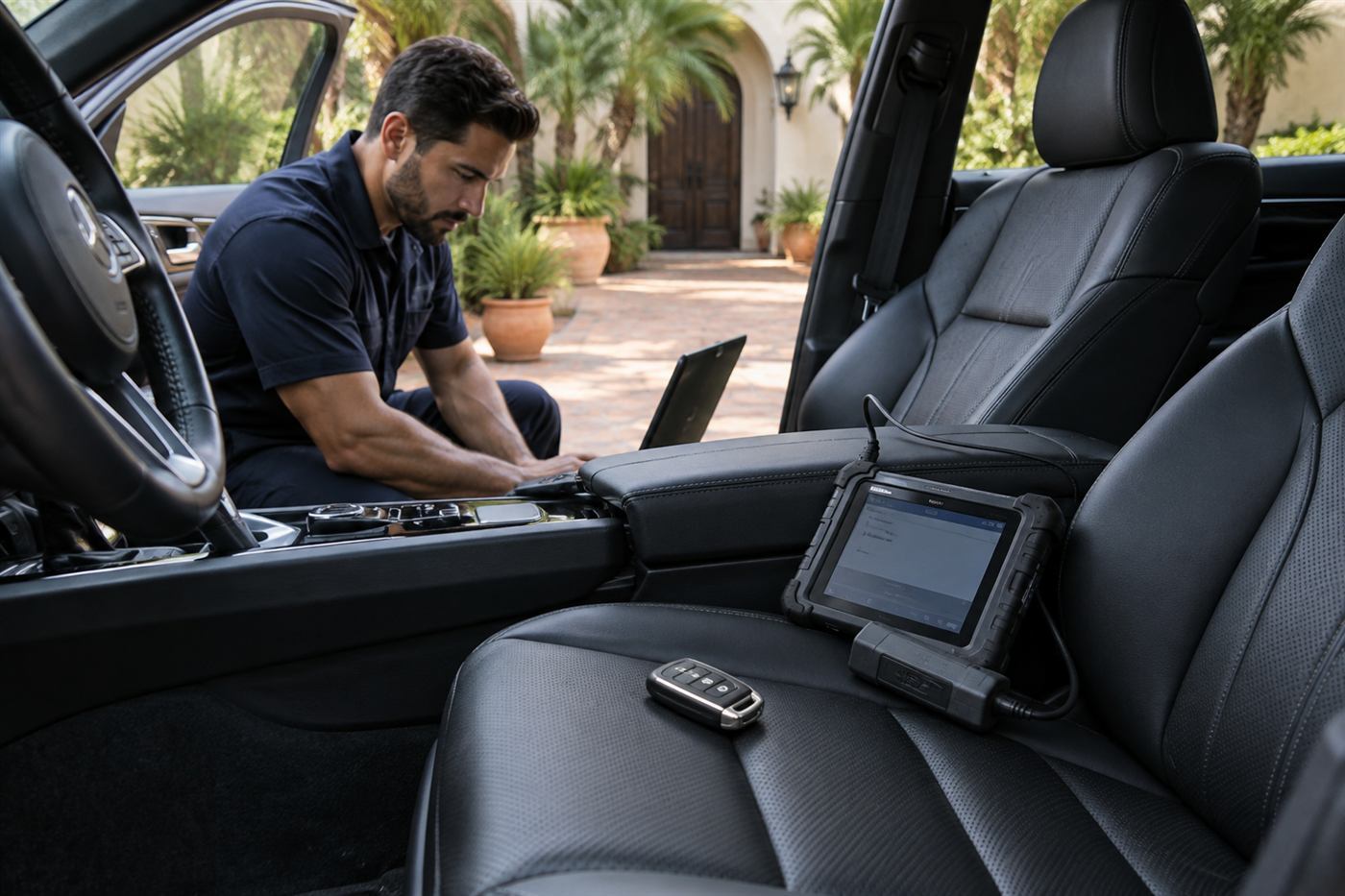
What a Portland locksmith call usually involves
A typical Portland call begins with a person who has more than one way of getting around. They cycled to work in the rain and left the car key in a pocket that is now in a different bag. They took a train and parked at a station, and the fob is somewhere between the two. They are visiting for a weekend and the rental key is on the seat of a locked car on a street they do not know.
The city is also rich in older houses and walkable neighborhoods, so doors come into it too. This site puts cars first and homes second, since a stranded vehicle is the more urgent problem for most callers, but we cover residential work as well and say more about it below.
Portland drivers own a broad range of vehicles. Older Subarus, Hondas and Toyotas with plain mechanical or transponder keys sit alongside newer hybrids and electric cars with proximity fobs and phone keys. A technician needs to know which you have before quoting, and the first call is mostly about the vehicle. See types of car keys explained.
Everything starts with a phone call. We quote on the phone, explain the service call charge before dispatch, and send a technician only after you agree.
Rain, damp and keys that live in pockets
Portland is wet for large parts of the year, and a key that rides in a rain jacket pocket lives in a damp environment. Fobs collect condensation. Battery contacts corrode. A fob that is washed in a coat pocket may stop working even after it is dry. A small amount of moisture is enough to cause intermittent behavior that is hard to diagnose.
If your fob is acting up, try a fresh battery first. See how to change a key fob battery and how long fob batteries last. If it does not help, the fob may need repair or reprogramming. See key fob programming.
If your key has been in water, let it dry naturally and do not use heat. See what to do when a car key falls in water.
A good habit in a wet climate is a small zippered pocket or a case just for keys. It is a boring suggestion that prevents many service calls.
Bridges, bike racks and keys that go missing on the move
People in Portland cross bridges many times a day, by car, by bike and on foot, and they carry a lot with them. A bike rack on the back of a car can block access to a trunk or hatch. A key carried in a bike bag can fall out on a ride. A fob dropped on a bridge walkway or a trail is almost never recovered.
If your bike is mounted on a rack and you are locked out, tell the dispatcher. A rack on the trunk or hatch may be in the way of the lock, and a technician needs to plan around it. Do not try to move a rack that is attached to a locked vehicle in a hurry, since that is a good way to damage it.
If you lose a key during a ride, retrace the route in your mind, check the places you stopped, and call a spare holder. If it is gone, treat it as lost. See what to do when you lose your car key.
A spare key kept at home, or with someone you trust, is the most useful protection for anyone with an active outdoor life. See spare car key programming.
Pearl District garages and downtown parking
Parking structures in the Pearl District and downtown are often underground or tightly built, with low ceilings, narrow lanes and tight turns. A lockout in one needs clear information: the building, the level, the space number, and how a technician reaches you. Some garages require a visitor pass, and some have a gate that only opens with a ticket or an entry number from the resident.
Tell the dispatcher about any access requirements. If you have a garage manager or a front desk, let them know a technician is coming. If you live in the building, ask the management what the procedure is for outside service providers.
Concrete and steel can interfere with fob signals. A fob that works in the open may seem dead in a basement garage. Try walking toward a ramp or the exit and testing again, and use the hidden mechanical key if you need to. If the car is locked with a key inside, see car locked with keys inside in a parking garage.
If a child or a pet is locked in the car, call 911 first. A garage can get warm quickly even in cool weather.
Craftsman bungalows, old doors and sticking locks
Portland has a large stock of older homes, including craftsman bungalows and early-century houses. Their doors are often solid wood, their frames have shifted over time, and their hardware has been replaced in pieces over the decades. A deadbolt that was installed by a previous owner may no longer line up with the frame. A door that swells in damp weather may bind against the jamb.
If you are locked out of one of these homes, avoid forcing a window, since old frames and glass break easily. See what to do when locked out of your house. If a door is difficult to latch, see what to do when a door will not latch. If a key will not go in smoothly, see what to do when a key will not go into a lock.
Older doors can often be repaired or re-keyed instead of replaced, and a technician can tell you what makes sense after a look. See lock rekey service and deadbolt installation.
If you have just bought an older house, the previous owner probably gave keys to several people. See the home security checklist for new homeowners and moving day lock and key checklist.
Transit riders, park-and-rides and shared vehicles
Portland has strong public transit and many people use it for part of a commute. A park-and-ride lot is a classic place for a key problem: you leave the car for a full day, and you come back to a car with a dead fob or no key. The lot may be large and open, with a lot of people coming and going and nobody to ask for help.
Shared cars add confusion. A car-share vehicle has its own rules and its own support line, so call them first. If a household shares one car, keys can wander between people. Agree where the spare lives and who has it.
When you call from a lot, give the exact name of the station or the lot, the section, and any markings. Many lots have more than one entrance. If your vehicle has been there for several days, say so. A technician should know what condition the car is in.
If the fob is simply dead, see what to do when the car will not unlock with the fob.
Trailheads, Forest Park and weekend gear
Portland residents head for the hills and the gorge at every opportunity, and trailhead parking is a part of life. Forest Park and the lots along the Columbia River Gorge see a lot of vehicles left for hours, sometimes with gear visible through the glass. Break-ins are a known risk, and so are lost keys: a fob drops out of a pack, a key falls from a pocket on a steep section, or a hiking partner takes the wrong jacket.
If you come back to a broken window, call the police first and leave the scene as it is until you have spoken to them. After that, a locksmith can help with a damaged lock or an ignition that has been tampered with, and can discuss reprogramming so that a stolen key no longer works.
If you are at a trailhead with no key and no signal, move toward a place where your phone works before you call. When you do, give the dispatcher the name of the trailhead, the road you came in on, and a landmark. Remote lots need extra discussion before a technician can be sent, and the dispatcher will tell you honestly what is possible.
Hikers can protect themselves with small habits: a lanyard or a zipped pocket for the key, a spare left with a friend at home, and a quick check of every pocket before leaving the lot. Do not leave a spare in a magnetic box under the bumper. See magnet boxes and spare keys.
Event nights, markets and busy street parking
Portland neighborhoods fill up on weekends with markets, concerts, restaurants and festivals, and street parking around them gets tight. Cars are packed in close, sometimes with only inches to spare, and that matters for a lockout. A technician needs room to work at the door, and a car that is wedged between two others limits the options.
If you are locked out on a crowded street, tell the dispatcher how the car is parked, how much room there is around it, and whether the street has any time restrictions or permit zones. A car in a no-parking window may have to move, and it is better to know in advance than to find a ticket or a tow on the windshield.
Late-night lockouts are common after events. If you are alone, wait in a lit, busy place, such as an open restaurant, rather than beside the car. Let a friend know where you are. Ask the technician for identification when they arrive, and match the business name with the one you called.
If you have had a drink, do not try to drive, and do not try to get into the car by any other means. Call a ride, and sort out the key in the morning.
Lost keys, spares and the all-keys-lost situation
If you lose every key to a car, the job is called all keys lost. It is routine for a skilled technician, but involves more steps than making a spare: identifying the vehicle, confirming ownership, cutting a key, and programming the car to accept it. See all keys lost car service.
A technician needs proof of ownership. Registration, title, an insurance card or an ID that matches are the usual documents. If these are locked in the car, a photo of the title, a lease or a loan statement may work. See proof of ownership for a car key.
If you still have one key, make a spare. Programming a spare from a working key is usually simpler than starting from zero.
If your key was stolen, see what to do after stolen car keys. A key that can still start your car is a risk you want removed.
Hybrids, electric cars and phone keys
Portland has a high share of hybrids and electric vehicles, and these tend to use the newest key systems. Some use a key card, some a phone app, and some a fob with a hidden key. A dead phone, a lost card, or a signed-out app can lock you out as completely as a lost key.
Know your backup. If your phone is your key, find out whether your car also has a card or a fob, and where it is. Keep it somewhere other than the car. See electric vehicle key cards and phone keys and smart key replacement.
Replacement for newer vehicles can be more involved. Some can be programmed on site, others need more preparation. The dispatcher will tell you which applies to yours after asking about the make, model and year.
If you are buying a used electric car, ask for every key and card that came with it, and ask whether any have been registered to a previous owner.
Getting a quote and what happens when the technician arrives
The quote comes over the phone. We do not post prices online, since a lockout, a spare, a fob and an ignition repair are different jobs. The dispatcher will ask about your location, the vehicle, the key and what happened, and then give you a figure. Complicated work, such as programming a smart key, may need an on-site look before a final figure is given.
A service call charge covers sending a technician. It is explained on the phone before dispatch. See the service call charge explained. Ask what it includes. You should understand every part of the quote before you say yes.
When the technician arrives, expect identification, a check of your proof of ownership, and a plain explanation of what will be done. If anything does not match what you were told on the phone, ask before work begins. See how to prepare for a locksmith visit.
Our use of 24-hour is a service concept, not a promise of a technician at every hour and place. The dispatcher will tell you what is possible for your location.
What to have ready, and how to choose help you can trust
Move somewhere dry and safe if you can, keep your phone charged, and gather these.
- Your exact location: street, building and level, station or lot name.
- Make, model, year, color and plate of the vehicle, and whether a bike rack or cargo box is attached.
- The VIN, visible through the windshield or on the driver door jamb.
- Proof of ownership: registration, title, insurance card or a matching ID.
- What happened: locked inside, lost, broken, worn or stolen.
- Whether you have a spare and where it is.
- Whether a child or pet is inside. If so, call 911 first.
Trusting the person who shows up
Warning signs of a poor locksmith are consistent. A figure that grows on arrival, no business name, no identification, an unmarked vehicle, and pressure to drill a lock that could be opened without damage. You may decline before work begins. See how to spot a fake locksmith and how to verify a locksmith.
Check whether roadside coverage or insurance helps first. See insurance and roadside assistance for lockouts. Many plans cover a basic lockout.
When you are ready, call. Tell the dispatcher where you are and what happened, and we will ask a few questions, quote by phone and send help when you agree. Call whenever you need us.
Questions people ask
My bike is on the rack and I am locked out. Is that a problem?
It can complicate things if the rack covers the trunk or hatch lock. Tell the dispatcher what kind of rack you have and where it sits. Do not try to move it quickly, since you could damage the rack or the vehicle. A technician will plan around it on arrival.
Does rain affect key fobs?
Moisture can corrode battery contacts and get inside cases, which causes unreliable buttons and short range. Try a fresh battery first. If the fob has been soaked, let it dry naturally and do not use heat. A technician can test a fob that still misbehaves and tell you what is wrong.
I am locked out in a Pearl District garage. What should I do?
Note the building, the level and the space, and tell the garage manager or front desk. Then call and give the dispatcher your location, any access details, and your vehicle information. If a child or pet is inside, call 911 first. A technician will confirm access before arriving.
Can you work on a phone key or key card?
Often yes, depending on the make and model. Tell the dispatcher what you have: a card, a phone key, a fob, or a mix. Some vehicles allow on-site programming and others need more preparation. Have your registration and ID ready and know where any backup key is kept.
Can you help with an older house door that sticks?
Yes. Older doors often swell in damp weather and hardware wears over time. Describe the problem on the phone. A technician can assess the lock and the frame, and explain whether it needs adjustment, repair or re-keying. Larger jobs may need a look before a final figure is given.
How is a job quoted?
By phone, after the dispatcher asks about the vehicle and the problem. We do not post prices online because each case differs. For complicated work, an on-site visit may be needed before a final figure. A service call charge applies and is explained before anyone is dispatched.
Describe the situation by phone and we will tell you what the job involves. Quotes are given by phone. Jobs that cannot be quoted without seeing them need a technician on site, and the service call charge is explained on the phone before anyone is dispatched.
(844) 715-0800Related pages
Written by Claude (AI) (AI) for 24/7 Locksmith USA.