
What we handle in Hialeah.
One mobile team across Hialeah, residential, automotive and commercial.
Marine & Dock Hardware
Corrosion-resistant cylinders and padlocks for boats, dock boxes and waterfront storage.
Historic & Period Hardware
Mortise locks and original hardware serviced rather than ripped out of a period door.
Impact Door & Storm Hardware
Multipoint locks and hardware on impact-rated doors adjusted, repaired or replaced.
Car Keys, Fobs & Remotes
Keys cut and programmed on site for most makes, including push-to-start smart keys and proximity fobs.
Commercial Door Hardware
Storefront locks, exit devices, closers and mortise cylinders serviced or replaced.
High-Security Cylinders
Medeco and Mul-T-Lock cylinders for doors that need genuine key control rather than hardware-store pins.
Locks in Hialeah: what actually goes wrong.
Because more than 90% of Hialeah housing predates 2000 and the city's own Housing Element says the vast majority of structures could be legally nonconforming, exterior door and frame assemblies are frequently pre-Hurricane-Andrew units that were never brought up to current product-approval standards. When any door or window is replaced the city requires Miami-Dade Product Control Approval and/or State Approval and a notarized application, plus a shutter permit if the unit is not impact-resistant, so hardware upgrades on older units can trigger a full assembly replacement. Hialeah's 2025 Housing Element counts 81,562 units and reports 0.9% built 1939 or earlier, 21.5% 1940-1959, 36.4% 1960-1979, 28.8% 1980-1999, 4.0% 2000-2009, 5.3% 2010-2019 and 3.1% 2020-2023, stating that more than 90% of the stock was built between 1940 and 1999 and that the vast majority of structures could be legally nonconforming under current code. Near the water, standard plated cylinders corrode from the inside out; solid brass or marine-grade hardware lasts several times longer for a small difference in price. Persistent high humidity and salt carried inland drive corrosion of lock cylinders, deadbolt bolts, strikes and fasteners - FEMA Technical Bulletin 8 documents salt-driven corrosion declining over the first 300 to 3,000 feet inland but measurable 5 to 10 miles from the shoreline. ANSI/BHMA A156.18 grades builders hardware finishes by salt-spray exposure using corrosion, staining and blistering as failure criteria, and also tests ultraviolet resistance for chipping, cracking and color loss. The city was platted in 1921 and incorporated in 1925, then grew through postwar and Cuban-exile-era working-class development. In practice that means concrete-block houses and low-rise apartment buildings from the 1940s-1970s, with door preps and frames from before modern strike and deadbolt standards. The county locksmith license requirement is also unusual within Florida and is a real gate on who can legally do the work.
Large households and the problem of too many keys
In a home where several generations or many adults live together, keys are in constant motion. One person drives to work, another picks up children, a third visits a relative and carries the only spare. When a key goes missing, nobody is sure whose it was or who else has a copy. That uncertainty is the real cost of a lost key, more than the metal itself.
A calm way to handle it is to count and label. Decide how many keys each door really needs, make that many and keep a simple list of who holds them. If a key is lost and you do not know where, rekeying the lock answers the question for good, because the lost key stops working no matter who finds it. Everyone then receives a fresh set, and the household starts with a clear picture again. It is worth stamping or tagging each key in a way only the household understands, such as a colored cap, so a bundle on a hook is easy to sort when someone is in a hurry. Never label a key with the address, in case it is lost.
This page is general guidance for people in Hialeah. It does not name streets, complexes or businesses, and it makes no claim about past work in the area. Rules for leases, associations and vehicle paperwork differ, so ask your landlord, building manager or the proper local office whenever a requirement matters. Most of what follows is simply common sense applied carefully.
What to say when you call a locksmith
A good call is short, specific and honest. Begin with what is locked and where you are. Add the type of lock if you know it: deadbolt, knob lock, keypad, smart lock, car door, trunk or ignition. Then say what happened. The key is lost, the key broke, the fob stopped working or the door slammed. Each answer tells the dispatcher what to prepare.
If the situation is urgent, say so at once. A child or an animal in a closed car, a person who needs medicine from inside the home, or a stove left on are all reasons to call emergency services first and to tell the locksmith as well. For everything else, take a breath and give clear details. You will hear the service call charge and a quote before anyone is dispatched, so ask about anything unclear. If the explanation is vague, ask again. A clear answer about what the call charge covers and what the job might add is a good sign.
Be ready to prove that you are entitled to have the work done. Ownership or authority is checked before opening, rekeying or programming. For a car, that usually means registration or title and a photo ID. For a home, it can be a photo ID with a matching address, a lease or a bill. The check is not a hurdle placed in your way. It is the reason a stranger cannot do the same to your door.
Apartments, shared entrances and gates
A large share of housing in a dense city is multi unit, and with it come shared entrances, lobbies, gates, mail rooms and parking areas. Your unit door may belong to you or your landlord, while the building entrance belongs to the owner or association. That split decides who can ask for work. If the problem is your own front door, you can usually arrange it. If it is the front gate, the manager must be involved.
Renters should read their lease before changing a lock. Some leases require approval or a copy of the key, and some prohibit changes. Landlords, for their part, ought to rekey between tenants so that no former occupant keeps access. If you manage a building, keep a log of key issue and return, and rekey when a master or a building key goes missing.
See apartment and landlord locksmith work for typical situations. If you are in a building where the doors are also operated by a code or fob system, ask the manager first, because access control is often managed by a separate company. A locksmith can usually advise on the mechanical lock but may not control the building system. Be clear on the phone about which part is failing: the door lock, the strike, the closer or the electronic reader. That distinction decides who should be called and prevents wasted effort.
Locked out of the house
A home lockout is always inconvenient and sometimes frightening. Take a breath, stay in a safe, visible spot and avoid any attempt to climb or force an entry. A shattered window or a damaged door frame will cost much more than a service call. Think about whether someone has a spare: a relative, a neighbor, a building manager or a lockbox.
If not, call and describe the door and the lock. A technician will confirm you live there before opening it. A photo ID with the matching address is the simplest proof, and a lease or a utility bill also works. Once inside, ask yourself what caused the lockout. If a key is missing, rekeying is the prudent response. If you only forgot it, a keypad or a trusted spare may be enough.
Our page on home lockout help walks through these steps. If a key breaks in the lock, the same principle applies: stop, do not twist, and let a technician extract the piece.
- Stay somewhere visible and safe while you wait.
- Look for a spare with a family member, neighbor or building manager.
- Have a photo ID and something showing you live at the address.
- Leave forced entry to professionals, since damage costs more than the call.
Car lockouts in busy lots and tight streets
Cars are parked everywhere in a busy city: shopping lots, garages, curbs, driveways, alleys. When a lockout happens, details about the location are as important as details about the car. Give the name of the nearest business or the sign you can see, and mention whether you are on a ground level or in a garage. If you are on a busy road, stand somewhere safe, away from traffic.
Check for a spare first. In a large household, someone almost always has one. If not, a locksmith can open most vehicles without damaging paint or door seals, once ownership is confirmed with registration or ID. Please avoid wedges, coat hangers and other improvised tools. They bend frames, tear weatherstripping and can set off alarms.
Learn what to expect at car lockout service. In hot weather, treat a child or pet inside the car as an emergency, call emergency services first and tell the locksmith the same. Never leave a child alone in a vehicle, even for a moment, and keep keys where children cannot reach them. Teach older children what to do if they are ever locked in: stay calm, honk the horn, and attract attention rather than trying to climb out. Small instructions repeated calmly can matter a great deal.
Replacing a car key or fob
Most modern keys include a chip that must be recognized by the vehicle. Others are smart keys carried in a pocket. In either case, a copy cut at a hardware counter may unlock the door but fail to start the engine. The proper replacement is cut and programmed for your car, usually from the vehicle identification number and proof of ownership.
You will likely need registration or title and a photo ID. If you are not sure where the VIN is, finding your VIN shows the usual places. Many families have several drivers on one car, so decide how many working keys you need. A spare for each regular driver prevents one lost key from stopping the household.
If every key is gone, read all keys lost service to see why the job takes more steps. If you still have a key, fob programming and spare keys are simpler. Ask about the type of key your car uses so the quote is accurate, and mention if you also want the remote buttons to work. Some people also want an emergency blade, a valet key or a second remote, and each of those is a separate item to discuss. A short list of what you want makes the quote simpler.
Broken keys, worn keys and ignition trouble
Keys wear out. Years of daily use round off the cuts, and a worn key can start to stick, wiggle or refuse to turn. If it snaps, part of it stays in the lock. The right move is to stop pulling and stop twisting, because forcing the piece deeper makes extraction harder. A technician has tools designed to remove a broken piece with little damage.
Ignition trouble has its own set of symptoms. A key that will not turn might have worn teeth, a worn ignition cylinder or a steering lock binding against the wheel. Describing what you feel helps: does it go in, does it turn partly, does the dashboard light up, does the engine crank? Do not force it, since a bent key or a damaged cylinder can turn a small problem into a bigger one.
Read about broken key extraction and ignition repair. Replace worn keys early, and keep your key ring light. A heavy bundle hanging from the ignition adds wear to the cylinder every time the car moves. If your key already feels loose in the ignition, do not wait for it to fail on a busy road. A replacement cut from the vehicle record costs less effort than a roadside breakdown.
Storefronts, small shops and business keys
Small businesses are the backbone of a city like this one, and each depends on a door that opens on time. A storefront lock that sticks, a back door latch that fails or a lost key after a staffing change can disrupt a working day. Commercial locks are often heavier than residential, with exit devices, closers and keyed systems for different roles.
When a business calls, the locksmith will ask who is authorized to request the work. That could be the owner, a manager or the property owner. Proof might be a lease or a business document. If you lease the space, check with the property owner before changing exterior locks, since some leases require shared access or a copy of the key.
Our page on commercial locksmith service describes common jobs. Put one person in charge of keys, record who holds what, and rekey the affected doors when staff change. It is a small, regular discipline that prevents most of the trouble. Keep spare keys for the shop in a secure place off site with someone responsible, and make sure at least two people know how to reach them. A locked store with the only key inside a locked store is a surprisingly common story.
Heat, humidity and storm season
South Florida weather is warm and humid for much of the year, with storms and hurricane season adding their own pressure. Moisture corrodes metal, wood doors swell, and fob batteries and electronics run hot. A lock that once felt smooth can start to drag. Treat stiffness as a warning, and replace worn parts before they fail.
Before a storm, put spare keys and key papers in a waterproof container and photograph your registration and ID. After a storm, check that doors still latch and that deadbolts reach the frame. Keep people away from any door that looks bent or off its hinges. Never attempt repairs on garage door springs, cables or openers, which are under dangerous tension and need a trained technician.
Our hurricane season lock and key prep guide lists what to gather. If a fob went into floodwater, read car key fell in water before trying to dry it, because heat can make matters worse. Also remember that locks outdoors, such as gate latches and padlocks, suffer most from damp air. Check them each season and replace any that feel rough or show rust, before they seize at an awkward time.
Keypads and smart locks for busy households
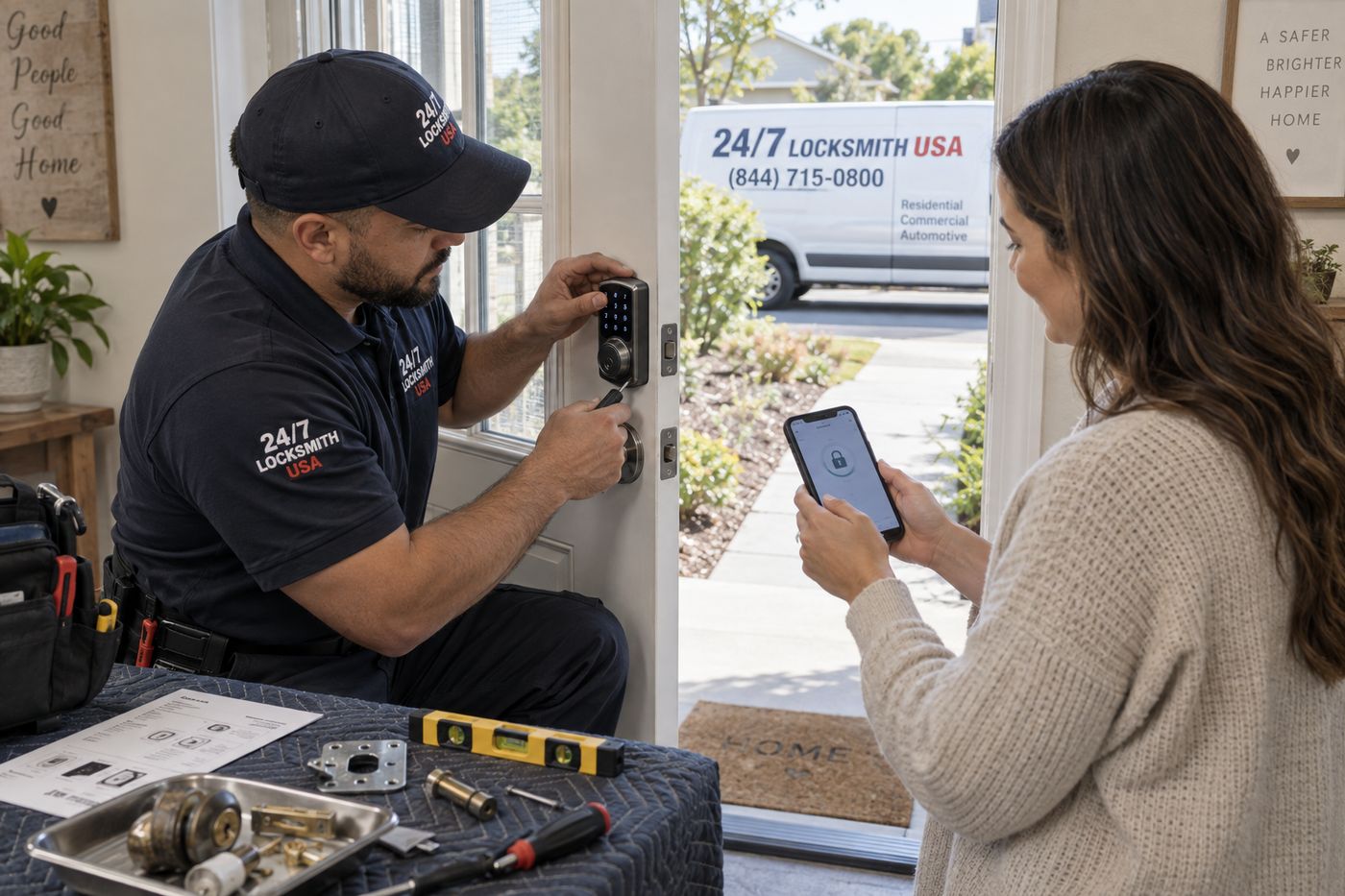
When many people come and go, a keypad or smart lock can reduce the number of metal keys in circulation. Each person can have a code, and a code can be removed without changing the hardware. That helps a family with several drivers, a landlord who hosts guests, or a business with shift workers. It is not a perfect answer, but it solves a real problem.
Think before you buy. Keypads run on batteries, and a dead battery at the wrong moment brings back the lockout you wanted to avoid. Ask how the lock signals low power, whether it has a backup key or an external power contact, and how humid air affects the electronics. Choose a lock that suits your door and your habits, not just the one with the longest feature list.
For an overview of what is involved, see smart lock installation. Plan to change codes regularly, particularly after a guest, a repair visit or a change in the household. Treat a code like a key: do not share it widely, do not write it near the door, and remove it when its purpose ends.
Choosing a locksmith with care
People who are locked out are anxious and hurried, which is exactly what unreliable operators count on. A trustworthy company explains the service call charge, gives a quote on the phone and checks ownership before opening anything. If the figure changes dramatically on arrival, stop and ask why. Our guide on how to spot a fake locksmith gathers warning signs.
If you travel around South Florida, our general guidance for Fort Lauderdale may help. Conditions differ by place, but the steps for a safe call are the same.
When you are ready, call, describe the problem and your location, and have ID and ownership papers close by. Ask for the service call charge and the quote, and make sure you understand both before anyone is sent. Clear expectations at the start are the surest way to a smooth visit.
Common questions
What should a big household do about lost keys?
Count the keys each door needs, label them and keep a list of who holds each one. If a key goes missing and you cannot trace it, rekey the lock so the lost key stops working. Everyone then receives a fresh set, and the household has a clear record again. Write down the date so you know when the last change was made.
Can a locksmith open my apartment door if I rent?
Yes, once your identity and right to be there are confirmed with a photo ID, lease or bill. If the problem involves a shared entrance, gate or lobby, the building manager or owner must authorize it. Tell the dispatcher which door it is.
How many car keys should we have for several drivers?
A working spare for each regular driver is sensible, because one lost key then does not stop the household. Each key must be programmed to the car, and ownership is checked first. Ask about the cost and process before deciding how many to make, and keep the spares in separate places so one mishap does not take them all.
What should I do if my key snapped in the lock?
Stop pulling and do not twist the piece. Keep any part of the key you hold. Call a locksmith and say whether it broke in a door or ignition. Extraction tools can often remove the broken piece without replacing the whole cylinder, and the piece you kept helps identify the right key blank.
Who can request lock work for a store?
The owner, a manager or the property owner, depending on who controls the door. A lease or business document may be asked for. If you lease the space, check with the property owner first, since some leases require a copy of the key or approval.
Is this page about specific local rules or history?
No. It is general guidance for Hialeah residents and businesses and does not describe any particular building, street or past job. Requirements for leases, associations and vehicles vary, so ask your landlord, manager or the proper local office when a rule matters.