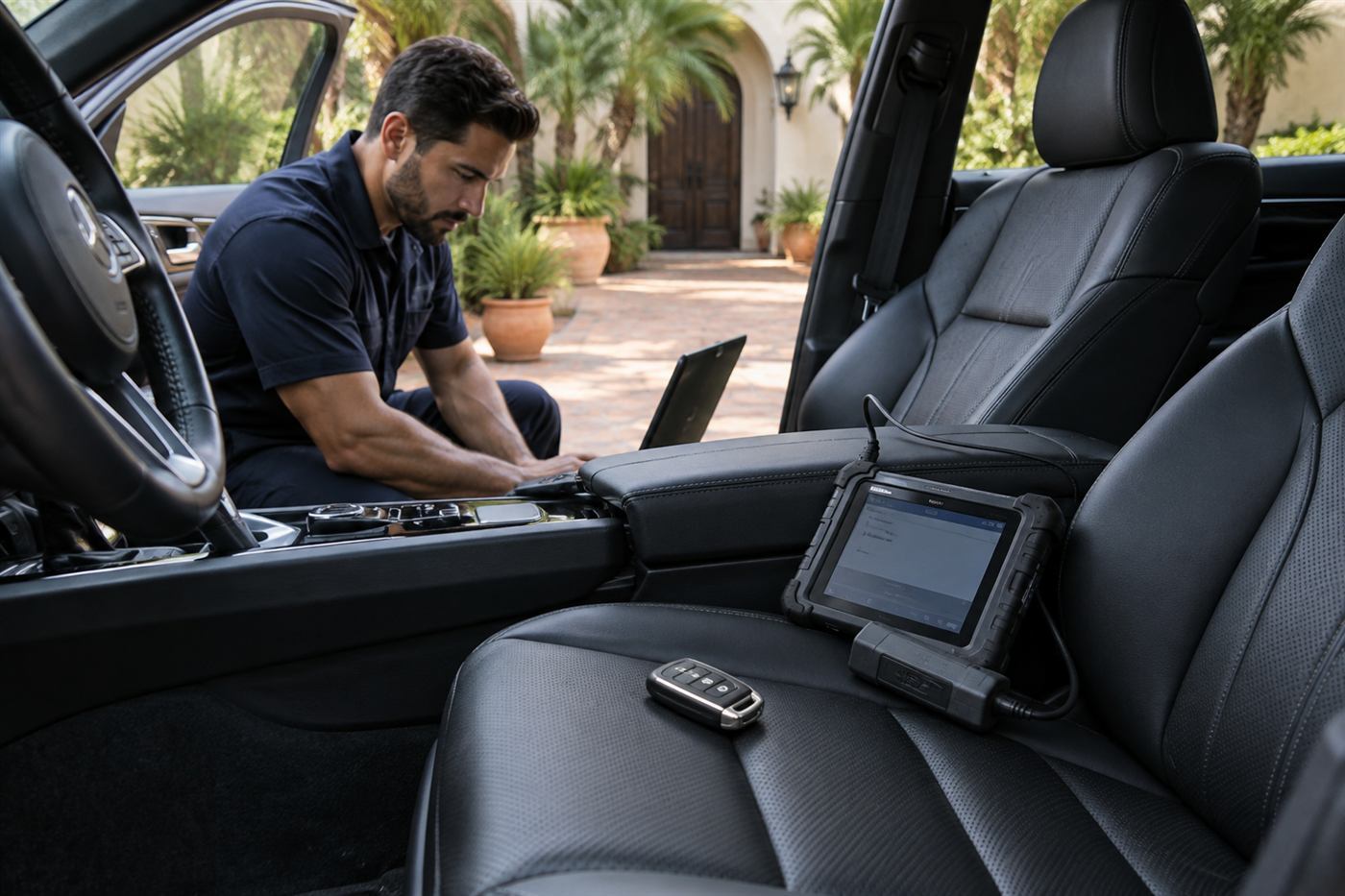
How a call works for Pennsylvania drivers
A job begins with a phone call. You tell the dispatcher where the vehicle is, what happened and the make, model and year. We ask whether you have any working key, whether anyone or any animal is inside, whether the car is on a public street or private property, and whether you can show the vehicle is yours. Those answers tell us what the work involves and whether a technician has to see the car.
Quotes are given only by phone. We do not post prices, because a simple door lockout on an older sedan and a new proximity key for a recent model are very different jobs. For complicated work we may explain that an on-site visit is needed before a firm number is possible. A service call charge applies when a technician is sent, and we explain it before dispatch so nothing comes as a surprise.
We do not promise arrival windows. Bridges, tunnels, rowhome blocks with no place to stop, snow on ridge roads and rush-hour traffic make a fixed promise dishonest. What we promise is a plain answer on the phone about whether and how we can help where you are, so you can plan your next step.
The 24/7 in our name is the idea behind the service, not a pledge of a technician at every hour in every place. If a person, child or pet is locked inside a vehicle in cold or heat, call 911 first. Emergency crews are the right first call, and the key can be handled afterwards.
Philadelphia: rowhomes, street parking and tight blocks
Philadelphia is a city of rowhouses, with long blocks of attached homes and cars parked bumper to bumper along the curb. Most residents park on the street, circling for a space after work and often parking several blocks from the front door. That has a direct effect on key problems. A key lost on the walk home, a fob dropped between the car and the stoop, and a spare left in a house a few blocks away are all common stories.
Street parking also makes a lockout hard to service. A technician needs a place to stop and room to work around the door, and on a narrow one-way street with cars on both sides that can be difficult. If you can, tell us whether the block is narrow, whether the car is double-parked or blocking a hydrant or driveway, and whether street cleaning, a permit zone or a loading area applies. Parking tickets and tows are a real risk, and we would rather you mention them than be surprised.
Rowhomes bring their own lock questions. Many have older front doors with original hardware, a vestibule, a rear alley door and sometimes a basement entry. A ring that holds the car key also holds three or four house keys. If a ring goes missing, think about all of it. Our page on lock rekey service explains how to make old keys stop working, and home lockout, locked out of the house covers the situation at the door.
For city specifics, see our Philadelphia locksmith page. When you call from a dense block, give the cross streets and the house number nearest the car, and describe which side of the street it is on. A location pin from your phone helps even more. We will tell you honestly whether and how we can help.
Pittsburgh: hills, rivers, tunnels and steep streets
Pittsburgh's terrain is unusual for a large American city. Rivers divide neighborhoods, bridges and tunnels connect them, and streets climb at steep angles. Some neighborhoods are reached by long stairways or narrow roads, and many cars are parked on grades that would stop a casual visitor. A vehicle on a steep street needs its parking brake and a good set of wheel angles, and a technician working on one needs to think about safety first.
Tunnels and bridges matter for planning. A call from one side of a river may mean a long trip around, and traffic at peak times can be slow. That is a major reason we do not promise arrival windows. If you can, tell us which side of the river you are on and which major road is nearest. Describe the grade of the street, whether you are on a hill and whether there is a safe place for a technician to stop.
Older neighborhoods have older housing, with row-style homes, duplexes and apartment buildings with worn door hardware. A driver who has lost a ring of keys may need help with both the car and a door. Our page on lock rekey service explains the options, and how often to rekey or change locks offers guidance.
For city specifics, see our Pittsburgh locksmith page. Steep hills and winter ice are a hard combination. If a lock is stiff on a cold morning, do not force it, and if you are standing on an icy slope, take care with your own footing. A stranded car on a hill is never worth an injury.
Winter salt, slush and what they do to locks and keys
Pennsylvania roads are salted heavily in winter, and the mix of salt, slush and meltwater gets into everything. Door lock cylinders, trunk locks and key fobs all live in that environment. Over a few winters, a lock that once turned smoothly can become stiff or gritty, and the key that opened it can become worn and rounded. The change is gradual, which is why it is easy to ignore until the day it fails.
Moisture in a lock that turns to ice can stop a key from turning altogether. Do not force it. A key that snaps in a lock creates a much bigger problem than the original one. Warm the key gently in your hand, and if the lock is iced, avoid pouring hot water on it, because the water can turn back to ice and damage paint and seals. Our page on door locks sticking in the cold explains more, and broken key extraction covers what we do when a key has already snapped.
Cold batteries are the other common failure. A fob that works in autumn may quit on the first hard frost. Replace the battery before winter and keep a spare cell at home. Our guide on how to change a key fob battery explains how to do it without cracking the case.
Worn keys deserve attention. A key that needs a jiggle, turns only in one position or has rounded cuts is telling you something. Our page on worn car key symptoms lists the signs. Replacing a worn key before it fails is simpler than rescuing a car on a cold morning. See our seasonal guide on winter lockout prevention too.
Small cities, the Lehigh Valley, Harrisburg and Erie
Between the two big cities, Pennsylvania is a chain of mid-sized cities and boroughs: Allentown and Bethlehem in the Lehigh Valley, Harrisburg on the Susquehanna, Lancaster, Reading, Scranton and Erie on the lake. Each has its own feel, but they share older housing, mixed street and lot parking, and winters that range from moderate to heavy. Erie, in particular, sits in lake-effect snow country.
Many of these towns have downtowns with metered parking, older garages and large employer lots. A lockout in a downtown garage is simpler if you tell us the garage name, the level and whether an attendant should be told. Some garages have their own rules about outside vendors. If you work for a large employer, a security desk can often help arrange access.
Warehouses and distribution centers are a big part of the economy in several of these regions, and drivers working long shifts in large lots are common. A driver finishing a late shift with a dead fob wants a clear answer quickly. We do not promise arrival times, but we will tell you honestly whether we can help at your location. Our page on truck and van keys covers work vehicles.
For drivers here, a spare key is a practical habit. A second key made while the first works is simpler than an all-keys-lost situation, and it spares you a long wait. See spare car key programming. If you run several vehicles for a business, our guide on key control basics for business owners explains simple tracking.
Mountains, the Poconos and rural Pennsylvania
Large parts of Pennsylvania are mountains, forest and farmland. The Appalachian ridges run across the middle of the state, the Poconos draw weekend visitors in the northeast, and rural counties have long stretches of two-lane road. A stranded vehicle in these areas may be far from any town, and mobile coverage can drop in valleys and on ridges.
Outdoor recreation drives certain calls. Hikers, hunters, anglers and skiers park at trailheads, gamelands and ski areas, often for long periods. A key lost on a trail or dropped in a stream is a common story. Vehicles parked at remote spots may also be targets for break-ins. If you suspect a break-in, call the local police first. Our page on what to do about stolen car keys explains the follow-up.
When you call from a rural spot, give the road name, the nearest town, any route number or mile marker and a landmark such as a barn, a gate or a sign. If you have a signal, share a location pin. If you do not, tell us how you got there. Be honest about road conditions in snow or mud, because a technician has to reach you safely.
Prevention matters when help is far. Carry a spare key somewhere other than the car, keep a fresh battery in the fob and tell someone where you are going. Magnetic hide-a-key boxes are a poor plan, because thieves know to look and the box can fall off on rough roads. Our guide on keeping a spare key in a magnet box explains why.
Key types and what a replacement involves
Pennsylvanians drive everything from older pickups to brand-new hybrids and electric cars, and the key technology varies. A basic metal key has no chip. A transponder key has a chip in the head that the car must recognize. A laser-cut key has a groove milled along the blade. A proximity key lets the car start by button when the fob is nearby. Our guide on types of car keys explained shows how to tell them apart.
Replacement depends on the type. A basic key is cut. A transponder key must be cut and programmed. A proximity key must be paired to the car's computer using the right equipment for the make. Some vehicles allow a technician to add a key at the car, while others need extra steps. Our guide on how car key programming works explains the process.
Be careful with online blanks. Some sellers offer fobs that look right but have the wrong chip or frequency, and some cannot be made to work with a particular vehicle. Ask us before you buy, and tell us on the call if you already have one.
Cloned and aftermarket keys have their own quirks. A cloned key can work for a while and then stop, and an aftermarket key may not behave like the original. Our pages on cloned key not working and aftermarket key problems explain the usual causes.
Lost every key: what to have ready
When no working key exists, a technician has to cut a new key from the vehicle's identification number and program it to the car. On many vehicles this can be done at the car, though some models take longer and some need extra steps. That is why we ask for the make, model and year before we say what is possible.
Gather your details before calling. The VIN is on the dashboard near the windshield on the driver's side, on the door jamb and on your registration and insurance documents. Have a photo ID and proof of ownership such as a title, registration or insurance record in your name. Our guide on how to find your VIN shows where to look.
We verify ownership before making a key. That check protects honest owners from someone else driving away with their car. If you cannot show paperwork at the vehicle, tell us on the phone, because there may be other ways to confirm. See proof of ownership for a car key.
If your keys were lost somewhere a stranger could find them, ask us about reprogramming the vehicle so the missing keys no longer start it. The details depend on the make and model. For the full service, see all keys lost service.
Choosing a locksmith and preparing to call
Lockouts happen at bad moments, and dishonest operators count on that. A local-sounding listing may route to a call center, and a low phone quote can become a much larger bill at the curb. Ask for the company name and the technician's name. Ask what the service call charge covers. Ask whether the phone quote is the amount for the work described. Our guides on questions to ask a locksmith before dispatch and locksmith scam warning signs list more.
We make no claim about credentials on this page, and we encourage you to check any locksmith yourself. Pennsylvania sets its own rules about business registration and consumer protection, and a reader can ask a company for its details and check them with the proper state or local office. See how to verify a locksmith's credentials.
Before you call, know your exact location, the make, model and year, and whether any key works. Have a photo ID and proof of ownership ready. Keep your phone charged and find a safe place to wait, away from traffic. Our checklist on how to prepare for a locksmith visit covers the rest.
If you are in Pennsylvania and need help with a car key, a lockout or a lost fob, call. Tell us where you are and what happened, and we will explain what is realistic and what comes next before anything is arranged. A service call charge applies when a technician is sent, and we explain it on the phone first.
Questions people ask
Do you publish prices for Pennsylvania service?
No. Quotes are given only by phone after we know the vehicle and the situation. A simple lockout and a new proximity key are very different jobs. Some work needs an on-site visit before a firm quote. A service call charge applies when a technician is sent, explained before dispatch.
Can you tell me how soon someone will reach me in a crowded city block?
No. We do not promise arrival windows because traffic, bridges, tunnels and weather vary too much. We tell you plainly whether we can help at your location and what is realistic. If anyone is in danger inside a vehicle, call 911 first.
My car is on a narrow Philadelphia street with cars on both sides. Is that a problem?
It can make the work harder, but it is not a reason not to call. Tell us the cross streets, which side the car is on and whether it blocks a driveway or hydrant. We will explain what is realistic and whether a safer spot would help.
My lock is stiff after a salty winter. What should I do?
Do not force the key, because it can snap. Warm the key gently and try again. If the lock still resists, call for advice before it fails. A worn key and a gritty cylinder often wear each other, and replacing a worn key early is simpler than a rescue.
I lost a ring with my car key and my house keys. What first?
Think about both. The car can often be reprogrammed so the missing keys no longer start it, depending on the make and model. The house lock can be rekeyed so old keys stop working. Call and we will explain the options for each before anything is arranged.
What proof do I need for a new car key?
A photo ID and a document that ties you to the vehicle, such as a title, registration or insurance record in your name. Know the VIN, which is on the dashboard near the windshield and on the door jamb. We check ownership before cutting or programming any key.
Describe the situation by phone and we will tell you what the job involves. Quotes are given by phone. Jobs that cannot be quoted without seeing them need a technician on site, and the service call charge is explained on the phone before anyone is dispatched.
(844) 715-0800Related pages
Written by Claude (AI) (AI) for 24/7 Locksmith USA.