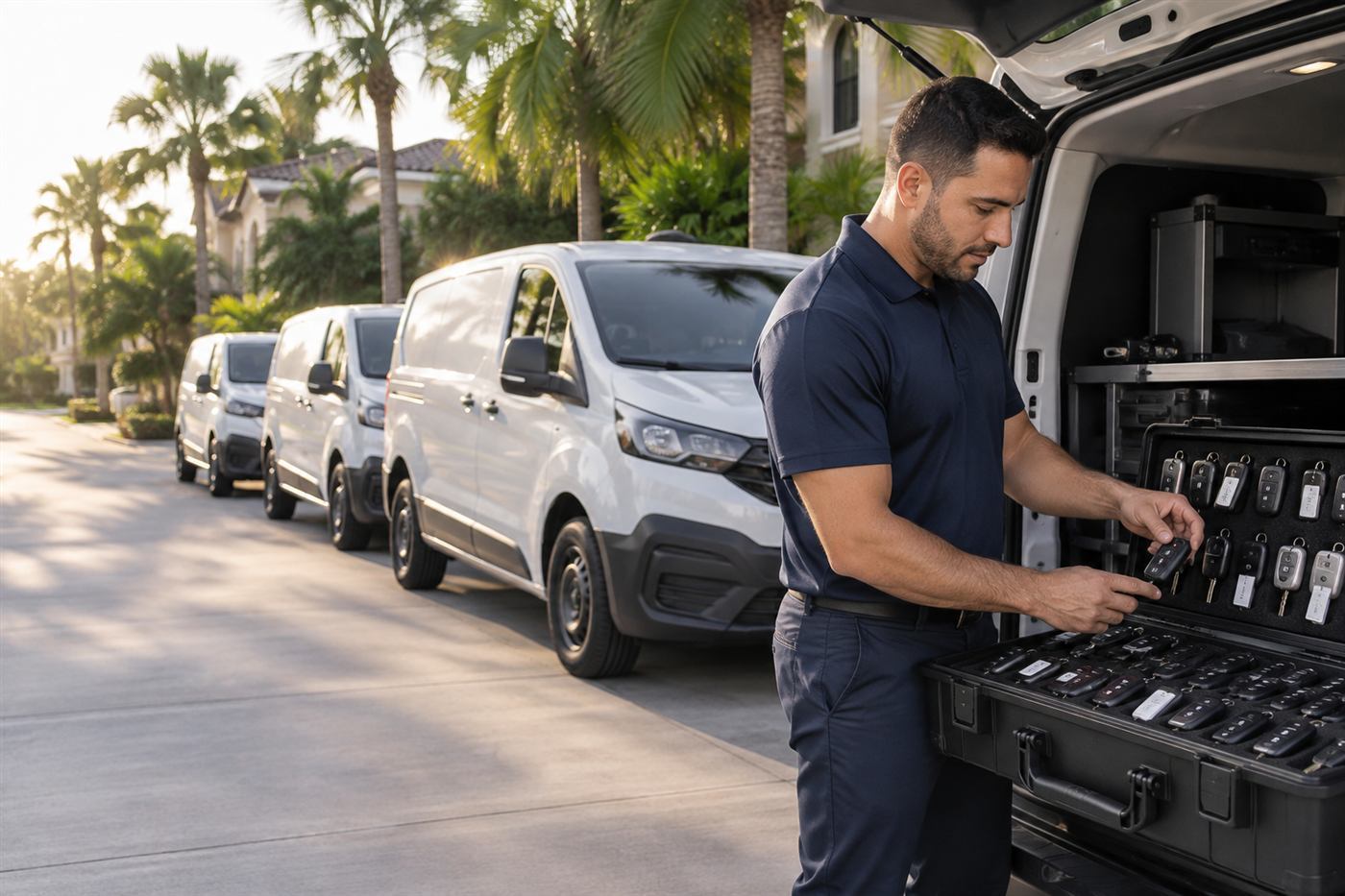
Why a fleet needs its own key plan
One family car and one set of keys is simple. A fleet of delivery vans, service trucks, shuttle buses or rental cars is a different matter. Each vehicle may have two or three keys, some with chips, some with remote fobs, and many of them are in the hands of drivers who rotate on and off the schedule. If you do not have a plan, you lose track of who holds what, and a single lost key can sideline a vehicle that is earning money.
The cost of a missing key is not only the replacement. It is the downtime while the vehicle sits, the driver who cannot start a route, the scramble to find a spare, and the worry that someone who should not have the key still does. For a business, that last point matters most. A key that left with a former employee is a security question as much as a convenience question.
A locksmith cannot run your key policy for you, but a locksmith can help you build the practical side of it: how many spares you need per vehicle, which keys must be programmed to the vehicle's computer, how to document what you hold, and what to do when a key is lost or an employee leaves. The sections below walk through the pieces so you can have a useful conversation when you call.
We handle the scheduling and quoting for fleet work by phone. Nothing about a fleet job is priced from a web page, because the right answer depends on the vehicle makes, the key types, the number of vehicles and where they are parked.
Know what kinds of keys your vehicles use
The first step in any fleet plan is an honest inventory of key types. Fleets often mix vehicle makes and ages, and the key technology can differ a lot between two vans that look alike. Our guide to types of car keys covers the full range, but here is the short version for a fleet manager.
- Plain mechanical keys: Common on older work trucks and some base model vans. They are the easiest and fastest to copy, and also the easiest for an unauthorized person to copy elsewhere.
- Transponder keys: A chip in the head talks to the immobilizer. The key must be cut and programmed to the vehicle before the engine will run.
- Remote head keys and flip keys: A key blade combined with a lock and unlock remote. These need cutting, chip programming and remote pairing.
- Smart keys and push button start fobs: The vehicle detects the fob nearby. These are the most complex to replace and the most sensitive to how many keys the vehicle will accept.
- Laser cut or high security keys: A milled track instead of an edge cut. They need the right machine and are not something every shop can cut.
| Key type | Needs programming | Fleet note |
|---|---|---|
| Plain mechanical | No | Easy to copy anywhere, so key control depends on policy |
| Transponder | Yes | Plan spares in advance; all keys lost is harder than adding one |
| Remote head or flip | Yes, plus remote pairing | Batteries wear out; keep spare batteries in the office |
| Smart or push button | Yes | Many vehicles accept a limited number of keys |
| Laser cut | Often yes | Needs specific cutting equipment; call ahead to confirm |
Building a spare key inventory
The easiest time to make a spare key is while you still have a working one. Copying from a working key is simpler than creating a key when every key is gone. Our page on all keys lost explains why that second situation takes more time and more verification. For a fleet, avoiding it is a clear goal.
A sound approach is to decide, vehicle by vehicle, how many keys should exist. Many businesses keep one key with the driver or the vehicle's assigned user and one in a secured key cabinet at the office. Vehicles in heavy rotation may warrant a third key kept by a supervisor. The right number depends on your operation, and a locksmith can talk through the options with you on the phone.
Tag every key with a number that does not reveal the vehicle's plate or VIN. Keep the key to number mapping in a separate record. If someone finds a loose key in a parking lot, the tag should tell them nothing useful. Do not write the plate or the company name on the key itself.
Order spares in batches when you can. If you are adding a driver or a new vehicle, bring in the work together. A technician can often make several keys in one visit, which is easier to schedule than many small visits. Keep in mind that vehicles with a limit on the number of programmed keys may need a plan so you do not use up every slot on spares.
What to do after staff turnover
When a driver or a manager leaves, ask two questions. Did they return every key they were given? And did they have a chance to copy any? If the answer to the first is no, or the answer to the second might be yes, you have a decision to make about whether the vehicles they could access should have their locks and keys reset.
There are a few options depending on the vehicle. For vehicles with chip keys, a locksmith can often erase the old keys from the vehicle's memory and program in fresh ones, so the old keys no longer start the engine even if copies exist. This does not always apply to every make, and some vehicles cannot be reset without the dealer's tools, so ask when you call. For door locks, the lock cylinders can sometimes be rekeyed so old keys no longer turn them. On vehicles with plain mechanical keys, rekeying or replacing the cylinders is the practical step.
Think about the other places the employee had access to. Fleet vehicles often carry keys to equipment cabinets, tool boxes, fuel caps and yard gates. A turnover review should list all of these. Our guide on business owner key control basics goes further on that side of the problem.
Document what you did and when. A short log with the date, the employee, the vehicles reviewed and the action taken is enough. It shows you took a reasonable step if a question comes up later, and it helps the next manager.
Programming, cutting and rekeying: how they fit together
Fleet managers sometimes treat these as the same job, but they are three different tasks, and knowing the difference helps you ask for the right thing. Cutting shapes the metal blade so it fits the lock. Programming teaches the vehicle's computer to accept the key's chip or the fob's signal. Rekeying changes the inside of a lock so a different key operates it. A single new key on a modern van often needs cutting and programming. A turnover reset may need rekeying, programming or both.
Ask for the work in terms of the outcome. For example: I need two additional working keys for each of these six vans, and I want the old keys removed from the vehicles' memory. Or: I have a truck where a driver left and I want the door and ignition locks rekeyed so the old key will not work. A technician can then tell you what is possible for each make and what needs a visit.
Our page on spare car key programming describes how adding a key to a vehicle works in general. Fleet work follows the same steps, repeated across vehicles. The main differences are scheduling and the paperwork that comes with managing several vehicles at once.
Some vehicles need unusual procedures, such as a waiting period on the dashboard before a new key is accepted. A technician should explain any waiting period before starting, so you can plan for the vehicle to be out of service for that time.
Scheduling work so vehicles stay on the road
The best way to protect uptime is to plan locksmith work around your operation. If a van is parked overnight at the yard, a visit at the yard in the evening costs you nothing in route time. If vehicles rotate through a depot during the day, arrange for the work to happen while each is already idle.
When you call, say how many vehicles are involved, where they are, and what hours they are accessible. If vehicles are spread across several sites, mention that, because it affects how the work can be grouped. Be honest about urgency. A single stranded vehicle with a lost key is an urgent call. A planned batch of twelve spares is a scheduled job and can be arranged to suit both sides.
We do not promise a technician at any particular hour or place. What we can do on the call is explain what is possible, ask about the vehicles and agree a plan. For anything involving many vehicles or more than one location, expect the person on the phone to ask for a list: make, model, approximate year, key type and whether each has a working key available.
Designate one person in your business as the point of contact for locksmith work. This is the person who can authorize the job, confirm ownership of the vehicles and receive the technician. Having a single contact avoids mixed messages and delays on the day.
Proving ownership for company vehicles
A technician will not make a key for a vehicle without reasonable proof that the person asking has the right to it. For a company vehicle, that usually means registration or title in the company's name, plus a photo ID for the person on site, and sometimes a letter or a call from an authorized manager if the person at the vehicle is a driver and not an owner or officer.
Leased and financed vehicles add a layer, because the title may be held by a lender or leasing company. Our guide on leased and financed car keys explains what is commonly asked for in that case. For a fleet, it is worth collecting the paperwork for each vehicle in a single folder, paper or digital, so a driver in the field does not have to track down documents while waiting.
Do not ask a technician to skip the ownership check. A reputable locksmith who skips it protects neither you nor themselves, and you should be concerned if anyone offers to. The check is a safeguard for your business as much as a formality, because it prevents a stranger from getting keys to your vehicles.
If a vehicle is rented to a customer or lent to a contractor, decide in advance who is authorized to call for key service. A short written rule that is shared with drivers saves confusion in a lockout.
Lockouts and lost keys on the road
Even with a good plan, a driver will sometimes be stranded. A driver at a delivery stop with the keys locked in the cab needs two things: a safe place to wait and a quick path to a solution. Give drivers a clear instruction card for what to do. If anyone, including an animal, is inside a locked vehicle in danger, call 911 first. Otherwise, the driver should call the dispatcher or manager, who confirms the vehicle and authorizes the call.
Drivers should know not to force a door, break a window or use tools they found online. Damage to a vehicle's door seals, window regulators and wiring is costly and often takes the vehicle off the road for longer than the lockout would have. Our page on car lockout service explains what a technician does and why a non-damaging approach is the usual choice.
Keep a record of lockouts by driver and by vehicle. A pattern may show that one driver is repeatedly locking keys in the cab, or that one vehicle has a faulty lock that needs repair. Both are fixable once you can see them.
Consider whether any vehicles should carry a key in a locked, coded lockbox attached to the vehicle. This approach has trade-offs, because the box itself can be a target, and some companies prefer not to. It is a policy decision for you, not a recommendation from us.
Keeping records and reviewing the system
A fleet key record can be simple. A spreadsheet or a logbook with one row per key is enough. Useful columns are: key number, vehicle, key type, who holds it, date issued, date returned, and notes. Update it whenever a key moves. Review it every few months, and always after a change in staff.
At each review, check that every key on the record can be found. Walk through the key cabinet and the vehicles, and compare. A missing key found early is a small problem. A missing key discovered after a theft is a large one. Make it routine for supervisors to check the cabinet at the end of a shift.
Look for patterns in your records. Which vehicles have had the most key problems? Are fobs failing often because of weak batteries? Do keys wear out faster on certain vehicles that are used in dusty or wet conditions? Our page on worn car key symptoms describes the signs that a key is near the end of its life, which is useful for a fleet manager planning replacements before a failure.
Finally, set a day each year to reassess your plan. As the fleet changes, the number of spares and the cabinet arrangements should change with it. A locksmith can discuss your setup on the phone and suggest adjustments.
How to get started with a fleet call
If you are ready to talk about your vehicles, gather a few details first so the conversation is quick and useful. The person on the phone will ask about the following.
- How many vehicles are involved and where they are kept.
- The make, model and approximate year of each, or of each group of the same type.
- The type of key on each vehicle: plain, chip, remote or push button.
- How many working keys exist for each vehicle right now.
- What you want to achieve: extra spares, a reset after staff turnover, a lost key replacement or a lockout.
- Proof that the vehicles belong to your business, and who on your side can authorize the job.
- When and where the vehicles can be reached, and any site access rules such as gates or visitor sign-in.
What to expect on the call
You will get plain answers. The person on the phone will explain what can be done for your vehicles, tell you whether any of them need extra handling, and quote the work by phone. If some of the work is complicated, for instance if several vehicles need to be reset in one visit or a vehicle needs a procedure that takes time, an on-site visit may be needed to assess it, and the service call charge is explained before anyone is dispatched.
Ask questions. Ask who will come, how they will confirm your authorization, and how the work will be documented. Ask what happens if a vehicle turns out to need a part or a tool the technician does not have. A good answer is clear and specific, and a vague answer is a warning sign. Our guide on questions to ask a locksmith before dispatch lists others worth asking.
When you are ready, call and tell us about your vehicles. Whether you have a single van with a lost key or a yard of trucks that needs a better system, we will take the details and work out a plan with you.
Questions people ask
Can you reset old keys so a former employee cannot start our vehicles?
On many vehicles, yes. A locksmith can often erase old chip keys from the vehicle's memory and program new ones, so old keys no longer start the engine. Some makes need dealer tools for this, and door and ignition cylinders may need rekeying instead. Tell the person on the phone the make and year of each vehicle so they can say what is possible.
How many spare keys should each fleet vehicle have?
There is no single right number. Many businesses keep one key with the assigned driver and one secured at the office, with a third for high rotation vehicles. Some vehicles accept only a limited number of programmed keys, so plan carefully. A technician can talk through the options for your makes when you call.
Do you give fleet prices on the website?
No. Quotes are given only by phone, because the cost depends on the makes, key types, number of vehicles and locations. Complicated jobs may need an on-site visit to assess, and the service call charge for that visit is explained before anyone is dispatched. Call with a short list of your vehicles and you will get a clear answer.
What proof do you need for company vehicles?
Usually the registration or title in the company name, a photo ID for the person on site, and sometimes confirmation from an authorized manager. Leased vehicles may need lender or lessor paperwork. Keep a folder of documents for each vehicle so a driver in the field is not stuck waiting while someone hunts for papers.
Can several vehicles be done in one visit?
Often, yes, when the vehicles are in one place and can be made available together. Grouping work is usually easier to schedule than many small visits. Tell the person on the phone how many vehicles, where they are and when they are idle, and they can discuss what is practical. We do not promise a technician at a set hour.
What if one of our vans is stranded with the keys locked inside?
If anyone or any animal inside is in danger, call 911 first. Otherwise have the driver contact your dispatcher, who confirms the vehicle and authorizes the call. Then call us with the location and vehicle details. Drivers should not force the door or window, because damage often costs more than the lockout would have.
Describe the situation by phone and we will tell you what the job involves. Quotes are given by phone. Jobs that cannot be quoted without seeing them need a technician on site, and the service call charge is explained on the phone before anyone is dispatched.
(844) 715-0800Related pages
Written by Claude (AI) (AI) for 24/7 Locksmith USA.