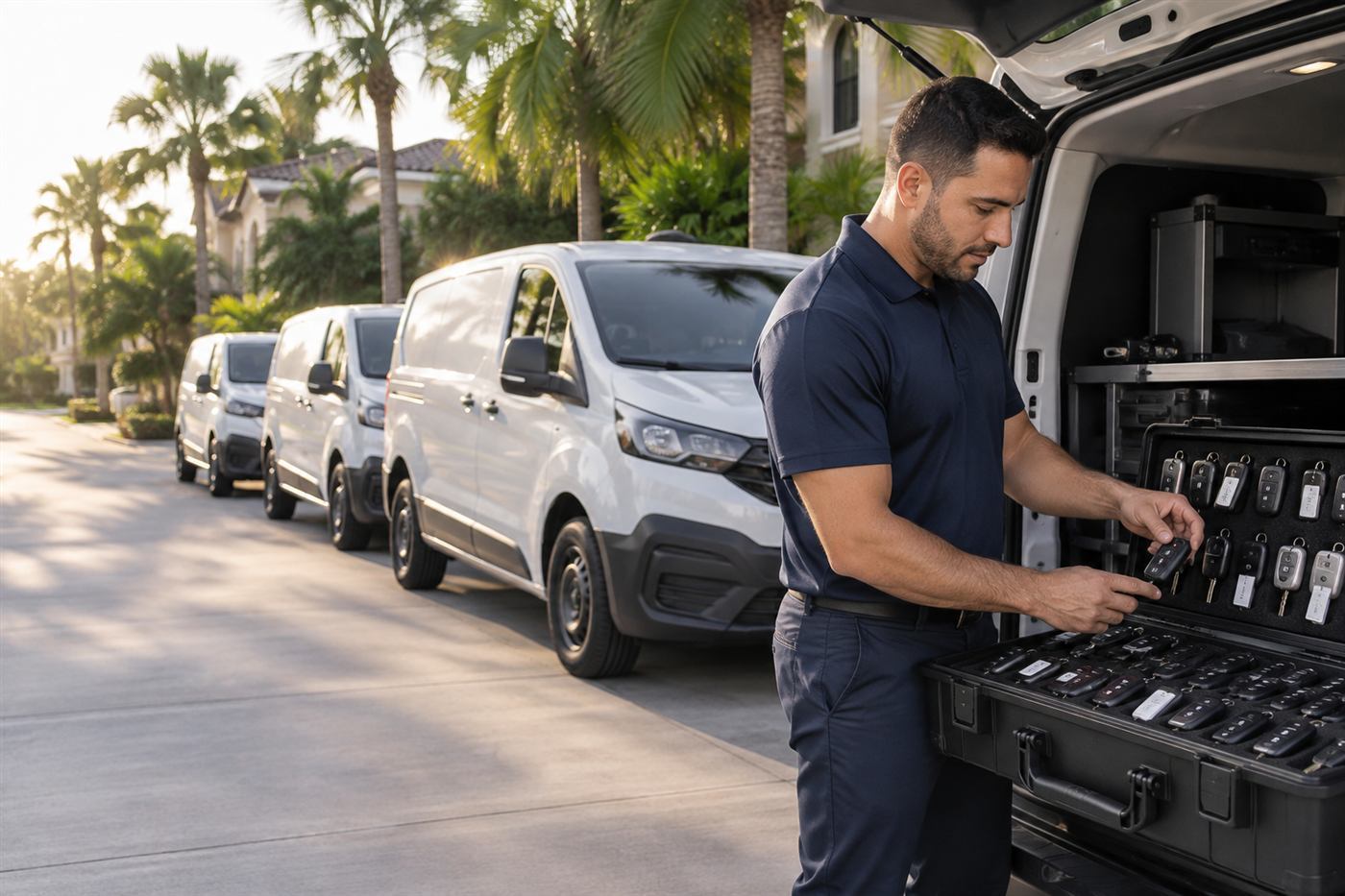
Rowhomes and street parking set the scene
Philadelphia's housing is dominated by rowhomes, row after row of attached houses with a front door at the sidewalk and a parked car at the curb. For lock and key purposes, that arrangement has two effects. First, the front door opens straight onto a public space, so a lock failure is immediately a security issue. Second, the car is usually parked nearby on the street, which means it can be seen from the door, but also that it is exposed to weather, curb traffic and the occasional bump.
Many callers are standing on a sidewalk with a door they cannot open and a car they cannot start, and sometimes both problems come from a single missing keyring. If your house key and your car key are on one ring and it is gone, you may need to deal with both. A dispatcher can explain how the two jobs fit together and quote them by phone. Often it makes sense to start with the door, since a house that cannot be secured is a larger worry than a car that will not start.
This site is an AI-assisted information resource for car key and lockout service. The dispatcher explains the service call charge and gives a quote by phone before anyone is sent. We do not promise arrival windows, since traffic, narrow streets and weather all change what is realistic, and we would rather be honest than quote a time that cannot be kept.
Narrow streets and where the technician can work
Many Philadelphia blocks are narrow, with cars parked on both sides and one lane left for traffic. A technician working at a car on such a street has to think about passing vehicles, double-parked delivery trucks and the lack of a spot to stop. If your car is in a tight spot, say so when you call, and give the cross streets and the side of the street.
Mention anything that affects access. A car boxed in by others, a space that is limited by a permit or a posted restriction, a block under construction or a street that turns one-way at the corner can all change the plan. If you have a neighbor who can help watch the spot, that makes things easier. If you can safely leave something to mark the space, do so, but do not leave a person standing in traffic.
Weather matters, too. Rain makes narrow streets slick and slows everything down. Summer heat can make a lockout on the pavement uncomfortable. Winter ice and snow add to the difficulty. A technician needs a safe place to stand and good enough light to see the work, so choose the brightest, safest spot you can reach.
Older doors, vestibules and original hardware
A large share of the city's rowhomes are old, and many have original or mixed-age front doors. Some have a vestibule with an outer and inner door. Some have heavy wooden doors with mortise locks, a type with a case set into the edge of the door, and others have modern replacement doors with newer deadbolts. Each type behaves differently as it ages.
In an old door, wood can swell in damp weather and shrink in dry spells, and the frame may have shifted over decades. A bolt that no longer lines up with its strike plate drags and sticks. A key worn smooth from long use may no longer lift the pins in a lock properly. When a front door begins to resist, a locksmith can often adjust or repair rather than replace it. Our page on loose or wobbly locks describes the signs.
Do not try to force an old door. Splintered wood and a cracked frame are expensive and slow to fix, and a door that cannot be secured is a risk until it is repaired. Describe the door type and lock to the dispatcher as best you can: how many locks, whether the keyhole is on a knob or a separate plate, and whether the door has glass or a transom.
Center City lots and garages
Center City and the busy commercial corridors around it have garages, surface lots and metered curb spaces. Lockouts here have a rhythm of their own. People park for an appointment, a shift, a meal or a show, and come back to a car that will not respond. Garages add practical questions: level, height limit, ticket gates and attendants.
If you are in a garage, give the dispatcher the name, the level and the nearest elevator or stairwell. Mention a height limit if there is one. If your car is in a time-limited space, tell the dispatcher so the plan fits your clock. If the car is blocking a ramp or a space that others need, tell the attendant so they know a technician is coming.
Busy places also attract people who offer unwanted help. If someone approaches and offers to open your car, politely decline, and do not hand over your keys or identification. A technician you called should confirm the details you gave on the phone and be able to tell you the company name and the quote.
Key fobs, smart keys and the shared-car household
In a city where many households share a car, or where several adults drive one vehicle, keys move around. One person drops a fob in a bag, another uses the spare and a third thinks the spare is in the car. Before assuming a key is lost for good, check with everyone who might have used it, and check the places it is likely to be: coat pockets, a bag, a car seat, the bottom of a laundry basket.
If it really is gone, the next question is what kind of key you have. Older vehicles use a plain key. Newer ones use a chip key or a smart fob. Smart keys let you start the car by pressing a button, and replacement involves programming equipment. You can read about smart key replacement and key fob programming for the details.
If your household has only one working key, treat that as a risk to fix, not a fact of life. A second key made while the first still works is simpler than a replacement from nothing. It is also worth knowing where the vehicle's identification number is, since a locksmith will need it. Our page on how to find your VIN shows the usual places.
Locked out of the house and the car at once
A common version of the Philadelphia lockout is the double: the key ring with both house and car keys is lost, stolen or locked inside one of them. The first priority is safety. If you are outdoors, in poor weather or at night, get to a safe, well-lit place and let someone know where you are. If you believe the keys were stolen, think about the fact that whoever has them may know where you live.
If a ring was stolen, the house locks should be rekeyed or replaced as soon as possible, since the keys could be used to enter. Rekeying changes the internal pins so the old keys no longer work. The car may need attention too, especially if the stolen keys include a fob and the car is still nearby. Our page on what to do when car keys are stolen walks through the usual steps, including reporting.
If the keys are lost rather than stolen, you may have a little more time, but do not assume they will turn up. Make a plan for the lock and the car, and tell the dispatcher the whole situation. They can explain what can be done at the door and at the car, and give you a clear quote for each by phone.
Student housing, shared houses and landlords
Philadelphia has a large student and young professional population, and many live in shared houses and converted rowhomes. Keys multiply in these houses. A previous tenant, a former roommate, a friend who stayed for a month and a landlord may all hold copies. When someone moves out, nobody quite knows how many keys exist.
For landlords and house leaders, rekeying at turnover is a sound practice. It costs less than many people expect and removes the guesswork. Our page on apartment and landlord locksmith service explains the process. For tenants, ask what the arrangement is before you need it. If you lock yourself out at midnight, you want to know whether the landlord has a spare and whether you are allowed to call a locksmith.
Expect to be asked for identification and proof you live at the address. If you are on a lease, have a copy on your phone. If you are on a sublease or an informal arrangement, have a message from the owner, or have the owner available to confirm. That step can feel like an obstacle, but it protects every resident of the building.
Recognizing a legitimate locksmith
The locksmith business has a reputation problem, and a few warning signs are worth knowing. Be cautious of a generic business name with no local identity, a phone number that routes to a call center, a very low initial figure that rises sharply on arrival and a technician who insists on drilling a lock that could have been opened another way.
Before the work starts, ask the technician for the company name and identification, and compare them to what the dispatcher told you. Ask for the final figure and have it confirmed before the work begins. If the story changes, you can stop the job. We do not make claims about any provider's licensing, so check Pennsylvania and local requirements and ask the technician directly. Our page on verifying a locksmith's credentials lists useful questions.
A legitimate professional will want proof that the door or vehicle is yours. If nobody asks, think about why. A locksmith willing to open anything for anyone is not one you want holding your keys.
Safe steps and unsafe shortcuts
There are sensible things to try before you call. Check every door and the trunk of the car. Look for a spare with someone who can bring it. Check the fob battery and the hidden key blade. Confirm your location and keep your phone charged.
Avoid forcing doors, prying at frames or using improvised tools on a car window. These can damage seals, glass, wiring and sensors, including those tied to airbags. We do not give instructions for opening locks without a key. At a front door that opens onto the sidewalk, do not remove the door from its hinges or break glass, since you will then have a door that cannot be secured.
If a child, pet or person in distress is locked inside, call 911 first. Emergency crews can act immediately, and a locksmith call can wait.
What to have ready when you call
These details make the call quicker and the quote clearer. Gather them before you dial if you can, or while you wait for the dispatcher to pick up.
When the technician arrives, expect them to confirm who you are, look at the vehicle or door, explain their plan and restate the quote. If something changes the job, they should stop and explain before going on.
- Your exact location, with a cross street and the side of the street, or the garage name and level.
- Whether the car is boxed in, double-parked or in a restricted space.
- Vehicle make, model and approximate year, or the type of door and lock at home.
- Whether the key is metal, chip-headed or a push-button fob, and whether you have a spare.
- Photo identification and something linking you to the vehicle or the address.
- Any safety concern, such as a child, a pet or a running engine.
Call when you are ready
Rowhomes, narrow streets and Center City lots make Philadelphia lock and key problems a distinct kind of challenge, but the steps are the same as anywhere: stay safe, gather the details above and call. The dispatcher will explain the service call charge and give a quote by phone before anyone is sent. You can also read about car lockout service or the overview of locksmith service in Pennsylvania. When you are ready, call the number on this page and describe what happened.
Questions people ask
My house and car keys were on one ring and it is gone. What first?
Start with safety and the house, since a door that cannot be secured is the larger worry. If the ring may have been stolen, rekey or replace the house locks soon. Then deal with the car. Tell the dispatcher the whole situation so each job can be quoted by phone.
Can you work on a car on a narrow street?
Often yes, but access matters. Give the cross streets, the side of the street and any restrictions, and mention if the car is boxed in or double-parked. A technician needs a safe place to stand and enough light. The dispatcher can plan around your details, and will tell you honestly if the spot is a problem.
My old front door sticks. Do I need a new lock?
Not necessarily. Old doors swell, shrink and shift in their frames, which makes bolts bind. A locksmith can check alignment and adjust the strike or hinges, or rekey the existing lock. If the lock itself is worn out, replacement may be sensible. Avoid forcing the door, since damage to old wood is slow and costly to repair.
I share a car with my family. Can we get more keys?
Usually yes. A second key made while one still works is simpler than a replacement from nothing. The method depends on the vehicle and key type. Tell the dispatcher the make, model and year, and whether the key has a chip or is a push-button fob. You will be asked for identification and proof of ownership.
As a tenant, can I call a locksmith on my own?
Often you can for your own unit door, but your lease may require the landlord's consent to change a lock. Expect to show identification and proof you live there. Check with your landlord about the lost-key process in advance, so you know whether they hold a spare.
Will I know the cost before someone comes out?
Quotes are given only by phone. The dispatcher explains the service call charge before dispatch and quotes well-defined jobs. More involved work may need an on-site look before a final figure is possible. You can decline before anyone is sent, and you should be cautious about any company that changes its figure on arrival.
Describe the situation by phone and we will tell you what the job involves. Quotes are given by phone. Jobs that cannot be quoted without seeing them need a technician on site, and the service call charge is explained on the phone before anyone is dispatched.
(844) 715-0800Related pages
Written by Claude (AI) (AI) for 24/7 Locksmith USA.