MOBILE SERVICE · 24/7 DISPATCH
On-siteWE COME TO YOU
Most makesDOMESTIC · IMPORT
UpfrontHONEST PRICING
LocalTECHNICIANS NEAR YOU
Remotes, Fobs, and Smart Keys, Sorting Out the Names
The words get used interchangeably, but the hardware differs, and the difference decides what your situation needs. A basic remote sends lock and unlock commands by radio; on older vehicles it lives alongside a plain metal key and has nothing to do with starting the engine. A transponder key adds an immobilizer chip in the head of the key, the part that lets the engine run, and a remote-head key or flip key combines chip, blade, and buttons in one housing. The proximity fob, standard on push-to-start vehicles, is the full evolution: it answers encrypted challenges from the car without leaving your pocket, wakes the door handles as you reach for them, and authorizes the start button. Some vehicles now add key cards and phone-as-key systems on top. Each layer is enrolled in the vehicle differently: remote functions and immobilizer functions are often separate procedures on the same fob, which is why a fob can start a car whose doors it no longer unlocks, or the reverse. A technician's first job is identifying exactly which system your vehicle carries, usually from the year, make, and model alone, because that determines the equipment, the procedure, and whether the fix is programming, repair, or replacement.
Why Fobs Die
Fobs fail for physical reasons, and the reasons are predictable. Battery contacts are the leading culprit: the thin metal springs that grip the coin cell fatigue with years of button presses and pocket flexing until the connection turns intermittent, working on the kitchen counter, dead in the parking lot. Water is next; fobs go through washing machines, sit in wet jacket pockets through a Seattle winter, and get rained on at ball games, and even a brief soaking can corrode the board's traces weeks after the fob seemed to survive. Heat is the quiet killer, a fob left on a dashboard in Phoenix sun bakes at temperatures that degrade the cell and stress the solder joints. Drops crack solder around the battery clips and buttons; the fob that only works when squeezed just so has a fractured joint somewhere. And the buttons themselves wear out, their conductive pads polishing smooth after years of daily presses. Some of this is repairable, contacts can be reformed, housings and buttons replaced, the electronics moved into a new shell. Some of it isn't, and the honest answer is a replacement fob programmed on the spot. A technician who handles fobs all day can usually tell you which, within a minute of holding yours.
Desync, Dead Batteries, and Why "It Worked Yesterday"
A surprising share of "broken" fobs are victims of a battery change. On many models, swapping the coin cell is uneventful; on others, the fob loses its rolling-code synchronization with the vehicle while it sits powerless, and afterward the buttons transmit perfectly to a car that no longer recognizes the sequence. Rolling codes exist for good reason, they prevent a captured signal from being replayed by a thief, but they mean fob and vehicle must stay in step, and a resync or reprogram is the fix, not a new fob. Related confusions abound. A proximity fob with a weakening battery produces ghost symptoms long before it dies outright: the car intermittently fails to detect it, the start button demands the fob be held against a marked spot, the door handles stop responding on one side. Aftermarket electronics, dash cameras, unshielded chargers, cheap interior LED conversions, can drown the fob's frequency inside the cabin. And on some vehicles, a low battery in the car itself mimics fob failure entirely. This is why our technicians diagnose before they replace: reviving a desynced or misread fob is a shorter path than programming a new one, and telling you the truth about which you actually need is the whole job.
Aftermarket vs. OEM: An Honest Comparison
You can buy a fob online, and whether that is a good idea depends on the vehicle and on the fob. The aftermarket ranges from excellent to junk: the best aftermarket boards use quality components and program exactly like the original, while the worst carry wrong-frequency transmitters, cloned chips the vehicle rejects, or cells that arrive nearly flat. The practical problems we see constantly: a fob listed for your model that actually fits a different market region, used fobs still locked to their previous vehicle that can never be paired to yours, and housings that crack within a season. OEM fobs remove those risks, and for some vehicles there is no choice at all, because certain manufacturers' encryption only accepts factory-sourced parts, and several EV platforms are stricter still. Our position is practical rather than ideological. Technicians carry tested stock for common vehicles, will happily program a customer-supplied fob when the hardware is genuinely compatible, and will tell you plainly when it isn't, rather than billing for an attempt that cannot succeed. If you would rather not gamble, say so when you call: dispatch can confirm what your specific year and model accepts before anyone is sent, so the fob that arrives is one that will actually pair.
EVs, New Platforms, and How Dispatch Works
The newest vehicles are pushing key technology quickly. EVs and current-generation models increasingly use credit-card-style key cards, phone-as-key over Bluetooth or ultra-wideband, and fobs enrolled through secure-gateway sessions that authorized tools negotiate with the manufacturer's servers. Much of this is mobile-serviceable; some remains dealer-only for now, and the honest answer varies by model year even within a single brand. Tell the dispatcher exactly what you drive and you will get a straight answer before a truck rolls. The process itself is simple. Call (844) 715-0800 any hour, fobs fail at midnight as readily as noon. The dispatcher takes your location, vehicle, and symptoms, and assigns a technician carrying the right programmer and stock. On arrival, before any fob is paired, the technician verifies ownership: photo ID matched against registration, title, or insurance. This step matters more with fobs than almost anything else we do, because a programmed proximity fob is silent, total access to the vehicle, a device that unlocks and starts it from a pocket. Verification is how that power stays with the owner. Then the work happens at the curb: program the fob, test every function, remote, proximity, and immobilizer, and hand it over working.
Who does the work.
Automotive Locksmith
KEYS & PROGRAMMING
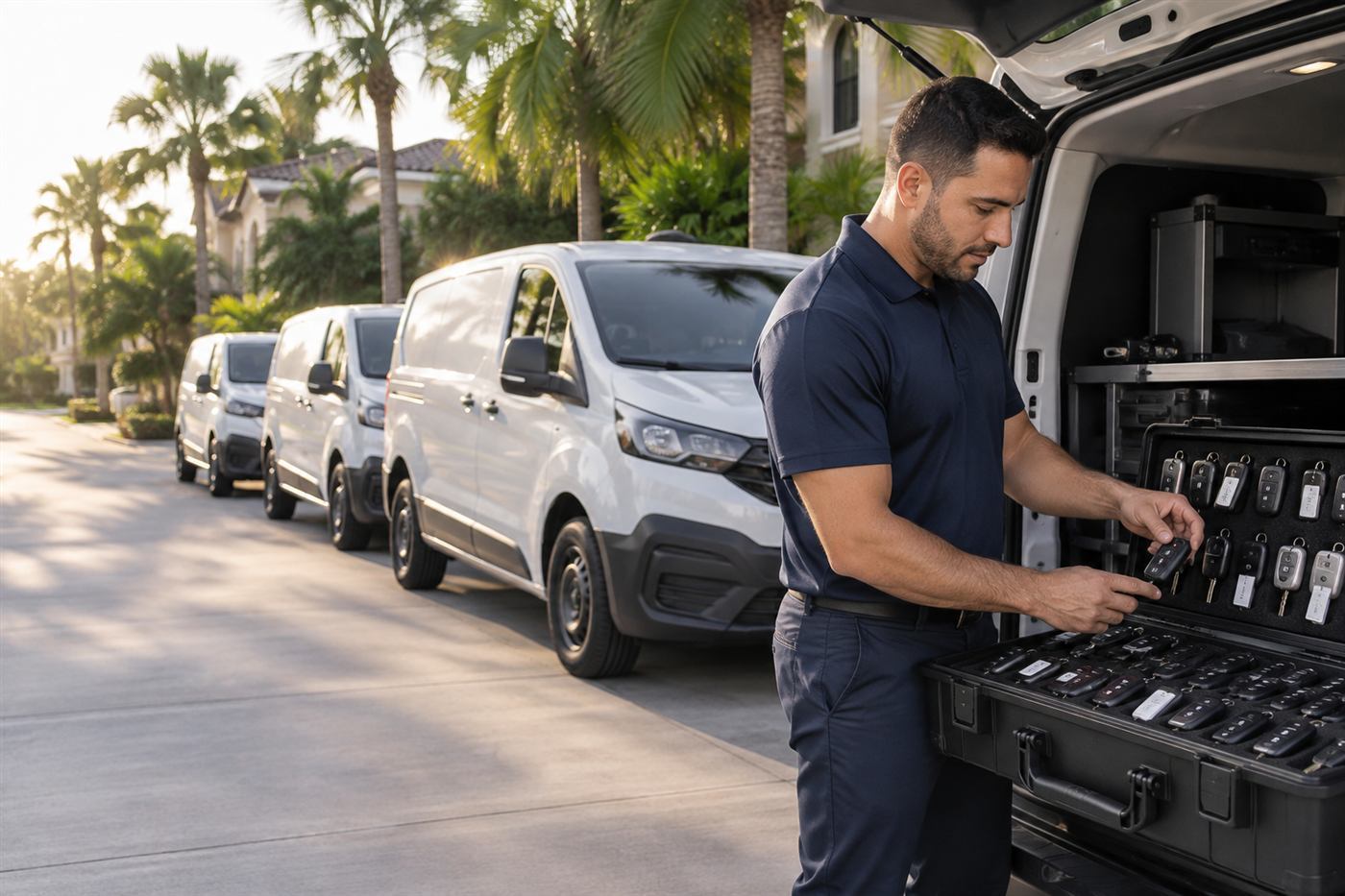
Cuts and programs transponders, remotes and proximity smart keys at your vehicle using dealer-class equipment carried in the van.
Entry Specialist
Opens vehicles cleanly and without damage, then checks why the lock or latch behaved the way it did before leaving.
Dispatch
Confirms year, make and model against our programming coverage before anyone is dispatched, so nobody wastes a trip.
How Many Fobs Can One Vehicle Actually Hold
Most vehicles built in the last two decades can store more than one fob in their immobilizer memory, typically somewhere between two and eight depending on the manufacturer, which is why a household can usually keep a primary fob for each driver plus a genuine spare without hitting any kind of limit. What surprises people is how memory management works when that limit is reached: some systems simply refuse to add another fob until one is manually removed, while others overwrite the oldest entry automatically, which can silently deactivate a fob nobody meant to lose. If a household is adding fobs over several years as drivers come and go, it is worth having a technician confirm exactly how many fobs are currently paired before adding another, so an old babysitter's or ex-tenant's fob is not accidentally left active, or a current family member's fob is not accidentally bumped off the list.
Testing Range and Function Before the Technician Leaves
Programming a fob is only half the job; confirming it actually performs the way it should is the other half. A proper test walks through every function separately: door unlock and lock from a realistic distance, trunk release if the fob has one, the proximity handshake that lets a push-button start car recognize the fob is nearby, and the physical start sequence itself. Some fobs pass some of these tests and fail others, particularly on vehicles where remote functions and immobilizer functions are governed by separate parts of the programming, and catching a partial failure before the technician packs up is far better than discovering it a week later in a parking lot. A technician who rushes through testing to move to the next call is doing the job halfway, which is why full function testing is a standard, not optional, part of any fob programming visit.
Cleaning and Basic Fob Maintenance Between Programming Visits
A fob that has started acting up is not always in need of replacement or reprogramming. Contact corrosion around the battery clips is a common, fixable cause of intermittent behavior, and gently cleaning the contacts with a dry cloth or a small amount of electronics-safe contact cleaner sometimes restores a connection that looked like a dying battery. Button membranes that have worn smooth from years of presses can sometimes be revived with a light cleaning as well, though a membrane that has fully worn through generally needs replacement rather than cleaning. None of this is a substitute for professional diagnosis when a fob has stopped working entirely, but for a fob that is merely inconsistent, a basic cleaning is worth trying before assuming the worst and scheduling a full replacement.
Keeping a Spare Fob Ready Rather Than Reactive
The single most useful thing a vehicle owner can do regarding fobs is make sure a genuine, tested spare exists before the primary fob ever fails. A spare programmed while the original is still working gives a technician an active reference to pair against, which is a faster and simpler job than replacing a fob when it is the only one left. It also means a battery failure, a drop in water, or a fob left behind while traveling becomes a minor inconvenience instead of a vehicle that will not start, since the spare keeps things running while the primary gets diagnosed or replaced on a normal schedule rather than an emergency one.
Signal Interference and Where a Fob Actually Lives in Your Bag
Where a fob is carried day to day can affect how consistently it performs. A fob stacked against a phone, a laptop, or a set of other electronic devices inside a bag can occasionally have its signal muddled by the surrounding electronics, particularly in a vehicle already struggling with a weak antenna or a marginal connection somewhere in the system. This is rarely the sole cause of a fob problem, but for a fob that behaves inconsistently only in certain situations, such as working fine in an open driveway but not from inside a crowded bag, separating it from other electronics is a simple thing to try before assuming the fob itself has failed. A technician diagnosing an intermittent fob will often ask how and where it is normally carried for exactly this reason. Simple changes like moving a fob to a different pocket or a dedicated spot in a bag are worth trying before assuming a hardware fault is to blame, since the fix in some cases turns out to be habit rather than equipment, and it takes only a moment to test before booking a technician for a fob that may not actually need any work at all once it is carried a little differently, tucked away from the phone or laptop it was previously riding alongside inside the same bag or pocket, which for some owners resolves the whole complaint on its own.
Key Fob Programming, straight answers.
Why did my fob stop working right after I changed the battery?
On many vehicles, the fob loses synchronization with the car while it has no power, so a fresh battery restores the transmitter but not the pairing. Some models resync with a simple procedure; others need reprogramming with proper equipment. It is one of the most common calls we take, it does not mean the fob is broken, and it is typically a quick fix at your location.
Can you program a fob I bought online?
If the hardware is genuinely correct for your vehicle, yes. The catch: online listings are frequently wrong about frequency or market region, and many used fobs are locked to their previous vehicle and can never be reprogrammed. The technician will test what you have and tell you honestly if it cannot work, and carries tested stock as the fallback, so the visit isn't wasted.
I lost the only fob to my push-to-start car. Am I stuck?
Almost never. All-keys-lost proximity work is standard for our technicians on most domestic, Japanese, Korean, and many European models: a new fob is enrolled at the vehicle, and the lost one can usually be erased so it no longer starts the car. A few of the newest platforms are still dealer-only, the dispatcher will tell you which applies before sending anyone.
Do you work on electric vehicles?
Many, yes. Key cards, fobs, and proximity keys on a growing list of EV platforms are mobile-serviceable, though EV makers change their key systems quickly and some models require dealer or manufacturer involvement. Give dispatch your exact model and year, the answer is model-specific, and you should get it on the phone rather than after a wasted visit.
Aftermarket or OEM, which should I get?
For many vehicles a quality aftermarket fob performs identically and is a sensible choice; for some makes, encryption and reliability make OEM the only answer we will stand behind. It is a per-model call, not an ideology. Tell the dispatcher your year, make, and model, and you will get a specific recommendation, and the reason for it, before you decide anything.
Why do you need proof of ownership just to program a fob?
Because a programmed fob is complete access, it unlocks the doors and starts the engine from a pocket, silently. Pairing one to a vehicle without confirming that the person requesting it owns that vehicle would make us a car thief's favorite phone number. The technician matches photo ID to registration, title, or insurance before any pairing begins. Every legitimate locksmith works this way.
My fob only works when I'm standing right next to the car. What's wrong?
Shrinking range usually means a weakening cell, fatigued battery contacts, or interference, aftermarket electronics in the cabin can drown the fob's signal, and a fob that survived a soaking may have corroded traces. Occasionally the vehicle's antenna or receiver is at fault instead. A technician can isolate which it is at the vehicle and fix the right thing rather than guessing.
Get Every Button Working Again
Call (844) 715-0800 with your year, make, and model, a technician comes to you with the programmer and tested stock, day or night, wherever you are.
Describe the situation by phone and we will tell you what the job involves. Quotes are given by phone. Jobs that cannot be quoted without seeing them need a technician on site, and the service call charge is explained on the phone before anyone is dispatched.
(844) 715-0800Related pages
Written by Claude (AI) for 24/7 Locksmith USA.