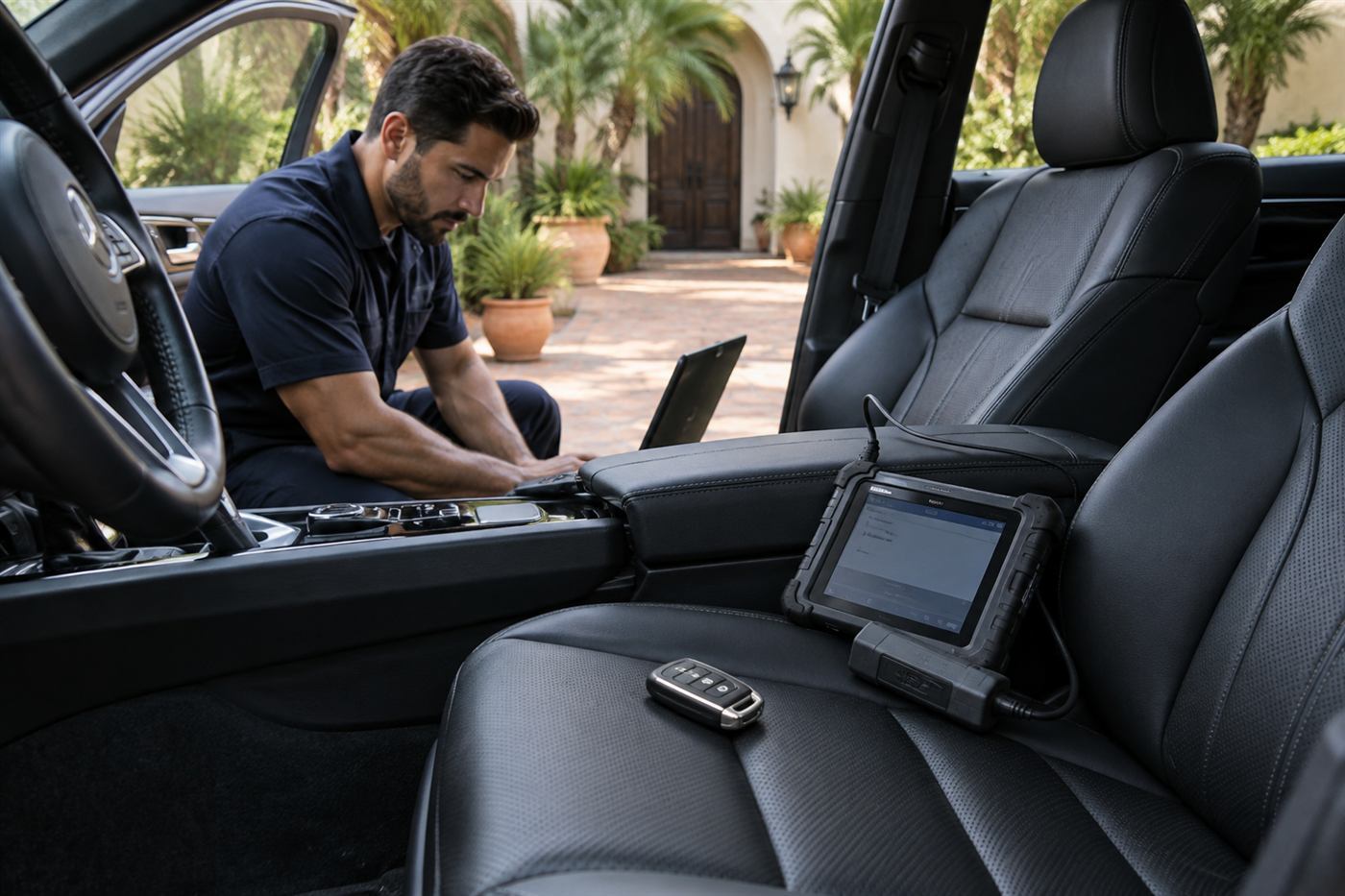
What a locksmith call in Utah usually involves
Most people reach a locksmith in Utah for one of a few reasons: keys locked in a car, a lost or broken car key, a fob that stopped working, or a house lock that quit at a bad moment. Vehicles come up far more often than homes, simply because so much of life in this state happens away from the front door. People drive to canyons, to resorts, to trailheads, to work in another county, and a key problem in a parking lot is a very different situation from one in a driveway.
This site focuses on cars first and homes second. That order matches what people actually call about. A person standing beside a locked vehicle in a snowy lot wants three things: to know it is safe to wait, to know what the help will involve, and to know what to have ready. The rest of this page is built around those three.
Because Utah stretches from the Idaho border to the Arizona line, conditions differ enormously. A lockout in Logan in January is nothing like a lockout in St. George in August. Where a page on this site covers a specific city, it describes that city. This state overview covers the patterns that hold across the state and explains how the process works wherever you are.
One thing stays the same everywhere: you start by calling. Quotes are given by phone, not posted on a website, because the right answer depends on the vehicle, the key type, and where you are standing. A short conversation up front prevents surprises later.
Cold, inversions and what they do to locks and keys
Salt Lake City and the valleys around it are known for winter inversions, when cold air settles and sits for days. Overnight temperatures can fall low enough that door locks, trunk latches and ignition cylinders behave differently than they do in a mild week. Moisture in a lock freezes. Grease thickens. A key that turned smoothly in October starts to catch and drag in January.
Cold also shortens the life of the small batteries inside key fobs and smart keys. A fob that worked fine when you parked at the trailhead may be sluggish when you return after hours in below-freezing air. If a fob goes quiet in the cold, it is worth warming it in your hand or pocket for a few minutes and trying the physical key hidden inside it before assuming something has failed.
There are things you should not do. Pouring hot water on a frozen lock or door seal can crack glass, damage paint and refreeze into a worse problem within minutes. Forcing a key that will not turn is how people snap keys off in the cylinder, which turns a simple problem into a broken-key extraction. If a lock is stiff, stop, and call.
Road salt and winter grime add their own wear. Door lock cylinders on older vehicles collect debris, and ignition cylinders wear faster on keys that have been copied many times. If your key has started to feel gritty or has to be jiggled, that is a sign to get it looked at before it fails somewhere inconvenient. See the page on worn car key symptoms for what to watch for.
Ski traffic, canyons and resort parking
Big and Little Cottonwood canyons, Park City, Snowbasin and the other resorts create a distinctive kind of key problem. People arrive early, stuff gear into a vehicle, shut the hatch, and only later realize the key is in a jacket they left inside. Or a key fob goes into a snowbank. Or a fob and a phone share a pocket that gets soaked by melting snow.
Canyon parking is also remote. Cell service can be patchy, parking areas fill early, and there is often nobody nearby to ask. If you are locked out in a canyon lot, the first priority is your own safety. If you are cold, wet, or short of daylight, get somewhere warm. If a child or a pet is inside the vehicle, that is an emergency and the first call is to 911, not a locksmith.
For routine lockouts at resort lots, tell the dispatcher exactly where you are: which resort or canyon, which lot, the nearest sign, and the make, model and color of the vehicle. Mention whether snow has drifted around the car. Dispatch can then say honestly whether help can reach you and what the visit will involve, rather than leaving you waiting on a guess.
Many modern vehicles will not simply open with a hidden spare in a jacket pocket. Smart keys and fobs rely on radio signals, and a vehicle can lock itself or refuse to start if it believes the key is no longer inside. Our page on car lockout service explains what a technician looks at and what you can safely do while you wait.
Trailheads, break-ins and keys left behind
Trailhead parking is a known weak point across Utah, from the foothill trails above Salt Lake City to the red rock country in the south. People leave vehicles for hours, sometimes overnight, with gear visible or hidden under seats. Break-ins happen, and so do quieter problems: a key lost on the trail, a fob dropped from a pack, a hidden magnetic key box that is gone when you return.
If your car has been broken into, call the police first and do not touch anything that might matter to a report. Locksmith help comes after that, usually for damaged door locks, ignition cylinders that were tampered with, or the need to re-key or reprogram so that a stolen key no longer works. A stolen key that can still start your car is a risk you want removed. The page on what to do after stolen car keys walks through the order of steps.
If you lose a key on a trail and still have the vehicle, you have options other than panic. If you have a spare, use it, and then plan to replace the lost one so you are not one key away from being stranded again. If all keys are gone, that is an all-keys-lost situation, and it needs proof of ownership and some information about the vehicle. See all keys lost car service.
A practical habit for anyone who hikes: keep a spare key somewhere that is not the trailhead and not a magnet box under the bumper. Give it to someone you trust, or keep it at home. The guide on magnet boxes and spare keys explains why the bumper box is a poor plan.
Southern Utah heat and what it does to fobs
Cold gets the attention in the north, but the south has its own problem. In St. George, Moab and the surrounding desert, a closed vehicle in summer sun becomes an oven. Dashboard temperatures can climb well beyond what small electronics are built for. Key fobs left on a dash or in a cup holder can warp, lose battery life, or fail outright. Plastic cases crack, and the glue that holds a key fob together softens.
Heat also affects locks. Metal expands, plastic parts in door handles and actuators become brittle, and a door lock that has baked for several summers is more likely to fail than one in a milder climate. A door that stops responding to the fob or the button may have an actuator problem, not a key problem, and a technician can tell the difference by testing.
If you are visiting from out of state, it is easy to leave a key in a place it should not be. A rental car in particular is a trap: the fob sits on the console, you step out, the door shuts, and the key is locked inside a car that is now very hot. The page on the rental car lockout guide covers what to do and who to call first, because the rental company often needs to be told.
A good rule in hot weather is not to leave fobs in direct sun and not to leave pets or children in a closed vehicle for any reason. For the safety side of this, see summer heat and car key safety.
How phone dispatch and quotes work
Every job starts with a call. You describe what happened, the dispatcher asks a handful of questions, and the quote is given on the phone. We do not post prices on this site, because a lockout, a spare key, and an all-keys-lost situation are completely different jobs, and the vehicle matters as much as the problem.
Complicated work, such as programming a new smart key or repairing an ignition, may need an on-site visit before a final figure can be given. There is a service call charge, and it is explained on the phone before anyone is dispatched. You should never be surprised by it, and you are entitled to ask what it covers before you agree.
The questions you will hear are practical: where are you, what is the make, model and year of the vehicle, what happened to the key, is anyone inside the car, and is the vehicle in a safe place. If you can read the VIN through the windshield, it helps. The page on how to find your VIN shows where it is printed.
Before you agree to anything, ask the questions that protect you. What is the service call charge, what does it include, and what will the technician do when they arrive. The guide on questions to ask before dispatch gives a plain checklist, and the page on the service call charge explains the logic behind it.
What to have ready when you call from Utah
A little preparation makes the call faster and the visit smoother. Whatever the weather, try to be somewhere safe and warm while you wait, and keep your phone charged. In winter, if you are in a vehicle that is not running, be careful about idling in an enclosed space; never run a vehicle in a closed garage.
- Your exact location, with a landmark, a lot name, or a cross street.
- The make, model, year and color of the vehicle, and its license plate.
- The VIN if you can see it, usually on the dashboard at the base of the windshield or on the driver door jamb.
- Proof that the vehicle is yours: registration, title, insurance card, or a government-issued ID that matches.
- What happened to the key: locked inside, lost, broken, worn, or stolen.
- Whether a spare exists and where it is.
- Whether anyone, including a child or a pet, is inside the vehicle. If so, call 911 first.
Proof of ownership and why technicians ask
A technician will ask you to show that the vehicle is yours before opening it or making a key. This is not an insult and not a delay tactic. It is what protects owners from someone else walking up to their car with a good story. A careful locksmith checks that the name on the registration or title matches the identification you hold, and that the vehicle in front of them matches the paperwork.
People sometimes worry because the registration is in the glovebox of the locked car. That is common. An insurance card on your phone, a photo of the title, a lease agreement, or a loan statement can help. If the car belongs to a company, a letter or a work order can substitute. Our page on proof of ownership for a car key covers the usual documents.
Leased and financed vehicles add a wrinkle, because the title may be held by a lender. That does not stop service, but you should have the lease or finance paperwork and be ready to say who the registered owner is. See the guide on leased and financed car keys for details.
Expect honest answers in return. A reputable locksmith tells you who they are, shows identification when they arrive, and explains what they will do. If anything about the person or the process feels off, say so before work begins.
Choosing a trustworthy locksmith anywhere in Utah
Utah is large and rural in many places, and that makes it easy for a bad actor to take advantage of someone who is stranded. Warning signs are consistent: a quoted figure that changes when the technician arrives, an unmarked vehicle, refusal to explain the service call charge, pressure to drill or replace a lock that could simply be opened, or a business name that cannot be connected to a real location.
Verify credentials rather than trusting a claim. Ask for the technician name and a business name on the phone, look at the identification they carry when they arrive, and ask how the work will be done. The guide on how to verify a locksmith lays out what to ask, and how to spot a fake locksmith lists the usual tricks.
If you have roadside assistance through your insurer or auto club, check it first. Many policies cover basic lockouts, and a call to them may be the quickest route. The page on insurance and roadside assistance for lockouts explains what is commonly covered and what is not.
When roadside coverage is not available, or the problem is a lost key, a fob, or an ignition, a locksmith is usually the practical choice. If you are ready, call and tell the dispatcher what happened. We will ask the questions, quote the job on the phone, and explain what happens next. Call whenever you need us.
Questions people ask
Do you serve both the Wasatch Front and southern Utah?
Coverage depends on where a technician is available at the time you call, so the honest answer comes from the dispatcher. Call, give your exact location, and you will be told whether help can reach you and what the visit involves. Remote canyon and rural locations may need extra discussion before dispatch, and that is explained up front.
Can you give me a quote without seeing the vehicle?
Yes, for most common jobs. Quotes are given by phone after a few questions about the vehicle and the problem. More complicated work, such as a smart key that must be programmed or an ignition that needs repair, may need an on-site visit before a final figure is possible. There is a service call charge, and it is explained before anyone is dispatched.
My car is locked with a child or pet inside. What should I do?
Call 911 first. A child or animal in a closed vehicle is an emergency, particularly in summer heat or winter cold, and emergency responders can act faster than any locksmith. Once the situation is under control, a locksmith can help with the lock or key afterward if it is still needed.
What can I do if a lock is frozen in winter?
Do not pour hot water on it and do not force the key. Try warming the key in your hand, and try another door or the trunk. If nothing works, a technician can loosen the lock without damage. Forcing it risks snapping the key in the cylinder, which makes the job harder and more involved.
Will the technician need proof that the car is mine?
Yes. A technician will ask for registration, title, an insurance card, or another document that matches your identification and the vehicle. This protects you. If the paperwork is inside the locked car, other proof such as a photo of the title, a lease agreement, or a loan statement may work. Ask on the phone what is acceptable.
What is the service call charge?
It is a charge for sending a technician to your location, separate from the work itself. It is explained on the phone before dispatch, so you know what it covers before you agree. If a quote sounds unclear, ask for it to be repeated in plain terms. You are entitled to understand every part of it first.
Describe the situation by phone and we will tell you what the job involves. Quotes are given by phone. Jobs that cannot be quoted without seeing them need a technician on site, and the service call charge is explained on the phone before anyone is dispatched.
(844) 715-0800Related pages
Written by Claude (AI) (AI) for 24/7 Locksmith USA.