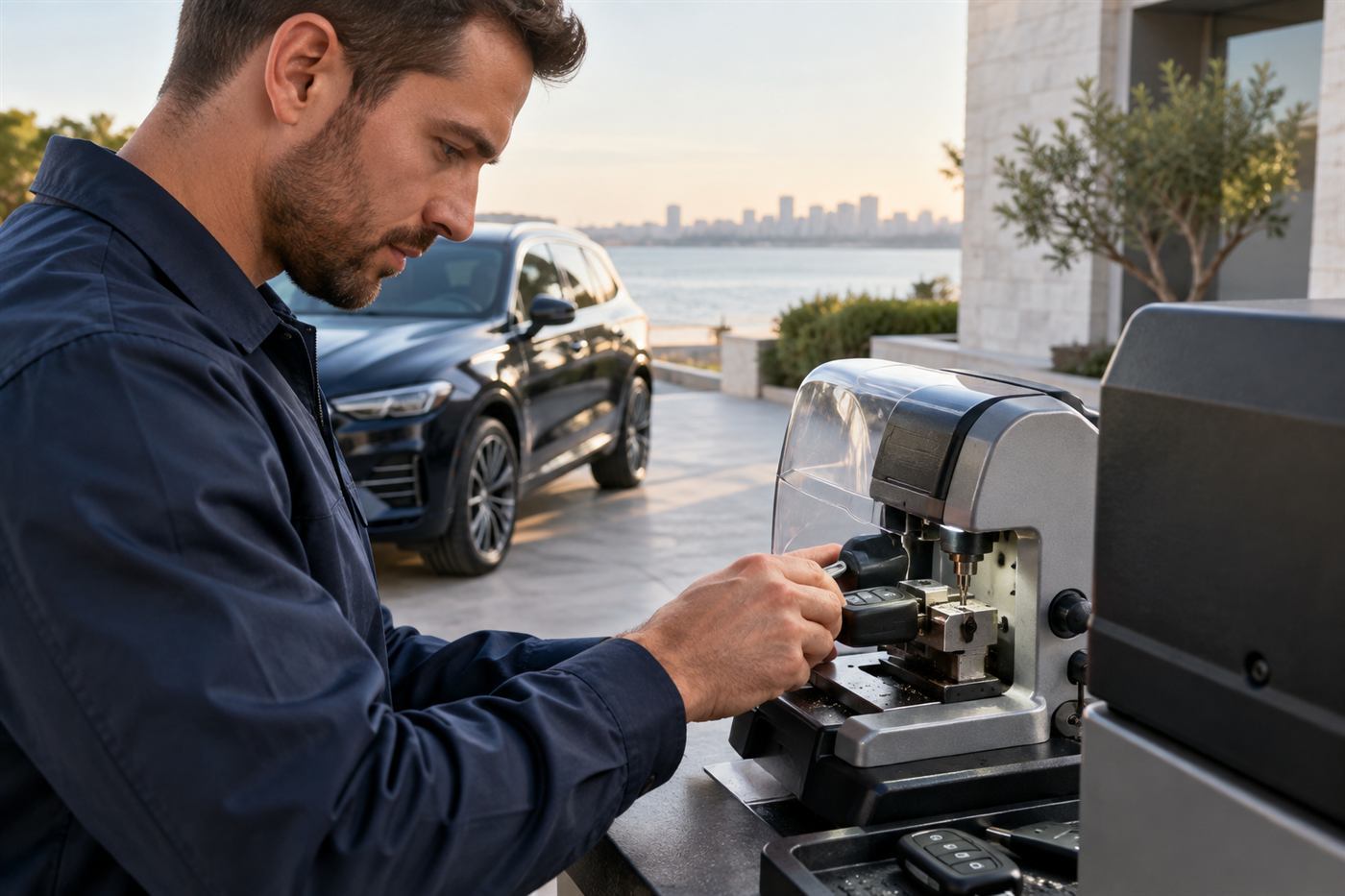
How a locksmith call works in Missouri
Every job begins with a phone call. The dispatcher asks where you are, what the vehicle or door is, and what happened. From those answers they can tell you whether this is a simple lockout, a key that needs to be cut and paired, a broken key to extract, or a problem that needs to be seen in person. Quotes are given by phone only, and no prices are listed on this site, because every job depends on the vehicle, the key type and the situation.
Some jobs can be quoted completely over the phone. More complicated ones, such as a worn ignition or a forced lock, need an on-site visit before a firm number can be given. There is a service call charge for dispatch, and it is explained before anyone is sent. Ask what it covers and whether the quote you were given is for the whole job. Those two questions prevent most misunderstandings.
The name carries the phrase 24-hour because the service is built around the idea that keys are lost at night and on weekends. It describes the concept, not a promise that a technician is waiting at every hour in every town. If a location is far out or conditions are poor, the dispatcher will tell you honestly what is possible.
- Where you are, in specific terms: street, lot, level, or landmark
- Vehicle make, model, and approximate year
- What happened, and whether anyone or any animal is inside
- A callback number that will work where you are standing
St. Louis: older brick housing and tight blocks
St. Louis has a large stock of older brick homes and multi-unit buildings, many with original or long-replaced doors and hardware. Brick construction is sturdy, but the doors set in it shift and settle over decades, and locks that were once smooth start to bind. A deadbolt that sticks may be a lock problem, a strike plate that no longer lines up with the bolt, or a door that has moved with humidity.
Before you force anything, check whether the door itself is the issue. If the key turns in the lock but the bolt does not retract fully, or if you need to lift or push the door to get the bolt to move, the frame is probably out of alignment. A locksmith can adjust the strike plate or replace the lock, and it is often a short job. The guide on a deadbolt that will not turn explains what to look at and what not to do.
Older neighborhoods also bring a steady number of rekey calls. When a house or apartment changes hands, no one knows how many keys exist for the old locks. Rekeying changes the lock so that old keys no longer work, without replacing the hardware. The page on rekeying service explains the process, and the guide on when to rekey helps you decide whether it is needed.
Kansas City and the sprawl: long distances between everything
The Kansas City area spreads across a very wide footprint, with suburbs on both sides of the state line and a lot of driving between them. People commute across long distances, run errands at far-flung shopping centers, and park in large open lots. When a key is lost or a car will not start, the question of distance matters, because a technician must travel to you.
The best thing you can do is be specific about where you are. A large shopping center may have a dozen entrances and several parking areas, and a technician who goes to the wrong one loses time. Give the store name, the nearest entrance, a row or a light pole number if there is one, and the color and make of the car.
Drivers in sprawling regions tend to rely on one car per person and rarely have a spare ready. A spare programmed in advance is the simplest protection against a long wait, and the page on spare car key programming explains how it works. If you have a working key, making a spare is usually a shorter and simpler job than replacing a lost one.
Storm season: wind, hail, flooding and power outages
Missouri has a real storm season. Severe thunderstorms, hail, high wind and tornado warnings can arrive quickly, and the aftermath brings its own lock and key problems. Doors are damaged by debris, car windows are broken by hail, and power outages disable keypad locks, garage openers and some smart locks.
In a severe storm, your safety comes before any lock or key. Follow the guidance of local emergency services and shelter appropriately. A locksmith is not an emergency service, and a lockout is never a reason to stay in a dangerous place. Once it is safe, think about what needs attention.
After a storm, check door locks and frames for damage. A door that was struck by debris may not latch properly, and a latch that does not engage leaves a house vulnerable. The page on a door that will not latch explains the usual causes, and the guide on lock repair after a break-in covers what to do if someone forced an entry during a power outage. Smart locks and electronic deadbolts may reset or lose settings after an outage, as covered on the page about smart locks that stop working.
- Get to safety first and follow local emergency guidance.
- When it is safe, check doors and locks for damage from wind or debris.
- Photograph any damage before moving anything, in case insurance is involved.
- Call a locksmith for anything that no longer latches or locks properly.
Hail damage, broken windows and cars that cannot be locked
Hail can shatter car windows, dent doors and damage the electronics inside. A car with a broken window cannot be locked in any meaningful way, and if the door lock mechanism or its wiring has been affected, you may find that the doors will not lock or unlock reliably. A fob that worked before the storm may no longer control the doors.
This is partly an insurance matter. Window replacement and body repair are handled by glass shops and body shops, and your insurer may direct you. A locksmith's role is the lock and key side: a door lock that has failed, a key that no longer works because the ignition was affected, or a fob that has lost its pairing. The guide on whether insurance covers a locksmith explains what to ask your insurer.
If a vehicle cannot be secured, do not leave valuables inside, and take photographs for your records. If you call, mention the damage when you describe the problem, because it helps the dispatcher understand what the technician will face.
Pickup trucks, work vehicles and rural roads
Outside the two big metro areas, Missouri is a state of pickups, farm vehicles and long rural roads. Work trucks are copied heavily and worn hard. Keys are carried in dusty pockets, dropped in fields, and left in vehicles that sit overnight in barns or on job sites. A key that has been used for many seasons may be worn smooth, and a copy of a worn key is a copy of its flaws.
For truck owners, the page on truck and van key service explains how the keys differ from standard passenger-car keys. The page on fleet service covers what to ask for if you run several vehicles. If a key breaks off in a door or ignition, stop and read broken key extraction before anyone tries to pull it out with pliers.
On rural roads, location is the main challenge. Give the road name, the nearest crossroads and any landmarks, and note any gates or dirt roads. Tell the dispatcher if signal is spotty, and give a second number if you have one. If you are in a dangerous place, such as the shoulder of a fast road at night, safety comes first, and 911 is the right call if you are at risk.
Car key problems that come up across the state
The same handful of key problems account for most calls everywhere, and Missouri is no different. A key that has been copied many times may stick. A key that is worn will turn a lock partially and then fail. A fob may lose its pairing after a battery change or a hot summer in a parked car. A blade may snap, leaving a piece in the lock.
A good rule is to stop at the first sign of trouble. Forcing a key can snap the blade, and twisting a stiff ignition can damage the cylinder or the steering lock. If the key will not turn, check that the steering wheel is not locked against the key, and wiggle the wheel gently while turning. If it still will not turn, call. The guide to a key that turns but the car will not start covers the related case where the key moves but nothing happens.
Missing keys are the other large category. If every key is gone, the process is called all-keys-lost service. A technician will verify ownership, identify the vehicle, cut a new key, and program it. The page on all keys lost explains the steps.
| Problem | What not to do | What helps |
|---|---|---|
| Key will not turn | Force or twist hard | Gently move the steering wheel, check the gear, then call |
| Broken blade in door | Pull with pliers or push deeper | Keep the pieces and call |
| Fob unresponsive | Press buttons repeatedly | Replace the battery, use the mechanical key |
| Door lock stuck | Pry the door | Try other doors and call |
| All keys lost | Order a random key online | Gather ownership documents and call |
Proof of ownership and spotting a scam
A reputable locksmith will ask for reasonable proof that you are entitled to a vehicle before making a key. The usual starting point is a photo ID and a matching registration or title. This protects you by making it harder for someone else to get a key to your car. Read the guide on proof of ownership for a car key for more.
The locksmith trade has its share of bad actors, and a person standing by a locked car is vulnerable. Be wary of a company that will not give its name, a quote that changes sharply on arrival, pressure to decide quickly, and an unmarked vehicle. The article on scam warning signs lists more, and the guide on verifying a locksmith explains how to check what applies in your area.
You can always say no if the work does not match what was explained on the phone. A technician who respects that is the kind you want at your car.
What to have ready before you call
A few minutes of preparation shortens the call. Know where you are. Know the make, model and approximate year of the vehicle, and if you can see the VIN through the windshield, note it. Have a photo ID and the registration or a clear photo of it.
If every key is lost, ask yourself whether you also want a spare while the technician is there. Making two keys in one visit can be more practical than making them separately, and the dispatcher will explain the quote for each option. If you have a working key that is worn, say so, because it may be better to copy it before it fails.
Be ready for a brief explanation of the quote and the service call charge, both given by phone before anyone is sent. Once you have your details together, call and tell the dispatcher what is going on.
Questions people ask
Do you serve both St. Louis and Kansas City areas?
Service depends on where you are and what the dispatcher can arrange at the time of your call. Larger metro areas are generally easier to reach than remote spots. Call, give your exact location, and the dispatcher will tell you honestly what is possible and how the visit would work.
My lock stopped working after a storm. What should I do?
Once it is safe, check the door and frame for damage. A door that was struck may not latch properly, and electronic locks may have reset after an outage. Do not force a stuck lock. Call and describe what you see, and the dispatcher can tell you whether a technician should visit.
Can you make a new key if every key is lost?
In many cases, yes. The technician needs proof you are entitled to the vehicle, such as a photo ID and registration, and a way to identify the car, such as the VIN. Push-button start and some imported models take longer. The dispatcher will explain how your vehicle is handled and quote the job by phone.
Does insurance pay for a locksmith after hail or a break-in?
It depends on your policy and the cause of the damage. Some policies or roadside plans cover lock repair or key replacement, and others do not. Ask your insurer before the work, and keep photographs and receipts. The guide on this site about insurance and locksmith service explains what to ask.
How are prices handled?
Quotes are given by phone only, and no prices are listed on this site. The dispatcher asks about the vehicle and the problem, then explains the quote. Complicated jobs may need an on-site visit first. A service call charge applies to dispatch and is explained on the phone before a technician is sent.
I drive a work truck with a heavily worn key. Is that a problem?
A worn key can be copied, but the copy inherits the wear, so it may also stick or fail. A technician can often cut a fresh key from the vehicle's key data instead of copying the worn one. Mention the wear when you call, and the dispatcher can advise on the best approach.
Describe the situation by phone and we will tell you what the job involves. Quotes are given by phone. Jobs that cannot be quoted without seeing them need a technician on site, and the service call charge is explained on the phone before anyone is dispatched.
(844) 715-0800Related pages
Written by Claude (AI) (AI) for 24/7 Locksmith USA.