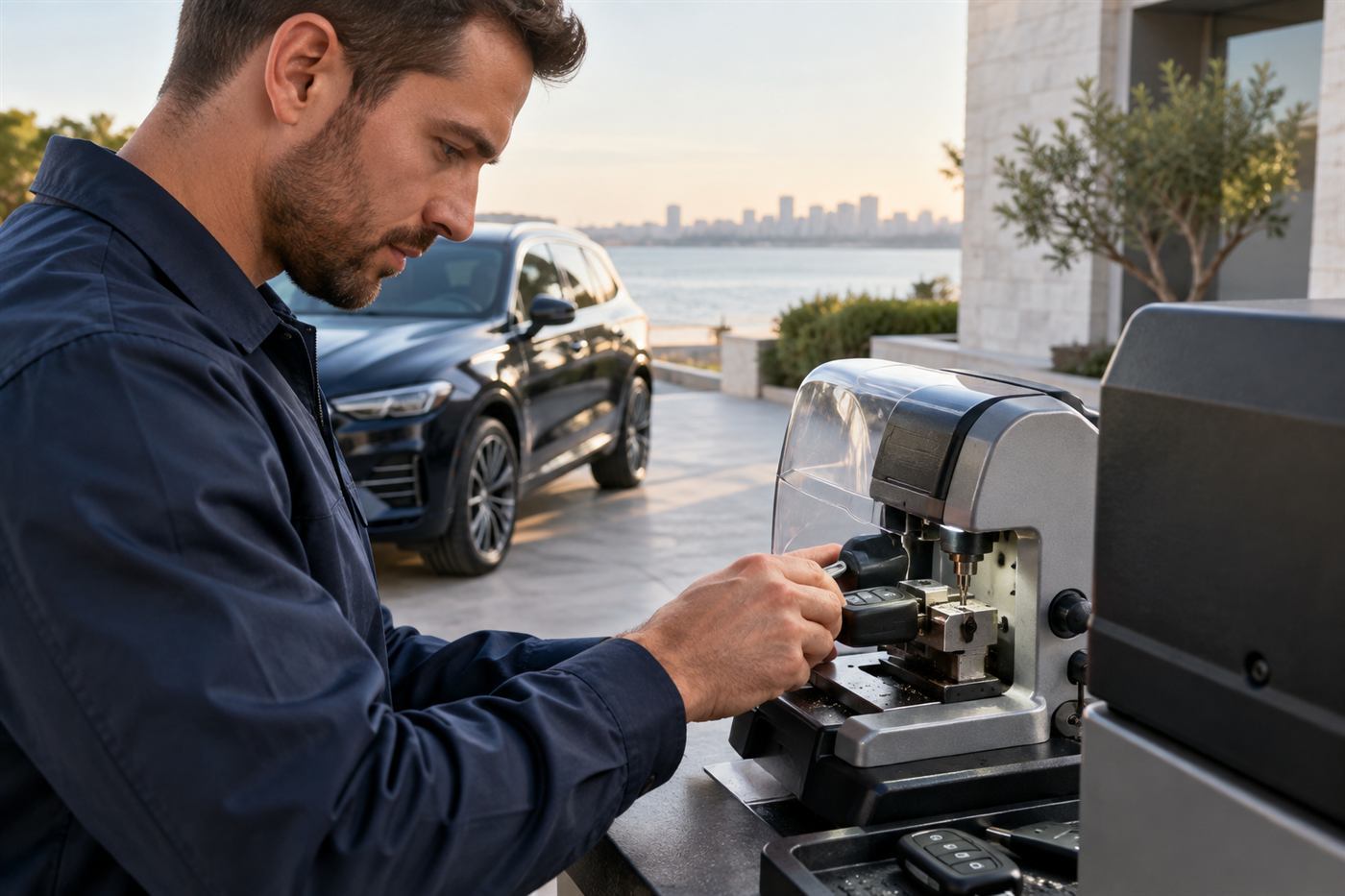
How a trunk lid opens
Most modern trunks are held shut by a latch that grips a striker on the body of the car. To open it, something has to release the latch. In older cars, a key cylinder on the trunk lid turns a rod or a cable that pulls the latch. In newer cars, the release is often electric: a button on the fob, a button on the dash or door, a button on the trunk lid, or a touch sensor under the handle sends power to a small motor called an actuator, which releases the latch.
Many cars have two or three of these paths at once. There may be an electric release, a mechanical key cylinder, and a pull cable or lever near the driver seat. Others have a kick sensor that opens the lid when it detects a foot movement or a key nearby. This is helpful when one path fails, because another may still work, and a quick test of each path narrows the problem.
Understanding the layers helps you describe the problem. A trunk that will not open from the fob but opens from the dash button points toward the fob or its battery. A trunk that will not open from any button but opens with the key points toward a failed actuator or a power problem. A trunk that will not open by any method points toward a latch or cable failure, or a lid that is physically stuck.
Quick owner checks that are safe
Start by trying each release in turn. Press the trunk button on the fob, with the fob close to the car. Press the button inside the car, if there is one, and the one on the lid or handle. Try the interior release lever, which on many cars sits on the driver side floor or the lower side of the seat, and is marked with a trunk icon. Try the key cylinder on the lid, if the car has one.
Next, check the obvious state of the car. Is the car in park with the parking brake set? Some cars disable the electric trunk release while the vehicle is moving or when it is not in park. Is there a child lock or a valet mode that disables the trunk release? Some cars have a switch that locks the trunk against remote opening so that a valet cannot open it. Look in the glovebox and owner's manual for such a feature.
Check the fob battery. A fob that opens the doors but not the trunk may have a weak battery, since the trunk command sometimes needs a stronger signal, or the button may be worn. Our guide on how to change a key fob battery explains the process, and our page on a key fob battery that keeps dying covers repeating problems. Replace the battery with the right type and try again.
- Try every release: fob, dash or door button, lid button, interior lever, and key cylinder.
- Check that the car is in park and that no valet or child lock mode is on.
- Replace the fob battery and test the fob button again.
- Press down lightly on the lid while you operate the release, since a lid under tension can bind the latch.
- Listen for a click or a motor sound, which tells you whether power is reaching the latch.
Fuses, power, and the click that tells you something
Electric release problems often come down to power. A blown fuse, a weak car battery, or a damaged wire at the hinge can cut the actuator off. Listen carefully when you press the release. A click, a buzz, or a motor whir suggests the actuator is getting power but cannot move the latch. Silence suggests no power at all.
Checking a fuse is a safe task when done properly. Your owner's manual shows the fuse box locations and which fuse protects the trunk release, often shared with other body functions. If other body functions, like power locks or interior lights, are also dead, the fuse is a likely candidate. A blown fuse can also indicate a deeper issue, such as a short in the wiring, and a replacement fuse that blows again should be left to a technician. Never replace a fuse with a higher rated one.
A weak car battery is another cause. Low voltage may run the starter poorly and leave small motors like the trunk actuator unable to move. If the car is slow to start or the lights are dim, the battery is a suspect. Do not attempt to work on wiring near the battery without proper knowledge, since modern cars have sensitive electronics and, in some models, high voltage systems.
Actuator and latch failure
The actuator is a small motor and gear set, and its plastic parts wear. Over time, the gears strip, the motor weakens, or the contacts corrode. A failing actuator often gives warning signs: the trunk opens only after repeated presses, the release works sometimes and not others, or you hear the motor spinning but the latch does not move.
The latch itself can also fail. Latches live near the rear of the car where they collect water, road salt, and dirt. In wet or coastal climates, corrosion can seize the latch. In cold weather, ice can hold it shut. A seized latch does not respond to any release, since the parts are physically stuck.
Do not pry the lid with a screwdriver or a bar. A pried trunk lid can bend, scratch, and damage the weather seal, and it may break the latch or striker. A more careful approach is to find an alternative path, such as through the rear seat, discussed below, or to bring the car to a technician who can reach the latch properly.
Cables, rods, and the interior lever
Cars with a mechanical release use a cable or rod from the interior lever to the latch. Cables stretch, kink, and fray. A cable that has stretched can leave the lever feeling loose, with no resistance, and the latch not moving. A cable that has slipped off its anchor at the latch end has the same effect. A rod can bend.
If the interior lever moves too easily, the cable may have separated. If it is very stiff, the latch may be binding or the cable seized in its housing. Do not force the lever. A cable can snap, and then the mechanical path is gone.
Replacing a cable is usually a technician job, because access involves removing trim panels and lining the new cable correctly. It is better to address a stretching cable early than to wait until you cannot open the trunk at all.
Getting into the trunk another way
If the trunk will not open from outside, many sedans allow access from the rear seat. A fold down rear seat, a pass through, or a release strap on the seat back lets you reach the trunk from inside the cabin. Check your manual for the seat release location. Some cars have a fixed seat, so this is not always an option.
Reaching in from the cabin lets you retrieve items and sometimes reach the release lever or latch from the inside. Be careful of sharp edges and moving parts, and do not reach into areas near the latch with the lid under tension. You may find a manual release near the latch, accessible from inside, in some cars.
Never climb into the trunk. If a person or a pet is trapped in a trunk, call 911 first. Many newer cars have an interior trunk release, often glow in the dark, so someone inside can get out. Teach children never to play in or around the trunk, and keep the car keys away from them.
Locksmith or mechanic: who should fix it
A trunk problem can belong to either trade, and sometimes both. A locksmith is the right call when the issue involves keys, fobs, key cylinders, or the programming of remote buttons. A worn trunk key cylinder, a fob that needs programming, or a key that will not turn in the trunk lock are locksmith jobs. Our page on key fob programming describes the fob side.
A mechanic or body shop is better for a failed latch assembly, a stretched cable, a corroded wiring harness, or a lid that has been bent in an accident. In practice, the boundary is not always clear. A good technician will tell you honestly which part of the problem falls to them and which does not.
Locksmiths also help with the situation where the car key is inside the trunk. This is a known trap: someone puts the key on the cargo area, closes the lid, and now cannot open the trunk. Our page on trunk lockout help covers that case, and the page on car lockout service covers the cabin.
Preventing future trunk trouble
Some simple habits help. Do not slam the trunk lid hard, since the shock damages the latch and striker over time. Do not overload the lid with items pushing down on it, and do not use the lid as a seat. Keep the weather seal clean and clear of debris, and wipe the latch area occasionally.
Use the key cylinder, if your car has one, from time to time, so that it does not seize from disuse. Apply a small amount of suitable lubricant on the latch and striker according to your car's manual. Avoid putting your only key in the trunk or leaving the fob in a bag you place in the trunk.
Replace the fob battery on a sensible schedule and carry the mechanical key. When a trunk starts to open slowly or intermittently, treat it as a warning and have it checked before it fails completely.
What to say when you call
Tell us the make, model, and year of the car, which releases work and which do not, whether you hear a click or motor, whether the key is inside the car or inside the trunk, and whether anything is trapped. Have the vehicle identification number handy, and be ready to show that you own the car.
Quotes are given by phone, and a service call charge applies, explained before dispatch. If the fault involves the latch, cable, or wiring, an on-site visit may be needed to confirm what is wrong before a firm price can be given. Do not expect an arrival window from this page, since availability depends on where you are and when you call.
Our guide on how to prepare for a locksmith visit lists what to have ready. When you are ready, call and tell us what the trunk does and does not do, and we will help you decide the next step.
Questions people ask
Why does my trunk open with the dash button but not the fob?
That usually points to the fob. The battery may be weak, the button may be worn, or the fob may need reprogramming. Replace the battery first with the correct type. If the button still fails, a locksmith can test and, if needed, reprogram or replace the fob.
Can I open a stuck trunk from the rear seat?
On many sedans, yes. Folding the rear seat or using a release strap gives access from the cabin. Check your owner's manual, since some cars have fixed seats. Take care around the latch, and never climb into the trunk. If a person or pet is trapped, call 911 first.
Is it safe to pry the trunk open with a screwdriver?
It is not a good idea. Prying bends the lid, scratches paint, tears the weather seal, and can break the latch or striker, which makes the repair bigger. Look for another path, such as through the rear seat, or have a technician reach the latch properly.
My car key is locked in the trunk. Can a locksmith help?
Often yes. It is a known trap, and there are professional ways to open the trunk or the cabin without damaging the car. You will need to show that you own the vehicle. Call, describe the situation, and we will explain the options and what the visit involves.
Could a blown fuse stop the trunk from opening?
Yes, on cars with an electric release. Your owner's manual shows the fuse box and which fuse covers the trunk release. Never use a higher rated fuse, and if a new fuse blows again, stop and have the wiring checked by a technician.
Should I see a locksmith or a mechanic for a stuck trunk?
A locksmith is right for key, fob, and lock cylinder problems. A mechanic or body shop is better for failed latches, stretched cables, and wiring faults. It is not always clear which, so call and describe what happens, and we will tell you honestly which trade fits.
Describe the situation by phone and we will tell you what the job involves. Quotes are given by phone. Jobs that cannot be quoted without seeing them need a technician on site, and the service call charge is explained on the phone before anyone is dispatched.
(844) 715-0800Related pages
Written by Claude (AI) (AI) for 24/7 Locksmith USA.