Step one: stop and search in an organized way
Before assuming the worst, retrace your steps calmly. People find lost keys in the places they have already looked, because the first search was rushed. Make a short list of every place you have been since you last used the key, and check each one slowly. Pockets of yesterday's clothes, coat linings, bags, and the gap between car seats are classic hiding places.
Check where keys tend to end up in your own home: the kitchen counter, the table by the door, the laundry, the bathroom, the child's backpack, the dog's bed. Check the car itself, even if you believe it is locked. A key left in the cupholder, the seat pocket, or the trunk is a frequent cause of a supposed loss. Look underneath the car seats and in any compartment.
Use technology if you have it. Some keys and fobs carry a tracker, and some vehicles let you see their last known location through a phone app. A phone based key, if your car supports one, may still be on the phone. Ask the people you live with, and check lost and found at the last place you visited. Give yourself a short, defined search period, then move on, because a long search while the car sits exposed is not a good plan.
Step two: decide whether the key may be stolen
There is a difference between a key that is misplaced and one that has been taken. Think about the circumstances. Did you lose a bag or a wallet that held the key? Was there a break-in at your home, office, or car? Was the key left with a valet, mechanic, or stranger? Did the key go missing along with your address on a document or a registration in the car?
If you think the key may have been stolen, treat it as a security matter. The thief may know where the car is, or may find out. Call the police and report it, especially if the key was taken together with documents or a bag that show your address. Our page on what to do if car keys are stolen covers that case in more depth.
If you are confident that the key is simply misplaced at home, the risk is lower, but you should still think about the possibility of someone else finding it. A key lost in a public place can be found by anyone, and if your address is on the key ring, the risk is higher.
Step three: protect the car while you work out the next move
If the car is with you, move it to a safe, visible place and lock it using any other method available. If the car is at home, consider where the spare key is, and whether the lost key could be used by someone who finds it. If the car is parked away from home, check that the doors are locked and that valuables are out of sight.
If you have a second key, now is the time to find it and keep it with you. Having one working key means you can use the car, and means the pressure eases. Do not give the spare to anyone you do not trust, and do not leave it in a hiding spot on the vehicle. Our guide on keeping a spare key in a magnet box explains why that habit carries risk.
If you have no spare and the car is parked away from you, you will need to plan how to reach it and get a key made there. Many vehicles can be driven only with a working transponder key, so there is no way to start the car without it. Do not attempt to bypass the ignition or the immobilizer. Doing so can damage the car and cause bigger problems than a new key would.
Step four: gather the paperwork and information
Whoever makes you a key will need to confirm that you own the vehicle or are authorized to use it. This protects you, since otherwise anyone could walk up to your car and have a key made. Gather what you can: your photo identification, your registration or title, and proof of insurance. A lease or finance agreement may be needed if the car is not yours outright. Our page on proof of ownership for a car key explains what is usually accepted.
Locate your vehicle identification number, called the VIN. It is a seventeen character number, found on the dashboard near the windshield on the driver side, on the driver door jamb sticker, and on your registration and insurance card. The VIN lets a technician identify the exact key type for your car. Our guides on how to find your VIN and how much information a locksmith needs for a car key help here.
Also note the make, model, year, color, and where the car is. If you can, write down what type of key you had: a basic metal key, a key with a plastic head, a remote key, a push button start fob, or a smart key. If you have a photo of the key, or the original box or card it came in, keep it handy.
- Photo identification that matches the name on the registration.
- Registration, title, or a lease or finance agreement.
- The VIN, written down or photographed.
- Make, model, and year of the car.
- Any information about the lost key, such as type and features.
- A way to show where the car is and that you have access to it.
Step five: choose who to call
There are three common routes for a replacement: the dealership, a locksmith, and, in some cases, an insurance or roadside provider that coordinates the work. Each has strengths. A dealership has factory access to key data for your brand, but you may have to arrange transport of the car and wait for an appointment. A locksmith can often come to the car, which saves towing and lets the work happen on the spot, particularly when all keys are lost. Our page on dealership versus locksmith keys compares them.
Check whether any of your existing coverage can help. Some insurance policies and roadside plans cover key replacement or lock assistance, depending on the plan. Our guide on insurance and roadside assistance for lockouts describes what to ask. We cannot say what your plan covers, so ask the provider directly.
Whoever you call, ask a few questions before agreeing. Ask whether they can make the key for your exact car, how the quote works, and what the service call charge covers. Our guide on questions to ask a locksmith before dispatch lists them. Be wary of any provider who will not explain pricing clearly before they arrive.
Step six: what the replacement process looks like
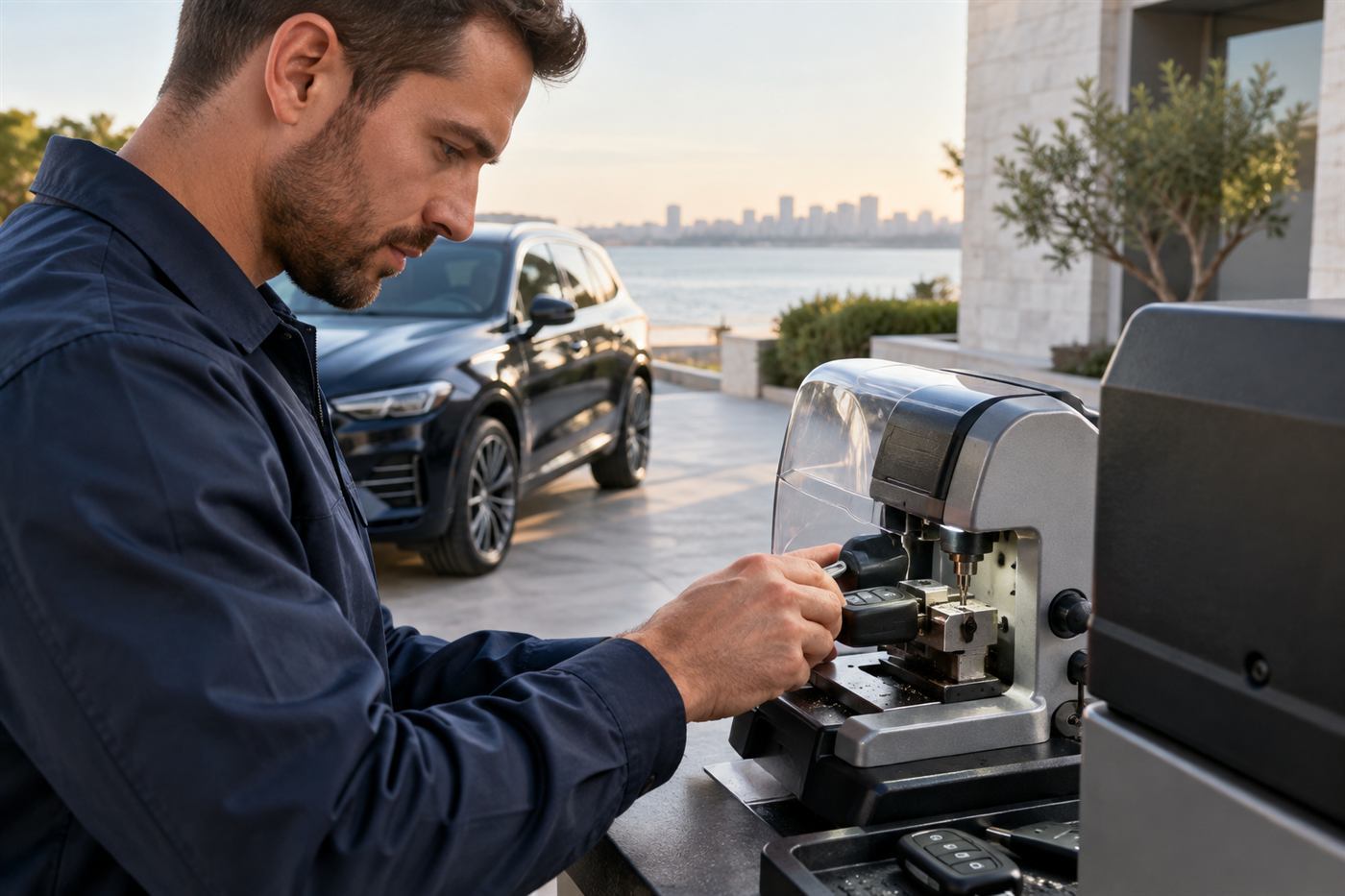
If you still have one key, a technician can usually make a duplicate, which is simpler than a replacement when no keys are left. If you have lost every key, the process is called an all keys lost situation, and it involves reading the vehicle's data, cutting a new key to match the lock, and programming the key to the car. Our page on all keys lost for a car describes how that works.
For most modern cars, the key contains a transponder chip that the car must recognize before the engine will start. Programming links the new chip to the car's computer. Our guide on how car key programming works explains in plain terms.
Be ready to test the new key thoroughly before the technician leaves. Check that it opens the door, unlocks the trunk if applicable, and starts the car, and that the remote buttons work if there are any. Ask for a second key to be made while the technician is there, since having a spare is much easier at that moment than later.
Step seven: disable or reset the lost key where possible
A lost key that is still programmed to your car can still start it if someone finds it. Many vehicles allow the old key to be erased from the car's memory during the programming of a new one, so that the old key no longer works. When you have a new key made, ask the technician whether the lost key can be removed from the system for your car, and whether that is standard in the process.
Not every car supports this, and the details differ by make. Some systems allow all keys to be erased and reprogrammed, which means you must bring every key you plan to use to the appointment. Make sure you do not leave a working spare behind at home, since you will want it programmed again at the same time.
If the lost key was also a key to your home, such as a combined key ring, handle the house locks as well. Rekeying the house locks removes the risk that someone could use your address and your key together. See our page on lock rekey service for how that works.
Step eight: prevent a repeat
Once the new key is in your hand, build a habit that makes losing it less likely. Give keys a fixed home when you walk in. Consider a tracker attached to the key ring, a bright fob, or a keyhook near the door. Keep a spare in a safe place at home rather than on the car. Avoid carrying all the keys you own on one ring.
Have a second key made if you do not have one. It is much easier to copy a working key than to create a new one when none work. Our guide on spare car key programming describes the service. Store the spare away from the car and away from the main key ring.
Consider the way you use your key. If you use a valet or leave the car at a shop, use a separate valet key if the car has one, and take the house key off the ring. Replace worn keys before they break, and check the fob battery on a sensible schedule. Our guide on how to avoid locking keys in a car adds more habits.
When you are ready to call
Call once you have your paperwork and the VIN, or even before if you are unsure what you need, and describe the situation: the car, where it is, whether you have any key, and whether the key may be stolen. If a person or pet is locked in a car, or anyone is in danger, call 911 first.
Quotes are given by phone, and a service call charge applies, explained before dispatch. Complicated jobs, such as all keys lost on some models, need a closer look and may need an on-site visit before a firm price is given. A legitimate provider will ask you to show that you own the car, which protects you.
Do not wait until you are stranded at night in a bad place. A lost key is easier to solve in daylight at home than late in an empty parking lot. When you are ready, call, tell us what happened, and we will walk you through the next step in plain terms.
Questions people ask
Can a locksmith make a car key if I have lost every key?
Often yes. It is called an all keys lost situation, and a technician can usually cut and program a new key on site once you show you own the car. Some vehicles are more complicated and may need a closer look. Call with the make, model, year, and VIN, and we will explain what is involved.
Will my old lost key still start the car?
It may, unless the car's memory is updated. Many cars allow the old key to be erased when a new one is programmed, so ask the technician about it at the time. This matters if you think the key was stolen or if your address was with it.
What paperwork do I need to get a replacement key?
Usually photo identification and proof of ownership, such as a registration or title, plus the VIN. If the car is leased or financed, a lease or finance document may be needed. These checks protect you from someone else having a key made for your car.
Is it better to go to the dealership or a locksmith?
Both can work. A dealership has factory access for its brand, but you may need to have the car delivered there and wait. A locksmith can often come to the car, which helps when every key is lost. Our comparison page explains the trade-offs in plain terms.
What if I think my key was stolen?
Treat it as a security issue. Report it to the police, especially if your address was with the key. Protect the car, have a new key made, and ask for the lost key to be removed from the car's memory if possible. If it was on a ring with house keys, consider rekeying the home too.
How can I avoid losing my key again?
Give your keys one fixed home, add a tracker if you like, and keep a spare in a safe place away from the car. Have a second key made while you still have one that works, and use a valet key for services when the car has one.
Describe the situation by phone and we will tell you what the job involves. Quotes are given by phone. Jobs that cannot be quoted without seeing them need a technician on site, and the service call charge is explained on the phone before anyone is dispatched.
(844) 715-0800Related pages
Written by Claude (AI) (AI) for 24/7 Locksmith USA.