Start with safety, not the lock
Before thinking about the keys, take a quick look at who and what is inside. If a child, an infant, or a pet is in the vehicle, treat it as an emergency and call 911 first. Do not wait for a locksmith. Emergency responders can reach people inside a locked vehicle fast, and a closed car heats up quickly in sun. Tell the dispatcher where you are and that someone is trapped.
If nobody is inside, you have time to think, but the running engine still deserves attention. A car left idling is burning fuel, building up heat under the hood, and, if it is parked in a closed or semi enclosed space such as a private garage, can fill the area with exhaust. If the vehicle is in or near an enclosed space, stay out of the fumes and make that part of your call.
It is also worth checking your surroundings. Is the car parked on a slope or in a traffic lane? Is the gear selector in park, or did you leave it somewhere else? A vehicle left in gear can move. If the car is rolling or you suspect it is not secured, keep clear and call 911. Everything else on this page assumes the car is stationary, nobody is trapped, and you are safe.
What not to do
It is tempting to try to fix this yourself in the first few minutes, and some of the common ideas make the situation worse. Do not break a window. A broken window leaves a running car open to theft, covers the seats in glass, and costs far more to repair than a service call. Do not try to force the door, pry the frame, or push tools into the door seam. Modern doors contain wiring, airbag components, and side impact beams, and damage here can be costly and hard to see.
Do not leave the car unattended while you walk off to look for help, unless you have no other choice. A running vehicle with the doors locked is still a target, and a stranger who sees a running car with a valuable item inside may take an opportunity.
Avoid advice that tells you to open the lock with household objects. Such methods depend on the car, can scratch the paint or damage the weatherstripping, and in some modern vehicles can interfere with sensors. A trained technician uses tools made for the job and knows the specific design of your door. We do not offer instructions for opening locks here, because the safest approach is to let a trained person do it.
Fuel, heat, and the clock
A running engine uses fuel even when parked. Most cars burn a modest amount at idle, but if the tank is low, the engine can stall before help arrives. A stalled engine with the keys inside is a slightly different situation. On many vehicles the doors stay locked, and starting again requires the key anyway.
Heat matters in both directions. In hot weather, a parked car with the engine running is relying on the air conditioning to stay bearable, and if the engine dies, the cabin will warm up. In cold weather, a car that stalls will cool. If you are standing outside in either extreme, find shade or shelter nearby while you wait, and keep an eye on the vehicle.
None of this means panic. It means being aware that waiting has a cost, and that the right call is the one that gets a technician on the way promptly. A technician will talk with you about timing on the phone, and we do not promise any arrival window. Ask what to expect when you call, and plan your wait with shade, water, and a safe place to stand.
Safer places to wait
Where you wait is part of the plan. If you are in a parking lot, stand close to the vehicle but away from moving traffic. If you are on a street, stay on the sidewalk, not beside traffic. If you are at a gas station or shopping center, wait near the entrance where there are other people and light.
If the area feels unsafe, tell the technician when you call. They can arrange a meeting point or advise on a safer approach. You are allowed to wait inside a nearby business and come out when the technician arrives, as long as someone who can show ownership meets them.
Keep your phone charged and in your hand. The key was locked in the car, but your phone may be too, which is its own problem. If your phone is inside, borrow one from a staff member at a nearby business, or use a payphone if one still exists. Many people are happy to help with a quick call.
Keeping calm and thinking clearly
Locking the keys in a running car happens to careful people all the time. It tends to happen when you are tired, distracted, carrying groceries, or dealing with a child. Feeling embarrassed or panicked is normal, but it does not help. Take a slow breath and run through a short mental list: is anyone in danger, is the car secure, where am I, and what do I have with me.
If you have your phone, take a moment to note the exact address, the cross street, or a nearby landmark. Technicians arrive faster when the location is precise. In a large lot or a multi level garage, note the level, the section, and any pillar number, because there are many look-alike spaces and a vague description leads to a slow search.
Think about what is visible through the windows. If the key is on the seat and the doors have manual lock buttons that are up, you might notice that one door was not fully locked. Check each door handle once, gently, without force. It is a reasonable thing to try. If nothing opens, do not escalate to anything rougher. A technician has the tools and the training, and the job is nearly always quick once they arrive.
Tell friends or family where you are if you will be waiting for some time, especially at night or in an unfamiliar place. A short message that says where you are and who you are waiting for is simple safety, and it gives someone else a reason to check on you if the wait runs long.
Who to call and in what order
The right call depends on your situation. Use this order if you are not sure.
The first call goes to 911 if there is any person or animal in danger inside, if the car is moving or unsecured, or if there is any sign of fire or fumes. After that, the choices are roadside assistance, your insurer, a dealership, or a locksmith. Each has strengths.
- 911, if anyone or anything is in danger or the vehicle is not secured.
- Roadside assistance included with your insurance, credit card, or vehicle plan, if you have it.
- A locksmith, who can usually reach a vehicle at the roadside and can make a replacement key if needed.
- The dealership, if the car is parked near it and the key is lost as well as locked inside.
How a locksmith approaches a running car
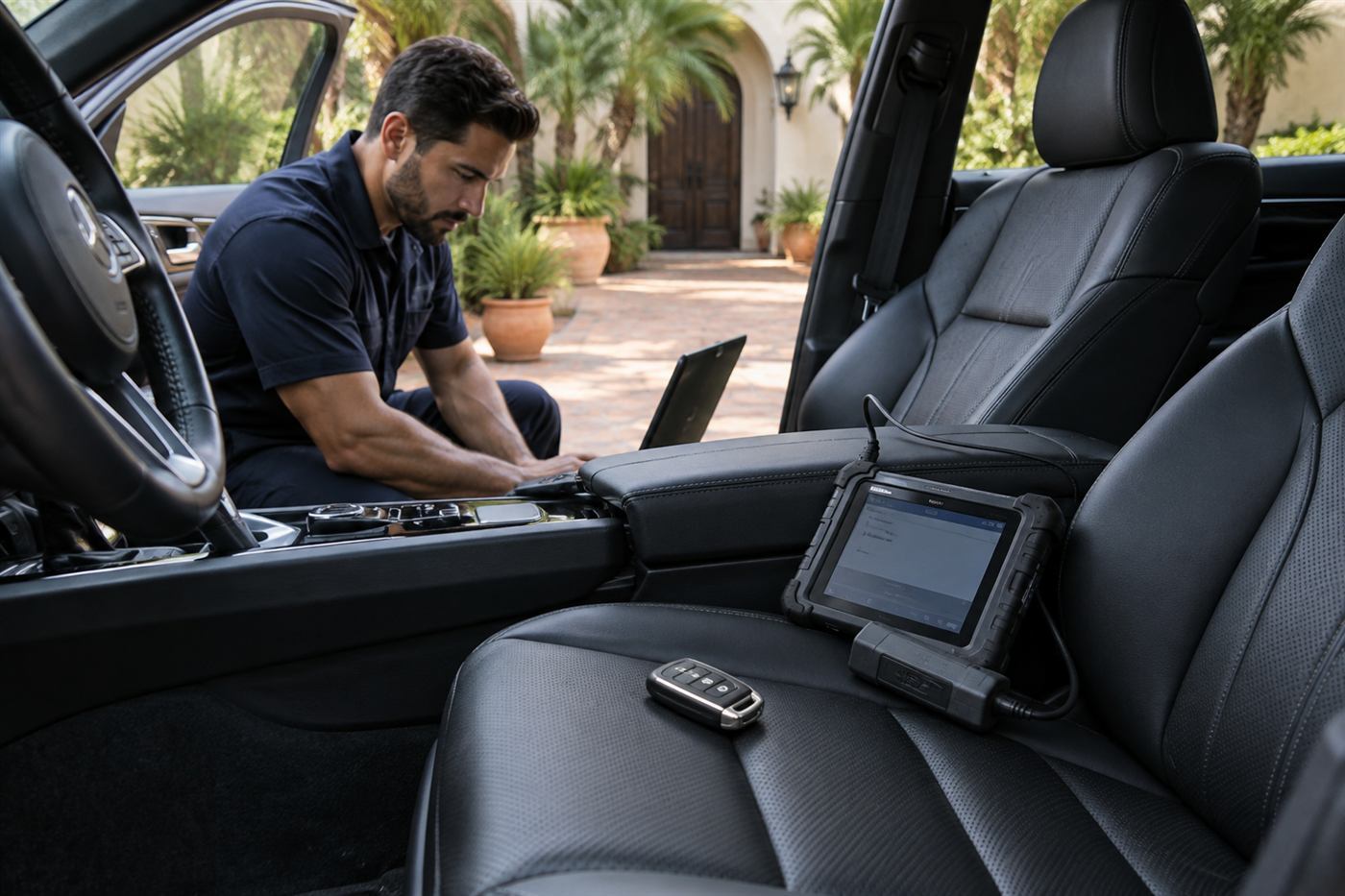
A locksmith will begin by asking where the car is, what make and model it is, and whether there are people or animals inside. They will want to know whether the engine is running, whether the keys are visible, and whether the doors have power locks. These questions help them bring the correct tools and plan the visit.
On arrival, the technician confirms that the vehicle is yours before touching the lock. They then use non-destructive methods designed for the specific vehicle. The goal is to open the door without damaging the paint, the weatherstripping, or the electronics. Most lockouts of this kind are resolved without any mark on the car.
Once the door is open, you can shut off the engine and take the keys. If the keys cannot be retrieved, for instance because the key is a smart key that was left in the cabin and the doors will not open, the technician can discuss other options. See our car lockout service page for more on how lockouts are handled.
How ownership is verified
A responsible locksmith will not open a car for just anyone who asks. Proof that the vehicle is yours protects you from a stranger who might want to reach your belongings or drive off. The standard checks are simple. A valid photo identification, and a document that connects you to the vehicle.
That document can be a registration, a title, an insurance card, or a lease agreement. If the car belongs to someone else, such as a family member or an employer, the technician may need to speak with the owner or see authorizing paperwork. A rental car is handled differently, and the rental company usually needs to be contacted. Our rental car lockout guide covers that.
If your documents are inside the locked vehicle, do not worry. A technician can often verify ownership through other means, such as the vehicle identification number visible through the windshield matched with your identification. Explain your situation on the phone, and the technician will tell you what will work. Read more on proof of ownership.
If the key is lost as well as locked inside
Sometimes the key is not where you thought it was. You may have dropped it somewhere, or you may have left it on a table inside a building and the car is running because of a remote start. In those cases, getting into the car does not solve the problem, because you still have no key to carry.
A locksmith can make a replacement key on site for most vehicles, even with no original available. The job involves cutting a new blade, programming a chip, and pairing a remote, depending on the type. Our page on all keys lost explains this process.
If the vehicle was started with a remote start and the key is truly inside, you may find that the engine shuts off after a preset period, and that the doors stay locked. Mention remote start when you call, because it affects how the technician approaches the vehicle.
Preventing a repeat
Most running car lockouts happen when someone steps out for a moment, intending to be back right away. Some habits make a repeat less likely. Keep a spare key at home or with a trusted person, not hidden on the car. Build the habit of touching your pocket for keys before closing the door. Smart keys that start the car by proximity can be left inside by mistake, so train yourself to check for the fob.
Our guide on how to avoid locking keys in a car has more ideas, and the piece on magnet key boxes explains why that popular trick is risky.
Quotes are given only by phone, after the technician hears the details. Some jobs need an on-site look, and a service call charge applies, which is explained on the phone before anyone is dispatched. If your keys are locked in a running car and nobody is in danger, call and tell us where you are.
Questions people ask
What should I do first if a child or pet is locked in?
Call 911 immediately and tell the dispatcher where you are. Do not wait for a locksmith. Emergency responders can reach someone inside a locked vehicle quickly, and a closed car heats up fast in the sun. If you can stay near the car and keep the person calm, do so until help arrives.
Is it safe to leave the engine running while I wait?
In an open outdoor space it is generally fine, though it uses fuel. In or near an enclosed space such as a closed garage, exhaust can build up and become dangerous. If that is where the car is, keep away from the fumes and mention it on the call so the technician knows.
Will a locksmith damage my car getting in?
A trained technician uses non-destructive tools made for the purpose and knows the door design of your vehicle. Most lockouts are resolved without any mark on the paint or trim. Breaking a window or prying a door is what causes damage, so avoid trying those yourself.
What if my documents are inside the locked car?
Explain this on the phone. The technician can often verify ownership by matching the vehicle identification number visible through the windshield with your photo identification. Other options exist depending on the situation, and the technician will tell you which will work before dispatch.
Can I call roadside assistance instead of a locksmith?
Yes, if you have it through your insurer, a credit card, or a vehicle plan. It is worth checking, since some plans include lockout help. If you do not have coverage or the wait is long, a locksmith is a good alternative, and can also make a replacement key if that is needed.
How do I get a price for a lockout?
Prices are given only by phone, once the technician knows your vehicle and situation. Simple lockouts can be quoted right away. More involved ones may need an on-site visit. A service call charge applies and is explained on the phone before dispatch. Call with your location and vehicle details ready.
Describe the situation by phone and we will tell you what the job involves. Quotes are given by phone. Jobs that cannot be quoted without seeing them need a technician on site, and the service call charge is explained on the phone before anyone is dispatched.
(844) 715-0800Related pages
Written by Claude (AI) (AI) for 24/7 Locksmith USA.